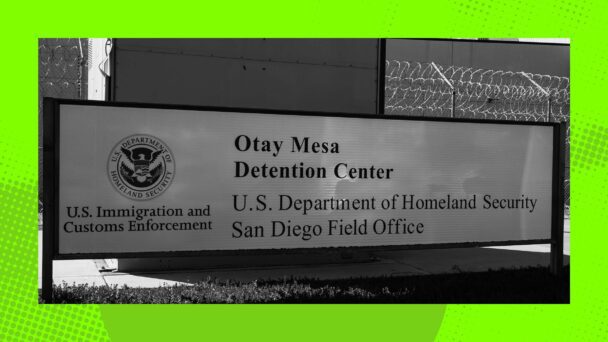
On Monday, December 1, the Trump administration fired eight immigration judges in New York City without warning or explanation. With these latest terminations, President Donald Trump has now fired over 100 immigration judges—about 1 in 7 of all immigration judges nationwide—since reentering the White House in January. The administration has involuntarily transferred or otherwise pushed out dozens more.
Immigration judges are the people who conduct hearings when the Department of Homeland Security wants to deport someone whom it claims violated federal immigration law. They decide things like whether a noncitizen can be removed from the country and, even if they can be, if there’s a good reason they shouldn’t be—for example, if they have a credible fear of persecution in their home country. Given the massive stakes and their lack of resources commensurate with those risks, immigration judges have likened their task to “deciding death penalty cases in a traffic court environment.”
It would be a mistake, though, to assume the judges who have been fired during Trump’s ongoing purge simply couldn’t hack a tough job. Many received positive performance reviews for years. But unlike most of the federal judiciary, immigration courts are housed within the Department of Justice. This means that immigration judges are literally executive branch employees. Their bosses are Attorney General Pam Bondi and President Donald Trump. And Trump does not want immigration judges who might fairly weigh a noncitizen’s claims against those of the government. He considers the job of immigration judges to be facilitating mass deportations, and wants employees he can count on to support his agenda.
To wit, a couple weeks ago, DOJ posted a recruitment ad encouraging attorneys to apply to “become a deportation judge” and “define America for generations.” On Twitter, DHS Secretary Kristi Noem invited lawyers to “join the Justice Dept as a Deportation Judge to restore integrity and honor to our Nation’s Immigration Court system.” In reality, only certain types of lawyers need apply: Early last month, an NPR analysis of 70 immigration judges Trump fired between February and October determined that judges who previously did immigrant defense work were more than twice as likely to be fired than those who did not.
One of the eight judges fired on Monday was Amiena A. Khan, the assistant chief judge at New York City’s immigration court and a former leader of the immigration judges’ union. Records show that between 2019 and 2024, Khan denied 10.3 percent of requests for asylum, while other New York City immigration judges in that time period denied 34.8 percent of asylum applications. Her work with the union and her relative compassion for noncitizens made her a target on a “DHS Bureaucrat Watchlist,” a project funded by the Heritage Foundation.
One recently fired immigration judge in San Francisco, fellow union leader Jeremiah Johnson, told NBC Bay Area that the Department of Justice has issued a bevy of memos “giving judges the hint” that they should hear and decide cases a certain way: “Move faster. Less due process, essentially,” he said. Another former immigration judge, Emmett Soper in Virginia, similarly told PBS that the Trump administration “does not fundamentally see the immigration courts as neutral decision-makers,” but as “a tool for this administration to advance its policy objectives.” Still another former judge in San Francisco, who spoke on the condition of anonymity, said, “Firing judges for doing their jobs is not about efficiency, it’s about control.”
Immigration courts already have a backlog of roughly 4 million cases, which will likely worsen with fewer judges around to make decisions. But George Pappas, who was fired from his immigration judge position in Massachusetts a few months ago, points out that the administration doesn’t actually care about the backlog. “They are not looking to reduce the backlog,” he said. “They are looking to create chaos.”
One of the judges who was fired on Monday, Olivia Cassin, told the New York Times that the firings didn’t make sense. “The judges who were fired acted as judges—upheld the rule of law, gave equal time to each side, considered the cases carefully and did their jobs as independent adjudicators—for a very long time,” she said. But “independent adjudicators” is not the job that the Trump administration wants immigration judges to perform.