
With the Senate adjourned until 2026, the book is closed on President Donald Trump’s first-year judicial appointments. How much damage did he do this time around? In my view, a lot—his 26 appointees this year were younger, whiter, and more openly partisan than those he appointed in his first term.
But if you’re looking for silver linings, it probably could have been worse. In 2017, the first year of Trump’s first term in office, he appointed Justice Neil Gorsuch to the Supreme Court and 12 judges to the courts of appeals, including the likes of James Ho and future Supreme Court justice Amy Coney Barrett. This year, although Trump appointed more judges overall than he did in 2017, the vast majority were for district court seats—important judgeships, to be sure, but not as powerful as the appeals court seats Trump prioritized in 2017.
Right now, Trump has fewer than 50 vacancies left to fill, and only one is an appeals court vacancy. Given how slowly new vacancies have arisen since his re-election, Trump may not get many more than that before the 2026 midterm elections, when control of the Senate—and the power to confirm judges—will be up for grabs.
Vacancies
In the last few weeks, just three district court judges have announced future retirement plans: Western District of Missouri Judge Douglas Harpool, Western District of Arkansas Judge Susan Hickey, and Eastern District of Tennessee Judge Thomas Varlan. Harpool and Hickey were both appointed by President Barack Obama, and Varlan was appointed by President George W. Bush. All sit in states with two Republican senators, which will make appointing their replacements easy.
In total, just 30 judges—three appeals court judges and 27 district court judges, 24 Republican appointees and six Democratic appointees—have created vacancies in the nearly 14 months since Trump won re-election. That’s less than half than the approximately 70 judges who left the bench during the same period during the Biden administration. There are 22 Republican-appointed appeals court judges and 39 Republican-appointed district court judges currently eligible to retire, and most of them were already eligible when Trump took office. So far, they’ve decided that allowing a doddering, warmongering fraudster to appoint their replacement is not the judicial legacy they want to leave.
As it stands, there are 40 current vacancies, all of which are for district court seats, and 28 of which are in states with two Republican senators. There are nine future vacancies, only one of which is for an appeals court seat.

Nominees and Hearings
Despite all those vacancies in states with Republican senators, Trump has announced only three new nominees in the last month: Brian Lea to the Western District of Tennessee, Justin Olson to the Southern District of Indiana, and Megan Benton to the Western District of Missouri. All three of them appeared before the Senate Judiciary Committee on December 17.
If a Benton from Missouri sounds familiar, it’s because last month we covered the retirement announcement of Eighth Circuit Judge Duane Benton, who also happens to be Megan Benton’s father. But putting aside any nepotism concerns, the younger Benton’s nomination is troubling on its own, particularly for her many connections to Republican politics and the anti-abortion movement. A current state court judge, Benton was formerly the chair of the Platte County Republican Central Committee, which touts its support for the “right to life” on its website. In her most recent judicial election, Benton was endorsed by the Missouri Right to Life PAC. And in college, she wrote a thesis titled In God We Trust: Messaging and Evangelical Political Behavior, which advocated using “morals messaging” to increase Republican electoral success.
Lea, a former clerk to Justice Clarence Thomas, has spent the bulk of his career at Jones Day in Atlanta, where he was a partner before he left to join the Justice Department earlier this year. While at Jones Day, Lea represented South Carolina Republican Senator Lindsey Graham when he was subpoenaed as part of a grand jury investigation into Trump’s attempts to interfere with Georgia’s vote-counting in the 2020 presidential election. Lea has also represented various religious employers in their challenges to the Affordable Care Act’s contraceptive coverage mandates.
Despite his ties to Georgia and the existence of a district court vacancy in Atlanta, Trump nominated Lea to a district court seat in Tennessee, a state where Lea has almost no connections: According to his responses to the Senate Judiciary Committee’s questionnaire, he doesn’t live there (Virginia), has never worked there (Atlanta and D.C.), didn’t go to law school there (Georgia), and didn’t clerk for any judges there (Alabama and D.C.). He does not appear to have ever tried a case in Tennessee, and was not admitted to practice in the state or the Western District until earlier this year.
What gives, then? Well, Tennessee has something Georgia doesn’t: two Republican senators. And with home state senator sign-off still required for district court nominees, Lea’s nomination would have been dead in the water in Georgia.
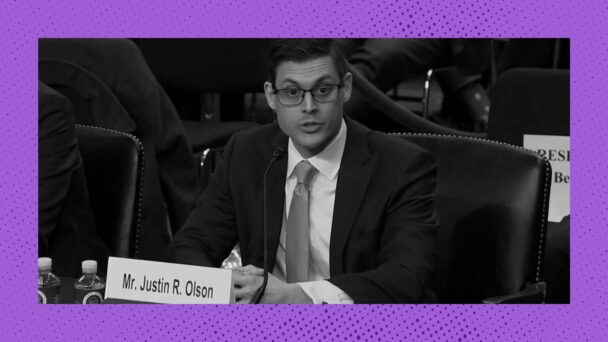
Despite the problems with Benton and Lea, no one came off worse at this week’s hearing than Justin Olson, an Indianapolis lawyer who specializes in litigation seeking to exclude transgender athletes from college sports. Louisiana Republican Senator John Kennedy asked Olson about his time as an ordained elder in the Reformed Presbyterian Church of North America, during which Olson gave sermons about how “transgenderism, homosexuality, and fornication” are “sexual perversions” that come from “shame on the inside,” and argued that God “has called wives to be subject to their husband.”
But Olson didn’t stop there. He also argued that marriage may not be for everyone, including “our handicapped friends or our persons with physical disabilities that might prevent the robust marriage that we’re called to.” Anti-gay, anti-trans, anti-woman beliefs have been pretty common among Trump nominees, but taking issue with disabled people because they might not be able to have enough sex is a new one. Variety is the spice of life!
Clip via SJC
As is now customary, the nominees also refused to say that President Joe Biden won the 2020 election and avoided acknowledging that the Capitol was attacked on January 6. Apparently unsatisfied with the number of rakes he’d stepped on already, Olson went further than his co-panelists’ standard no-comment responses and characterized the insurrection as “individuals enter[ing] the Capitol,” which is sort of like characterizing D-Day as “a fun day at the beach.”
Confirmations
Between the Thanksgiving holiday and the meaningless votes on health care policies two weeks later, the Senate confirmed seven district court nominees: David Bragdon and Lindsey Freeman to the Middle District of North Carolina, Matthew Orso and Susan Rodriguez to the Western District of North Carolina, Robert Chamberlin and James Maxwell to the Northern District of Mississippi, and William Crain to the Eastern District of Louisiana.
What’s Next
Nothing until 2026! By a unanimous consent agreement, Western District of Louisiana nominee Alexander Van Hook’s nomination will remain with the Senate until lawmakers return in January, but all other nominees—Nicolas Ganjei, David Fowlkes, Aaron Peterson, John Guard, Lea, Benton, and Olson—will by rule be returned to Trump. Technically, these nominees must be renominated, sent back to the Judiciary Committee, and voted out again. But this is very common, and you can expect all these nominees to be back on the Senate floor by mid-to-late January.
The Big Picture
It’s worth taking stock of these nominees collectively to see what they reveal about Trump’s new approach to appointing judges. In total, Trump announced 34 nominees this year. 30 (88 percent) of the nominees are white, and 26 (77 percent) are male—both increases from Trump’s first term. Their average age is about 45 at the time of their nomination, which is three years younger than the last time around. More than half—19—clerked for a federal appeals court judge, and in all but one case, that judge was appointed by a Republican president. Seven clerked for Republican-appointed Supreme Court justices—most commonly, Clarence Thomas.
For Trump’s six appeals court nominees—judges who have the power to set precedent in their multi-state jurisdictions—the average age was closer to 42, a decrease of nearly five years from Trump’s first-term appointments. Some are young enough that they won’t reach the statutory retirement eligibility age until the 2050s.
Taken together, Trump’s 2025 record reflects a movement still intent on reshaping the courts in his embittered, grievance-fueled image—a movement constrained (for now) only by some combination of a lack of pressing vacancies and general executive branch incompetence. Although these judges are not as powerful, and although he may not eclipse his first-term totals, Trump’s second-term nominees are younger and more uniformly partisan than ever. And you can bet that, wherever they sit, they’ll do their level best to push the law to the right for decades to come.