On Wednesday morning, the Supreme Court heard oral argument in Bost v. Illinois Board of Elections, a case about how Illinois counts absentee ballots. Representative Michael Bost, a Republican member of Congress from Illinois, alleges that the state violates federal election law by counting mail-in ballots that arrive up to 14 days after Election Day.
But the legality of that policy is not actually the question the Supreme Court is concerned with right now. The only question before the Court is if Bost has standing—the legal right to challenge this provision of state law in the first place.
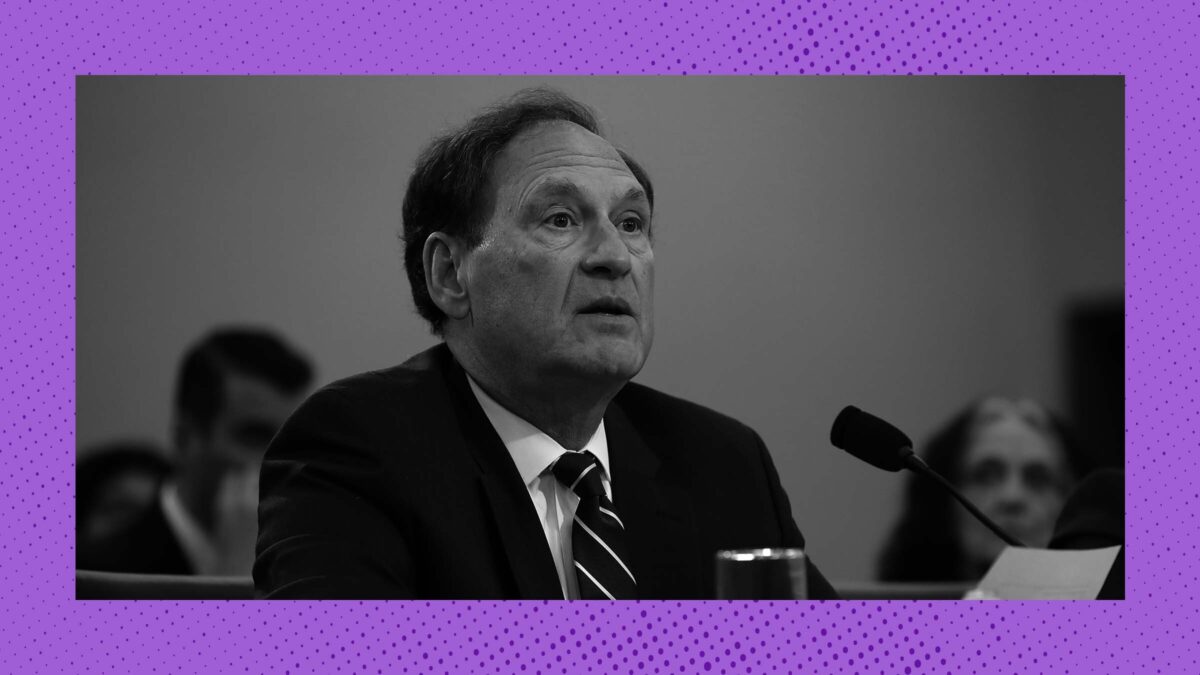
Generally, plaintiffs have standing to sue if they suffered (or are about to suffer) a real, concrete injury that the defendant caused and the court can fix. And in Bost’s complaint, he argued that candidates for office are uniquely injured when their campaigns must expend 14 more days’ worth of resources, and by the inclusion of “untimely and illegal ballots” in the final vote tally for their elections. But at oral argument today, Justice Sam Alito brought up an important, additional way that he thought Bost could be harmed by Illinois’s law, which Bost carelessly left out of his complaint: People could vote for Democrats.
“It’s not clear to me why you couldn’t have done a lot better than you did in your complaint, and alleged what most people believe to be true, which is that loosening the rules for counting ballots like this generally hurts Republican candidates, generally helps Democratic candidates,” said Alito. “Why didn’t you pursue that? Why didn’t you try to do something with that?”
Data shows that Alito does not know most people or what they believe. An August 2025 Pew Research Center survey shows that 58 percent of Americans support mail-in voting. And despite the frequency with which Republican politicians insist that mail-in voting confers some kind of built-in advantage for Democrats, it does not: A study of elections conducted between 1996 and 2018 showed that switching to mail-in voting increased the vote share for Democratic candidates by 0.7 percent—within the margin of statistical error, meaning there could have been no impact on election outcomes at all. Vote-by-mail surged during the pandemic, jumping from 21 percent of voters in 2016 to 43 percent in 2020, and although more Democrats than Republicans voted by mail that year, by 2024, Republicans had narrowed the gap considerably.
Put differently, there’s nothing inherently advantageous for Democrats about the post office. And, most importantly, it is not at all clear why a belief that Alito attributes to “most people” would be relevant to determining whether Bost experienced a legal injury.
But President Donald Trump opposes mail-in voting and has whipped much of the Republican Party into a frenzy against it. In August, for instance, Trump urged Republicans to “get tough” on mail-in ballots because they’re “corrupt” and “the only way” Democrats can get elected. (The fact that he lost the 2020 election probably has something to do with this conclusion.) So, in Alito’s mind, mail-in voting is inherently suspicious. At oral argument, he even asked when the Illinois law at issue was enacted and by whom, suggesting that the party identification of the lawmakers who supported it could impact Bost’s legal right to sue.
“Do we know what the partisan breakdown of the vote was, and could we take judicial notice of that?” asked Alito. The rule was changed in 2005, and when Democrats controlled the state legislature and the governor’s office, but even Bost’s lawyer, the conservative litigator Paul Clement, seemed skeptical that this would prove injury to Bost: In response to Alito, Clement said he did not think there was “robust data” that would allow the justices to take judicial notice.
During oral argument, Clement repeatedly stressed that there’s no need for the Court to engage in the kind of partisan evaluation that Alito was itching to get into. Bost alleges that he had to reallocate his campaign resources to comply with Illinois’s law, and economic harm is a textbook source of standing. “The pocketbook injury just makes it easy,” said Clement. “There is no need to make the standing inquiry here any more complicated than that.” But for Alito, this case presented an opportunity to lash out at imagined Democratic nefariousness—and to parrot one of Trump’s favorite conspiracy theories in the process.