In October 2019, the Supreme Court heard oral argument in Bostock v. Clayton County, a case about whether a federal civil rights law that prohibits employment discrimination based on “sex” extends to gay and transgender Americans, too.
On paper, right-wing culture warriors had good reason to be optimistic that the Court’s answer would be no. A year earlier, President Donald Trump had replaced Justice Anthony Kennedy, who occasionally sided with the liberals in cases about LGBTQ rights, with Justice Brett Kavanaugh, a staunch conservative with a track record of adopting the movement’s preferred positions when it mattered most. His confirmation gave the right what it had sought for decades: the five Supreme Court votes necessary to turn its policy agenda into binding precedent.
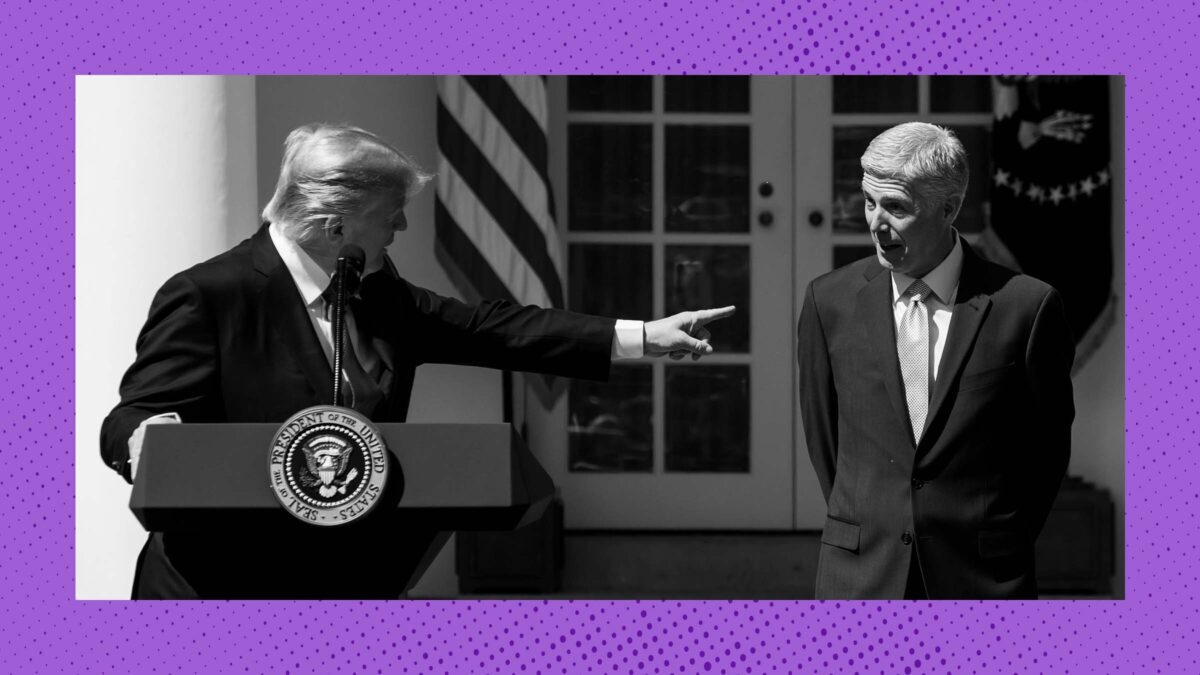
Eight months later, though, a six-justice majority of the Court held that federal employment protections indeed protect trans people in the workplace. The basic logic of Justice Neil Gorsuch’s majority opinion in Bostock, which Chief Justice John Roberts and the four liberals joined, is that if an employer treats a transgender man differently than they would treat a man assigned male at birth, they are treating that trans man differently “because of sex.”
Conservative types who’d expected Kavanaugh’s confirmation to pay immediate dividends promptly lost their minds. In a dissent joined by Justice Clarence Thomas, Justice Samuel Alito called the majority’s argument “deceptive” and its conclusion “preposterous.” One conservative activist accused Gorsuch of abandoning textualism and succumbing to pressure from “college campuses and editorial boards”; another compared Bostock to Dred Scott, the 1857 Supreme Court case that denied citizenship to Black Americans and more or less started the Civil War. In a somber speech on the Senate floor, Missouri Republican Josh Hawley declared that the decision heralded “the end of the conservative legal movement.”
Bostock felt like ancient history on Tuesday morning, when the Court heard oral argument in Little v. Hecox and West Virginia v. BPJ, two cases about state laws that ban trans women and girls from playing on sports teams consistent with their gender identity. This time, the members of the Court’s conservative bloc sounded far more comfortable with imposing some limits on legal protections for trans people. In an exchange with West Virginia Solicitor General Michael Williams, Roberts sought to distinguish these cases from Bostock, asserting that a “sex-based classification” about sports eligibility might not “necessarily” implicate transgender status, and thus might not be discriminatory at all. Williams, realizing he was getting good news from a justice whose vote he needed, had the sense to quickly agree.
After Roberts, counting to five gets easy. Last year, in a different case about trans rights, Barrett wrote a concurrence joined by Alito and Thomas in which she opined that trans people are probably not a “suspect class” for purposes of equal protection, and that trans sports bans are thus likely constitutional. Kavanaugh, another Bostock dissenter, did not join Barrett’s opinion, but his questions at oral argument in Hecox and BPJ suggest that he is willing to give states some flexibility in the name of preserving the sanctity of women’s sports. Even if—and this is a huge “if”—Gorsuch were to stick to the logic of Bostock, the conservatives still have the votes to allow lawmakers to legislate their trans constituents out of existence.
The shift from the Court’s approach in Bostock has less to do with substantive legal issues than it does with the evolving social and political context in which the justices will decide these cases. Bostock came five years after the Court’s landmark decision in Obergefell v. Hodges, in which the justices held that the Constitution protects the right of same-sex couples to marry. Although conservatives mourned that case in the same way that they would mourn Bostock, Obergefell was consistent with established trends in public opinion: A month before the Court decided the case, Gallup found that 60 percent of Americans supported marriage equality—an all-time high, and up from just 27 percent two decades earlier.
In the wake of Obergefell, legal protections for trans people seemed, for a moment, like they might be on the same trajectory. North Carolina’s “bathroom bill,” which Republicans passed in March 2016, was an economic and public relations disaster that cost the state thousands of jobs, billions in investment and tax revenue, and the privilege of hosting the 2017 NBA All-Star Game. In a 2017 survey, about 70 percent of respondents said the country was becoming “more tolerant” of transgender people, and slightly more than 50 percent wanted the government to “do more to support and protect” them. To anyone whose brain was not pickled in right-wing media, Bostock was not some outrageous act of judicial overreach, but a simple, overdue acknowledgement of what most people believed the law required.
The right responded as it has always responded to threats to its cultural relevance: by redoubling its efforts to incite a moral panic, villainizing trans people as dangerous and anti-woman. Since 2021, state lawmakers have introduced more than 2,500 bills that target trans people, including more than 1,000 just last year. On the campaign trail in 2024, President Donald Trump, who during his first term sought to ban trans people from serving in the military, promised more of the same if voters returned him to the White House. Attack ads in swing states contrasted Democratic nominee Kamala Harris as “for they/them,” and Trump as “for you.” In October 2024, the month before the election, Fox News aired at least 47 segments about trans athletes, up from six in September—nearly a sevenfold increase.
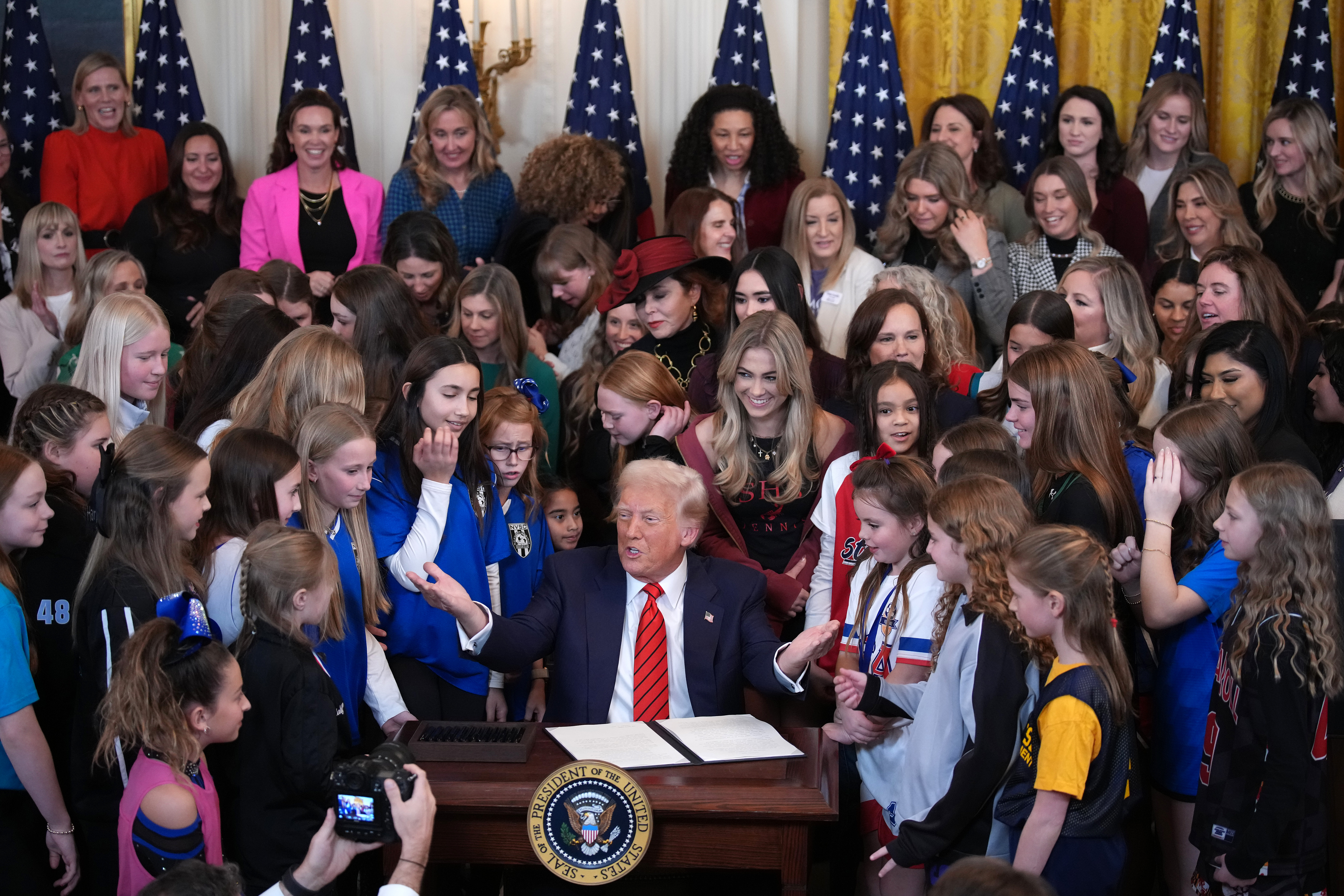
President Donald Trump signs the “No Men in Women’s Sports” executive order at the White House, February 2025 (Photo by Andrew Harnik/Getty Images)
This steady drumbeat of transphobic agitprop was maybe even more successful than its proponents had hoped. Today, fundamental legal protections for trans people—the same protections the conservative-controlled Court extended in Bostock—are less popular than they were three years ago, according to Pew Research Center data from February 2024. This is true not only among Republican voters, but also among Democrats looking to apportion blame for Harris’s loss. In the aftermath of the 2024 election, some Democratic politicians publicly argued that the party’s support for trans rights contributed to its losses at the ballot box. One Democratic member of Congress went so far as to parrot vile anti-trans talking points to The New York Times, explaining that he did not “want to discriminate against anybody,” but did not believe “biological boys should be playing in girls’ sports.”
Back in 2018, YouGov found that 29 percent of Americans thought society had gone “too far in accepting people who are transgender.” Today, that number has increased to 36 percent. Support for explicitly anti-trans policies like bathroom bans, sports bans, and bans on gender-affirming care for young people is stronger than it was as recently as two years ago. Sports bans like those at issue in Hecox and BPJ are especially popular, supported by two-thirds of voters, including 45 percent of Democrats, according to the Pew Research Center.
The most important predictor of the Court’s behavior is its ideological composition. The confirmation of Barrett in late 2020, which cemented the current six-justice conservative supermajority, certainly made outcomes like Bostock less likely. But the Court’s apparent willingness to retreat from Bostock in Hecox and BPJ is not just a product of its changing membership. It is also the result of a cynical campaign to dehumanize trans people, and to ensure that whenever the Court decided it was ready to roll back LGBTQ rights, Americans who might have otherwise been supportive of those rights would be just fine with that result.
Perhaps the most ominous sign for the future of trans rights is that Trump’s election in 2024 has emboldened anti-trans activists like never before. Since taking office, Trump has issued executive orders that (among many other things) require passports to display the holder’s sex assigned at birth, and that pull federal funding from certain providers of gender-affirming care, and that (again) ban trans people from military service. On its shadow docket, the Court has backed Trump by rejecting requests to temporarily block some of these orders from taking effect. The result is a vicious cycle of bigotry: anti-trans voices persuading voters to elect anti-trans politicians who pass anti-trans laws blessed by anti-trans judges and celebrated in anti-trans media outlets, which then whip voters into an anti-trans frenzy all over again.
The eventual opinions in Hecox and BPJ will be long on legalese, and explain in excruciating detail why, notwithstanding the result in Bostock, the Court’s precedent empowers Republican lawmakers to stop trans women and girls from playing women’s and girls’ sports. The better explanation for the decisions will be much simpler: The conservative movement spent years working to prevent anything like Bostock from happening again. The justices are simply delivering the payoff.