Late last month, Fox News published what is, even in Fox News-adjusted terms, perhaps the least essential piece of journalism I have ever laid eyes on: an op-ed from Ben Aguiñaga, a former clerk to Justice Samuel Alito, in which he declares his old boss to be the smartest, nicest, bestest Supreme Court justice to ever walk this earth.
The op-ed is mostly a collection of treacly anecdotes that Aguiñaga intends to use to shed some light on Alito’s good character, which the liberal media, in its endless pursuit of “clicks and likes,” simply refuses to acknowledge. Aguiñaga, who is now the Solicitor General of Louisiana, says that Alito “never raised his voice or directed displeasure toward us,” and possesses “the driest humor known to Washington.” He remembers fondly the time Alito gave him a “thoughtful thank you note” for his work on a particular memo, and the time Alito “did not bat an eye” when Aguiñaga turned in an assignment late.
Finally, Aguiñaga asserts that Alito would routinely send the clerks “perfectly cited draft opinions,” thus demonstrating that he “did not need us” and “could do his job just as well (probably better) without clerks.” This is, in my view, a prudent thing for a clerk to wait to divulge until the term is over and they have collected their law firm bonus.

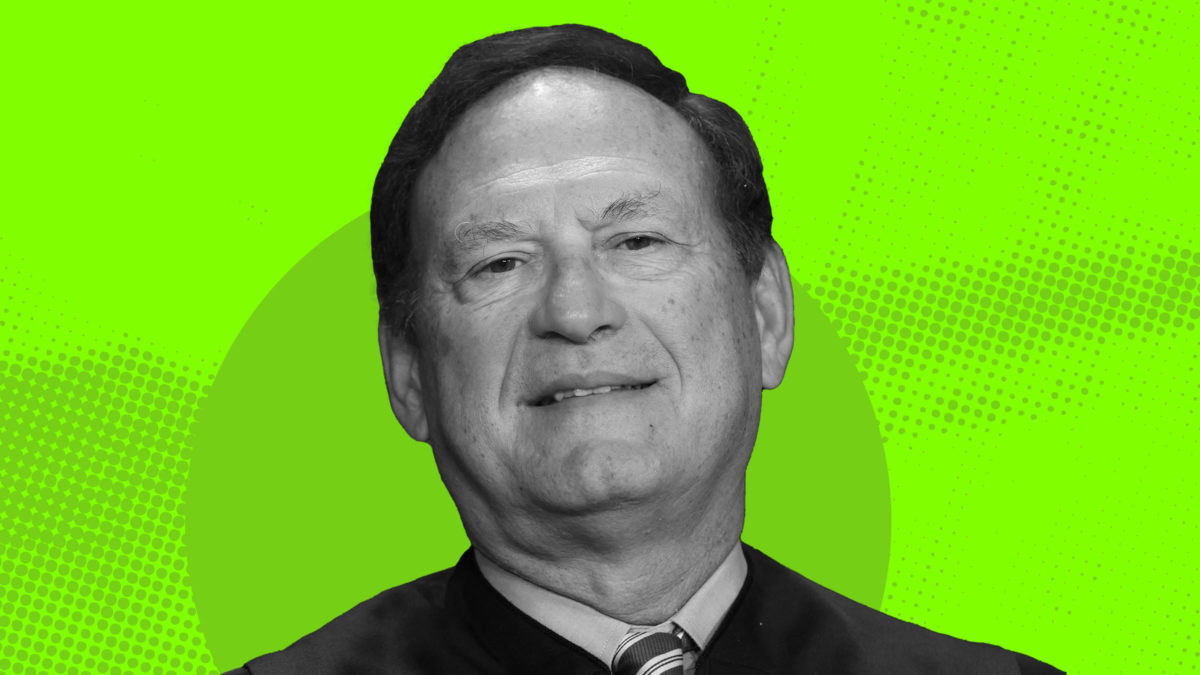
Alito at a Federalist Society event in 2023 (Photo by Jahi Chikwendiu/The Washington Post via Getty Images)
There is a long history in the legal profession of former clerks singing the praises of their former bosses (or riding valiantly to their defense when the occasion calls for it). In 2017, for example, 39 former clerks for then-Judge Neil Gorsuch signed a letter calling him an “extraordinary” judge worthy of swift confirmation to the Supreme Court. This total nearly doubled the 20 former clerks who did the same for Judge Ketanji Brown Jackson in 2022, and dwarfed the 11 former clerks who similarly endorsed Judge Amy Coney Barrett in 2020. (In fairness, Gorsuch, who was appointed as a federal appeals court judge in 2006, had a considerable head start on Jackson and Barrett, who became judges in 2013 and 2017, respectively.)
When Alito was nominated to the Court during the Bush administration, he, too, had a sizable roster of former clerks ready to go to bat on his behalf: I count 51 signatories to this November 2005 letter urging the Senate to confirm him, citing his “humility,” his “decency,” and his “absolute devotion to his family.” In 2018, Judge Brett Kavanaugh received multiple types of letters of recommendation from his ex-clerks—for example, a more general letter from 34 clerks who described him as “unfailingly warm and gracious,” and another from 18 women clerks who felt “compelled to write separately” to convey their “uniformly positive experiences” with Kavanaugh “on issues of gender and equality in the workplace.”
The incentives here are obvious to anyone who understands the importance of maintaining friendly relationships with the biggest names on your reference list. A Supreme Court clerkship is a ticket to some of the most prestigious jobs in the legal profession, from BigLaw to academia to the bench. And for many people in one of those first two roles, a clerkship also makes it all the more likely you will one day be returning to argue before the Court—and even before your former boss.
Really, the only way a clerkship doesn’t work in a former clerk’s favor is if their judge or justice has some reason not to put in a good recommendation when asked. It thus behooves ambitious alums to occasionally reiterate how much they cherish the time they spent in chambers, and to do so as obsequiously as possible. Aguiñaga gestures at this professional imperative in his op-ed, writing that he often reflects on “the immense gratitude that I will always express to the justice who dramatically impacted my life.”
A quick tally of current federal judges who signed the letters I mentioned above illustrates the wisdom of this strategy. I count two Trump appointees on Gorsuch’s letter (Eric Tung, Allison Jones Rushing), one on Alito’s (Michael H. Park), and a whopping four on Kavanaugh’s (Jennifer Mascott, Sarah Pitlyk, Rebecca Taibleson, and Justin Walker). In addition to signing both Kavanaugh clerk letters, Taibleson also testified in support of his confirmation in person before the Senate Judiciary Committee, praising his “easy laugh” and “great sense of humor.” Her willingness to put in that extra effort seems to have paid off.
More galling is the timing of Aguiñaga’s op-ed. As solicitor general of Louisiana, he is one of those former clerks who practices before the Supreme Court, and he published this essay while three cases he argued this term are still pending before the justices: Louisiana v. Callais, a case about racial gerrymandering under the Voting Rights Act; Landor v. Louisiana Department of Corrections, a case about the religious liberty of people in the state’s prisons; and Chevron USA v. Plaquemines Parish, a case about oil companies’ liability for causing environmental damage to the Gulf Coast. (In January, Alito recused himself from Chevron on the grounds that he owns stock in one of the relevant companies. This is both good, in that Alito is no longer participating in a case in which he has a conflict of interest, and also alarming, in that, as Chris Geidner pointed out at Law Dork, Alito had no problem participating in Chevron throughout the cert-stage process.)
To put a finer point on it, Aguiñaga is not just another former clerk taking a convenient opportunity to signal his enduring loyalty to his conservative boss in the conservative media outlet of record. In his role as Louisiana Solicitor General, Aguiñaga needs at least five justices to take his side in three cases that the Court will decide in the next five months. This makes right now a very good time for him to land a fawning op-ed in which he hails one of those justices as “kind, humble, thoughtful and selfless,” not to mention “incredibly smart.”
Oral argument in Landor, which took place last year, went pretty well for Aguiñaga and the Louisiana Department of Corrections. And as a practical matter, it is probably true that Aguiñaga does not need to lose much sleep over whether Alito, a longtime hater of the Voting Rights Act, will cast a vote to stuff what remains of it into the jurisprudential garbage can. But in a functioning legal system, Aguiñaga would at least have the shame to wait until the summer to publish a puff piece like this. His willingness to do so now speaks to just how little many people in the profession’s elite circles care about maintaining even the illusion of judicial impartiality. For Aguiñaga, there is no downside here: If he wins his cases, great. If he loses, well, at least Alito knows which one of his former clerks is most enthusiastic about having his back in public.