The Supreme Court heard oral argument today in Trump v. Barbara, a case about President Donald Trump’s executive order purporting to redefine birthright citizenship and render hundreds of thousands of American-born infants stateless every year. Crucially, the Constitution already provides a definition of birthright citizenship: Under the Fourteenth Amendment, “all persons born or naturalized in the United States, and subject to the jurisdiction thereof, are citizens of the United States.”
For well over a century, every branch of government has understood this provision to mean that babies born on American soil are Americans—and have equal rights as Americans—with very limited exceptions. Trump’s executive order nevertheless contends that people are not “subject to the jurisdiction” of the United States unless, at the time of their birth, at least one of their parents is a U.S. citizen or legal permanent resident.
Put differently, Trump is claiming that the post-Civil War Constitution’s guarantee of birthright citizenship permits him to reimpose a pre-Civil War legal order. His new definition would recreate an inheritable racialized underclass, deny citizenship to American newborns with disfavored ancestry, and make babies born in America vulnerable to forcible removal to who knows where.
Such a claim would have been widely understood as bullshit from roughly 1868, when Congress adopted the Fourteenth Amendment, to 2025, when the right-wing legal intelligentsia had to pretend otherwise if they wanted to stay in the president’s good graces. As a result, every court so far to consider Trump’s executive order on the merits has ruled against him. Trump appealed those losses, and rather than simply deny his petition, the Supreme Court decided to hear him out.

Trump issued his birthright citizenship order a year and a half ago, and the Court has had ample opportunities to rebut his assault on a foundational constitutional commitment. It is appalling that the justices even gave his claims the time of day. Mercifully, however, the justices largely spent that time tearing those claims to shreds. Throughout Wednesday’s oral argument, a majority of the Court confirmed that the Fourteenth Amendment means what it says, and Trump’s arguments to the contrary are meritless.
Solicitor General D. John Sauer argued on behalf of the Trump administration that, as used in the Fourteenth Amendment, “subject to the jurisdiction thereof” means “not owing allegiance to anybody else,” and “lawful domicile is the status that creates the requisite allegiance.” According to Sauer, the United States has historically made birthright citizenship dependent on whether parents are “lawfully present and have an intent to remain permanently.”
This puzzled the justices, because there is a vast historical record showing the exact opposite. Justice Sonia Sotomayor, for instance, asked Sauer what he made of United States v. Wong Kim Ark, the Supreme Court’s 1898 decision broadly interpreting the Fourteenth Amendment to automatically grant citizenship to everyone born in the United States, except for children of foreign diplomats and members of sovereign Indian tribes. Sotomayor also read from a report, quoted at length in Wong Kim Ark, written by Secretary of State Daniel Webster in 1851: Webster said it was “well known” that anyone born in the U.S. is subject to its jurisdiction “independently of a residence with intention to continue such residence,” “independently of any domiciliation,” and “independently of the taking of any oath of allegiance or of renouncing any former allegiance.”
Justice Ketanji Brown Jackson similarly highlighted an amicus brief by Professor Eric Muller discussing the mass detention of Japanese Americans during World War II, and the citizenship status of children born in the internment camps. The Fourteenth Amendment granted those babies birthright citizenship even though “the parents were declared enemies of the United States,” said Jackson, so the concept of “allegiance” could not have been the decisive factor. “Are you saying this is wrong or they shouldn’t have gotten birthright citizenship?” she asked. Sauer tried to have it both ways, saying the babies should have gotten citizenship “if they were domiciled” but not “if they were temporarily present.”
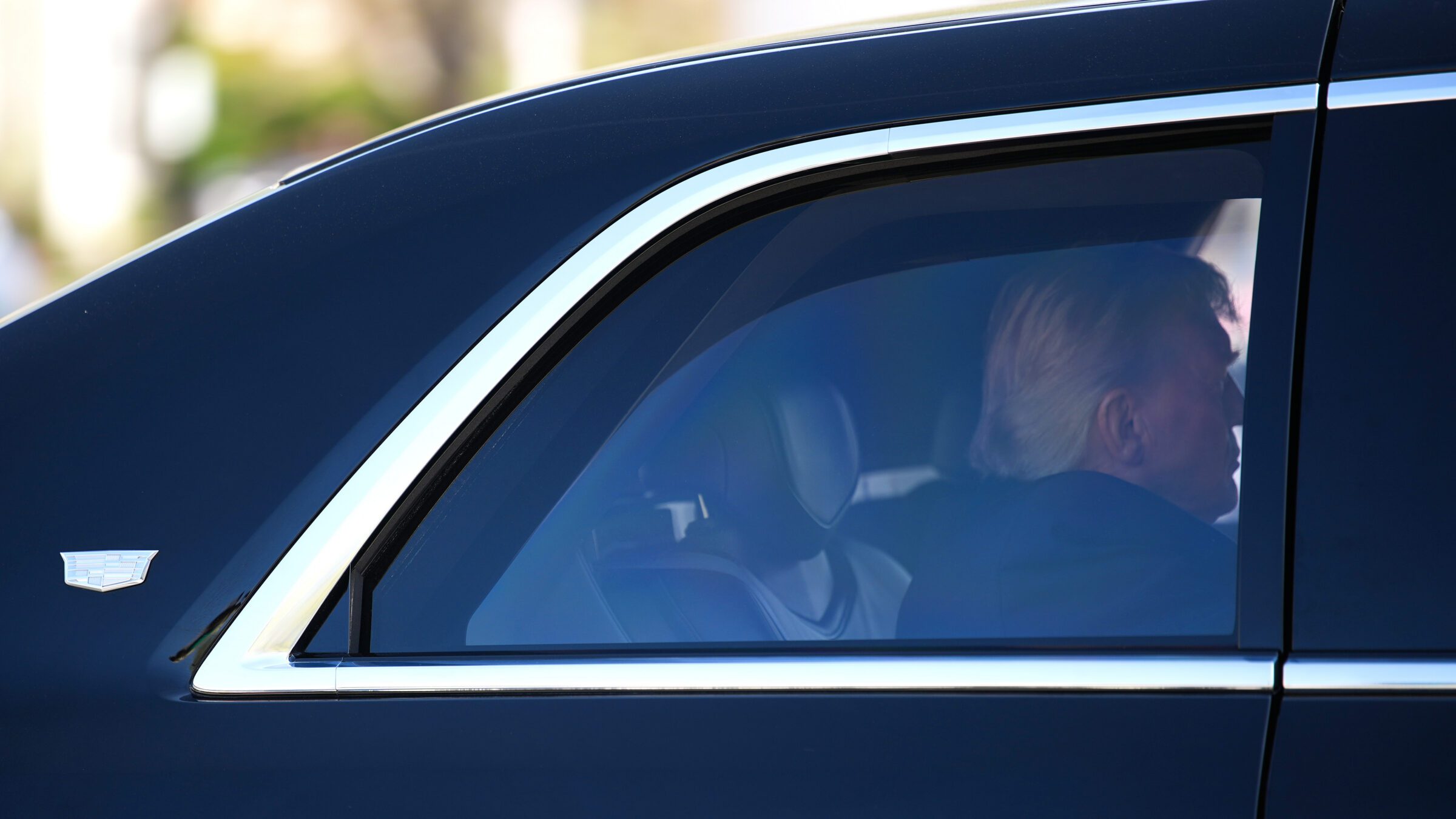
Trump leaves the Court on Wednesday after attending part of oral argument (Photo by Andrew Harnik/Getty Images)
Justice Elena Kagan said outright that the Trump administration was taking a “revisionist” position “with respect to a substantial part of our history,” and asked what magnitude of evidence it should take for the Court to accept a view “diametrically different” from what everyone has believed “for a long, long time.” Although the justices didn’t specify what amount would be sufficient, they suggested Trump didn’t have enough: Chief Justice John Roberts characterized Sauer’s examples, some of which related to children born on warships, as “idiosyncratic” and “quirky.” And Justice Neil Gorsuch called it “striking” that “none of the debates” that Congress had about the Fourteenth Amendment make mention of parents’ domicile, if those concepts were indeed so important.
Many of the justices’ questions exposed Trump’s argument as irreconcilable with the historical evidence. Other questions revealed the administration’s position as incompatible with common sense. Justice Amy Coney Barrett, for example, questioned how Sauer’s standard would apply to people who were brought to the country as slaves. Sauer recognized that the Fourteenth Amendment granted citizenship to formerly enslaved people, but also contended that citizenship is tied to “lawful presence with intent to remain permanently.”
Unless you’re a neoconfederate dedicated to the happily enslaved Negro myth, it’s pretty obvious that slaves did not want to be there. Barrett was skeptical, as a result, that the government’s standard would in fact grant citizenship to people who were brought to the U.S. in bondage “in defiance of laws forbidding the slave trade,” and who wanted “to escape and go back the second they can.” Returning to the present day, Jackson further questioned how the government would go about determining whether a parent intended to stay in the country anyway. “Are we bringing pregnant women in for depositions?” she asked.
Sotomayor also pressed Sauer about the implications of the administration’s theory, and if ruling for Trump in this case would replicate the harms of U.S. v. Singh Thind, a 1923 decision involving an Indian immigrant who served in the U.S. Army and later became a naturalized citizen. There, the Court ruled that only “free white persons” were eligible for naturalization, and revoked Thind’s citizenship. The federal government then embarked on a denaturalization campaign, and dozens of Indian Americans lost their U.S. citizenship. “There would be nothing limiting that, according to your theory,” said Sotomayor.
Sauer insisted that the Trump administration is only asking for prospective relief, as the executive order is not retroactive. But that answers a different question than the one that Sotomayor asked: Whether the administration is seeking to strip people of their citizenship right now is distinct from whether its theory would empower it to do so in the future.
The possible harm Sotomayor was wary of gets to the heart of why the birthright citizenship provision exists, and why Trump’s executive order is both legally and morally repugnant. Congress adopted the Fourteenth Amendment to ensure that the Constitution would no longer tolerate a racial caste system, and that bigoted politicians could not arbitrarily exclude people born in America from equal membership in American society. Accepting Trump’s view of birthright citizenship would shatter both multiracial democracy and the constitutional tool used to forge it.