
After two years of watching a doddering racist take a buzzsaw to the federal government while deploying masked thugs to disappear brown people off the streets, voters made clear on Tuesday that they would very much like something else. As of this writing, Democrats are projected to win 258 seats in the House of Representatives and 55 seats in the Senate, including in states like Iowa, Kansas, South Carolina, and Texas, all of which I would have casually described as “deep red” as recently as last week. The last time American reactionaries were defeated in such overwhelming fashion, Robert E. Lee and Ulysses S. Grant were shaking hands in Wilmer McLean’s living room.
Without control of the White House, there is of course only so much Democrats can do with their newfound power. And in the context of the myriad horrors of the first half of President Donald Trump’s second term, talking about what the party “should” do next is roughly analogous to deciding which out-of-control forest fire to fight first: There is not enough water, there are lots of worthy candidates, and all of them are getting worse.
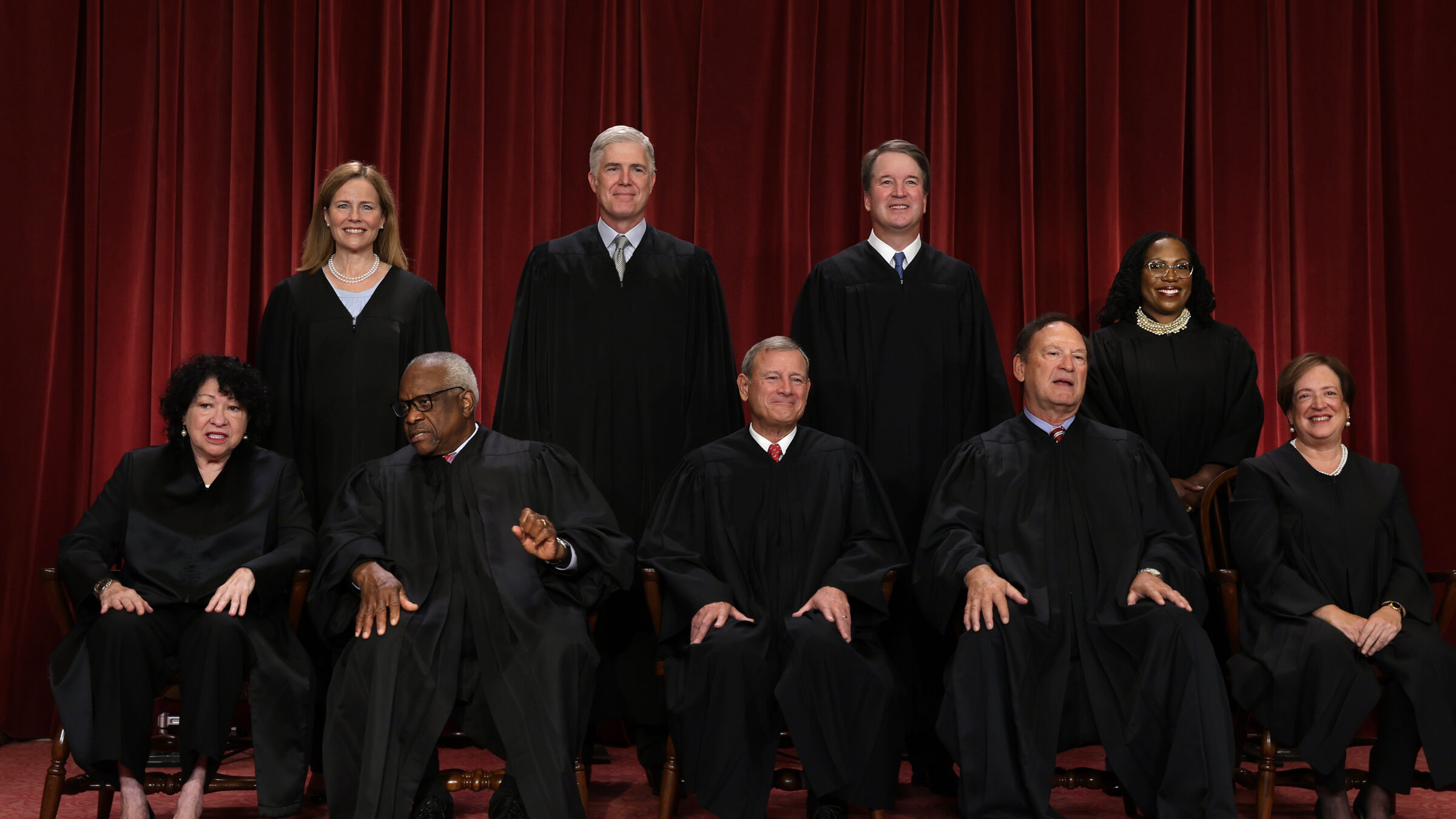
One thing must be true, though: Whatever issues Democratic lawmakers choose to focus on—and, as the 2028 ideas primary gets underway, whatever ambitious ideas Democratic presidential hopefuls choose to support—the party must also have a plan for taking on the Supreme Court, which remains an existential threat to anything Democrats might hope to accomplish. Even if the party is fortunate enough to win a trifecta—the House, the Senate, and the White House—in 2028, things like a Green New Deal and Medicare for All and a new Voting Rights Act do not stand a chance before this six-justice conservative supermajority. Regrettably, what I wrote in 2020 is just as true today: If Congress passes any one of these proposals into law, the only real question is which justice ends up writing the opinion that kills it.
(Photo by Alex Wong/Getty Images)
Not all forms of “Supreme Court reform” are created equal, either. For Democrats, an essential task over the next two years is building support, both among voters and within the caucus, for adding seats to the Court as soon as a Democrat is back in the White House. (At least four seats, although I can be persuaded to go higher, and we can save that debate for another day.)
To give you a sense of the stakes here, a 2024 study estimated that unless Congress expands the Court, Republicans will probably control the institution until at least 2065. For Democrats who actually aspire to do the work of governing, four decades is simply too long to wait.
The good news is that for politicians, it is easier to talk about expansion today than it was back in 2020, when the Democratic establishment, whose elders are forever viewing the Court through Warren Court-colored glasses, still considered the concept too “radical” to be worthy of serious discussion. Six years later, with Roe v. Wade in the history books and the Voting Rights Act reduced to a husk, the Court is historically unpopular not only among Democratic voters, but also among independents. With increasing frequency, voters are correctly identifying the animating principle of the Court’s work not as doing equal justice under law, but as doing what is in the best interests of the Republican Party and/or Donald Trump.
To the extent that the conventional wisdom about Supreme Court expansion was ever right, Tuesday’s results underscore just how wrong it is now. If you are a Democratic elected official, running against the Court is not a political risk. It shows the voters whose rights the Court keeps taking away that you understand the problem, and are prepared to do something about it.

Please don’t hear what I’m not saying: Other forms of Supreme Court reform are also perfectly good ideas. Term limits, for example, would prevent justices from reigning as unelected quasi-monarchs for multiple generations, clinging to their seats until the bitter end to ensure that theirs remain in their preferred party’s hands. A meaningful ethics code could prevent them from vacationing on the dime of right-wing billionaires who cannot believe how easy it is to buy influence on the nation’s highest court. Jurisdiction stripping would prevent the Court from simply wagging its finger and saying “no” every time Congress tries to protect the right to vote; shadow docket reform could at last prevent the conservatives from greenlighting the Trump administration’s flagrantly illegal stunts without the burden of having to explain themselves.
Court expansion, though, is the only proposal that solves the most urgent problem with the Court right now, which is that anti-constitutional ideologues control two-thirds of its votes. Requiring Clarence Thomas to fill out more forms during tax season will not make the Court any less hostile to voting rights. Forcing the conservative justices to put their names to their shadow docket opinions will not make their shadow docket opinions any less devastating for people whose lives hang in the balance. Even if an 18-year term limits bill were to survive a constitutional challenge—a case that would eventually be decided by the same Supreme Court it is trying to rein in—a hypothetical statute that requires Amy Coney Barrett to retire in 2038 still leaves Amy Coney Barrett with 12 years to do the conservative legal movement’s bidding.

(Photo by Chen Mengtong/China News Service via Getty Images)
I do not expect the Democratic establishment to embrace this reality enthusiastically. After all, the party blew a golden opportunity to build support for expansion five years ago, when President Joe Biden convened a blue-ribbon commission of liberal lawyers and academics to examine the universe of possibilities for Supreme Court reform. Unfortunately, after several months of Zoom meetings, the commission managed to offer only tepid support for term limits, warning in its final report that Court expansion was unwise because it risked undermining “the very goal of some of its proponents of restoring the court’s legitimacy.”
Set aside, for now, the Biden Commission’s conclusion that “restoring the court’s legitimacy” is the relevant metric for evaluating proposals to reform the Supreme Court. As the last five years have demonstrated, the Court is capable of ceding its legitimacy all by itself.
Again, the political environment is different today. As the Court’s approval rating has gone down, support for expansion has increased, especially among Democratic voters: A Marquette poll conducted earlier this year found that 53 percent of respondents are in favor of adding seats to the Court. Sure, support for term limits and an ethics code was even higher, but the point is that there is no longer a good reason—whether substantive or strategic—for Democrats to settle for half-measures when it comes to the subject of Supreme Court reform. Voters want change, and are looking for leaders who will deliver more of it, not less.
The all-caps headlines this morning are framing the midterm results as an emphatic rejection of Trump and his political movement. This is right, but for Democrats, just as important as defeating Trump is deciding what will come after he is gone. For as long as Democrats are reluctant to disempower the Supreme Court he built, their agenda is not an agenda. It is a wish list. They had better get to work.