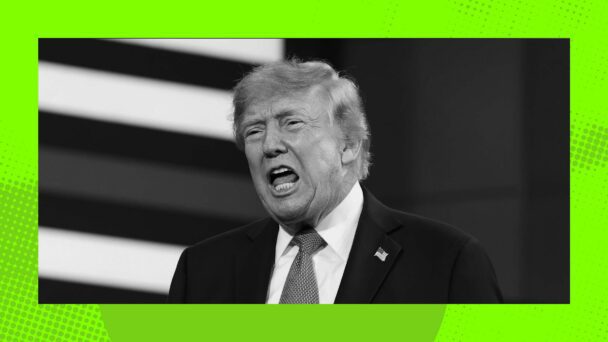
President Donald Trump has had a stressful midterm elections season. Opinion polling shows that a whopping 60 percent of Americans disapprove of the standard-bearer of the Republican Party. The GOP is widely expected to lose its majority in the House of Representatives. And Senate seats once considered Republican strongholds now look more like toss-ups. The New York Times reports that the “mood” in the White House is “grim.”
The last time Trump was in the White House and unhappy with the results of an election, he abused the power of the White House in efforts to set those election results aside. Following his defeat in 2020, Trump directed the Department of Justice to conduct sham election crime investigations, pressure state officials to replace legitimate electoral votes with votes for him, and otherwise lean on states to alter election results and keep him in power.
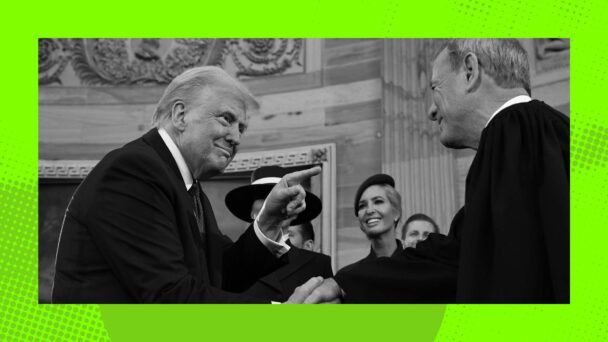
A federal grand jury indicted Trump for this conduct, but in July 2024, the Republican majority on the Supreme Court shut down the attempt to hold him criminally responsible. Chief Justice John Roberts downplayed Trump’s conscription of DOJ attorneys into service as election saboteurs, characterizing the scheme as mere “discussions with Justice Department officials.” In Trump v. United States, Roberts reasoned that deciding which crimes should be investigated and prosecuted is a “quintessentially executive function,” and he concluded that presidents are “absolutely immune from criminal prosecution” for conduct that falls within their “exclusive sphere of constitutional authority.”
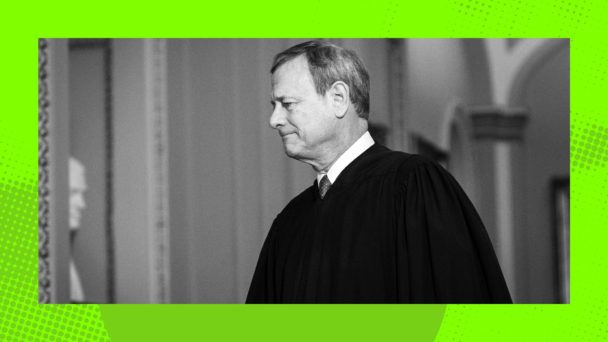
Fast forward to November 2026, and Trump is again facing rejection at the ballot box. So, armed with Roberts’s blessing, Trump has again weaponized the DOJ in an effort to reject democracy. Over the past few months, Trump’s Justice Department filed a slew of federal lawsuits that aimed to limit who could vote; to control whether and how votes are counted; and to challenge election results. But so far, none of them have succeeded.
Last year, Trump demanded that nearly every state in the country hand over their complete, unredacted voter registration files and remove specific individuals upon request. The Justice Department sued 30 states and Washington, D.C., for refusing to do so. To date, at least 27 of those cases have been dismissed.
The Trump administration nonetheless cobbled together a list of tens of thousands of people who it contended were “likely” noncitizens, and went to court to demand their removal from the voter rolls. On October 13, after California had already mailed ballots to voters, the administration directed California to review its list within 48 hours, confirm the citizenship status of the listed individuals, and set aside the ballots of anyone whose citizenship they could not verify. When California did not comply, Trump’s Justice Department immediately sued, asking a federal district court to order the state to segregate and exclude more than 20,000 ballots.
Apparently unsatisfied with the pace of district court proceedings, Trump’s DOJ quickly filed an appeal, which construed the fact that the court had not issued a ruling yet as a “constructive denial.” On October 26, the Ninth Circuit dismissed the Justice Department’s appeal as premature. Two days later, the district court ruled against the Justice Department, too, rejecting the administration’s ploy as “unprecedented,” “unconstitutional,” and a “danger” to democracy.

Foiled again, Trump’s Justice Department recently tried a different gambit. Instead of trying to decide who votes and how the votes are counted, the DOJ filed a lawsuit to preemptively ignore the will of the voters. In Alaska, Senator Dan Sullivan, a Republican, is running for reelection against multiple candidates, including someone who is also named Dan Sullivan. The DOJ’s complaint contends that the inclusion of both Dan Sullivans on the ballot is “confusing to voters” and that any election results “tainted” by the challenger Sullivan must not be certified until an “investigation” determines if votes cast for the challenger were meant for the incumbent.
The Republican-led government of Alaska, the Democratic Senate candidate’s campaign, and nonpartisan organizations all filed motions to dismiss the DOJ’s complaint. And on November 1, Alaska’s federal district court granted all three motions, finding that the DOJ’s requested relief—investigating voters and segregating their ballots based on the candidates they selected—was “infeasible” and would “clearly violate Alaskans’ right to a secret ballot.”
Much like the villain in a Halloween movie, though, Trump’s DOJ never just stays down. Last week, The New York Times published an investigation into Alaska Democrats’ recruitment of the second Sullivan to run for senate. In response, the DOJ has already issued dozens of grand jury subpoenas and is flirting with the idea of criminal charges. Any such prosecution is unlikely to succeed—sometimes “conspiracies” are just funny, not criminal—but it creates another avenue for Trump to contest the legitimacy of the democratic process, and try to override any outcome he doesn’t like.
The Supreme Court has allowed and empowered Trump to try to overturn elections. But as this midterm season shows, the Court did not guarantee that Trump’s Justice Department would succeed. The elections also confirm, though, that Trump has many tools at his disposal to thwart the democratic process. And the Supreme Court gave him every incentive to keep trying his luck.