In 1978, the Supreme Court upheld the right of colleges and universities to use affirmative action in order to assemble diverse student bodies—a goal the Court described as “of paramount importance in the fulfillment of [a school’s] mission.” The result in that case, Regents of the University of California v. Bakke, so infuriated the conservative legal movement that it spent decades organizing around the principle that no Black student should ever occupy a seat in an Ivy League classroom that could have gone to a white student instead.
In 2023, the Court’s six-justice conservative supermajority at last gutted Bakke and banned the use of race-conscious admissions policies in Students for Fair Admissions v. Harvard. The impact on higher education was immediate: A 2026 analysis published by the Brookings Institution found “precipitous” drops in Black enrollment at elite schools, and in 2025, an Associated Press survey of 20 selective schools found that Black enrollment had decreased at 19 of them. At Princeton, the entering class of 2029 was 5 percent Black—according to The Daily Princetonian, the lowest Black enrollment figure since 1968.
But for Justice Samuel Alito, a Princeton alum who enrolled in the fall of that year, schools have not been resegregating as quickly or as drastically since Students for Fair Admissions as he would prefer. In a speech on Monday evening, Alito warned a roomful of conservative activists of “considerable resistance” to the Court’s decision, as evidenced by the fact that at least some schools are continuing to admit at least some nonwhite people in numbers he considers too significant to be legal.
“I am afraid diligent judicial enforcement of Students for Fair Admissions will be needed going forward,” Alito told attendees at the annual American Enterprise Institute gala in Washington, D.C. He wondered aloud about whether it is even possible for affirmative action to be “rooted out” of higher education, and warned that for as long as Americans continue to “divide up into tribes, elbowing for advantage, the result will not be pleasant.”
This obsession with ostensibly less-deserving interlopers is not new for Alito, who throughout his career has been an especially vociferous opponent of affirmative action, and especially at Princeton. His stance does not come from his adherence to a particular jurisprudential philosophy. It comes from the fact that he finds the presence on campuses of people who do not look like him to be personally offensive and legally suspect.
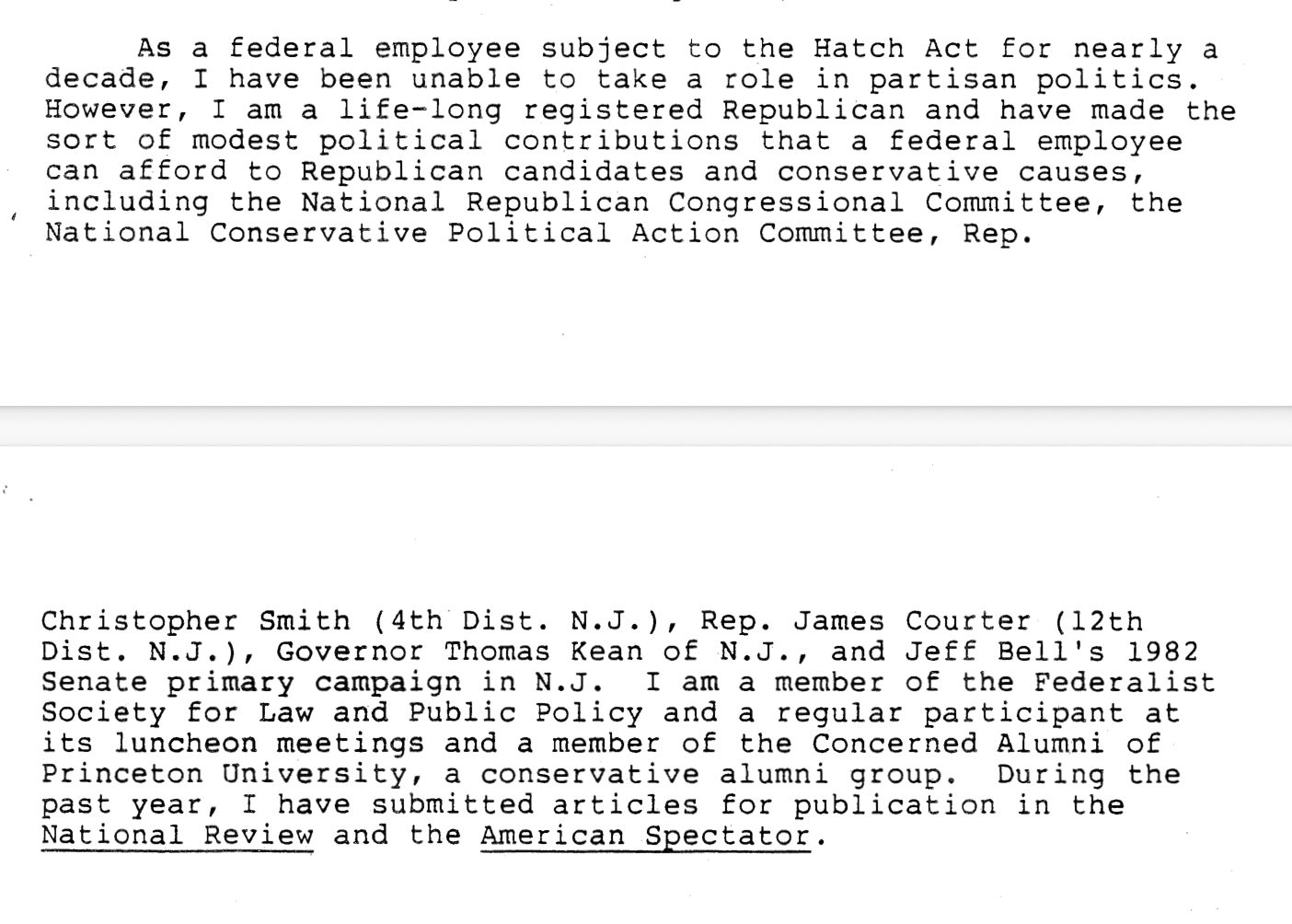
I am not speculating here: In 1985, Alito, a lawyer in the Solicitor General’s office, applied for a job in the Office of Legal Counsel, the Justice Department office responsible for advising the administration of then-President Ronald Reagan. In his application, Alito described his work on cases “in which the government has argued in the Supreme Court that racial and ethnic quotas should not be allowed” as “an honor and source of personal satisfaction.”
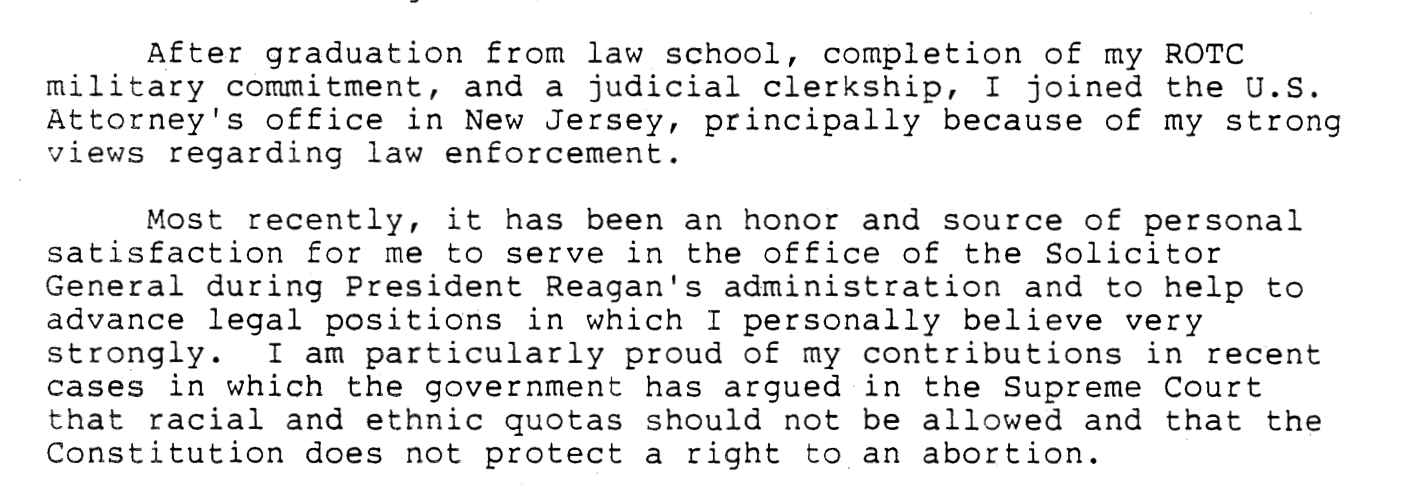
As Peter Canellos explains in his book, Revenge for the Sixties: Sam Alito and the Triumph of the Conservative Legal Movement, at that time, the Reagan Justice Department was concerned about accidentally hiring insufficiently conservative lawyers, and so its application process was designed to separate mere Republicans from true reactionaries. Alito left nothing to chance in his responses. “I am and always have been a conservative and an adherent to the same philosophical views that I believe are central to this administration,” he wrote. Rolling back affirmative action, he added, was an issue in which he “personally believe[d] very strongly.”
In his application, Alito also noted his membership in the Concerned Alumni of Princeton University, which he described as a “conservative alumni group.” A detail he did not note, but which Reagan lawyers at the time would have known, was that the organization’s primary “concerns” were Princeton’s use of affirmative action and its decision in 1969 to allow women to enroll for the very first time. The campus had changed in a hurry: In fall 1973, Princeton’s 1,113-person class included 191 students who were not white. In the class a decade earlier, there had been three.
For Alito, who graduated from Princeton in 1972, this experience was too traumatic to forget. To give you a sense of what Concerned Alumni members were like, in the early 1970s, one of the founders, Shelby Cullom Davis, asserted that Princeton’s student body should consist of men “relatively homogeneous in interests and backgrounds, who had known and liked each other over the years.” He also encouraged members to keep in mind that recent increases in the number of women and minorities were “by no means irreversible.”
By the mid-1980s, Concerned Alumni was in decline and was known on the Princeton campus as sort of an institutional embarrassment—vile, sure, but not influential enough to take seriously. In 1984, the organization made national news when its monthly newsletter, edited at the time by Dinesh D’Souza, published details about a particular freshman woman’s sex life, which prompted Princeton students to circulate a petition to ban the newsletter from being delivered on campus. The fact that Alito was so eager to tout his affiliation with Concerned Alumni in 1985, just one year later, indicates just how deeply he believed in the mission, and how eager he was to prove that he would not abandon it.
When asked about the Concerned Alumni of Princeton during his Supreme Court confirmation hearings in 2006, Alito said that he had “no specific recollection” of the organization. To be fair, this is probably what I would say if I were a grown adult who had proudly claimed membership in an organization that sought to cap the combined enrollment of women and minorities at my alma mater at between 10 and 20 percent.
Today, even after vanquishing the affirmative action programs that made him so upset all those years ago, Alito remains unsatisfied. His word choice in his speech on Monday—in particular, his description of “considerable resistance” to Students for Fair Admissions—would not have been lost on his conservative audience. It echoes the language used by white Southern politicians in the 1950s, when the Court, led by Chief Justice Earl Warren, ruled unanimously in Brown v. Board of Education that school segregation was unconstitutional. Two years later, white Southern politicians unveiled a scheme of “massive resistance” to Brown, which included passing laws to defund and close schools that dared to comply with the Court’s decision. By invoking this language today, Alito is effectively asserting that in his mind, the Warren Court’s fight to end school segregation is just as noble as the current Court’s fight to reinstitute it.
Maybe the most pernicious aspect of Alito’s call for more “diligent judicial enforcement” is its implications for the future of the conservative legal movement’s involvement in higher education. Since Students for Fair Admissions, it has become a common talking point on the right that if elite schools are really following the law, the “correct” number of nonwhite students at these schools will be zero. For Alito, the fact there are fewer Black students at Princeton and elsewhere these days is not evidence that conservatives won the war on affirmative action. It is proof that they need to work harder to make Black students disappear altogether.