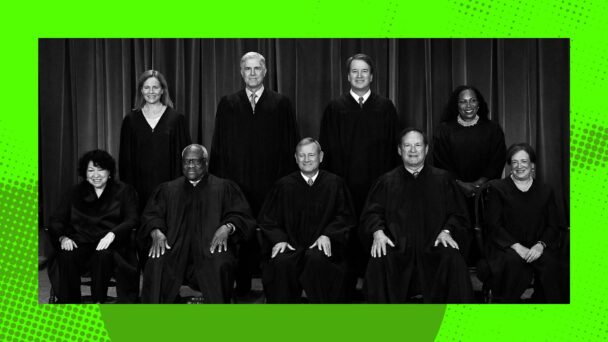
After a disastrous showing in the November 2025 elections and under pressure from President Donald Trump, many Republican-controlled legislatures are looking to (further) gerrymander their states prior to the 2026 midterms. The Court’s recent shadow docket decision permitting Texas Republicans to use their new map in 2026 is just the latest signal that whatever Republicans try, the U.S. Supreme Court will back them up.
Even more alarming is that other Republican-controlled states have been expanding on the same playbook that Texas just used to sneak in its illegal map. And under the Roberts Court’s application of what’s become known as the Purcell principle, Republican states can deliberately time redistricting to dodge meaningful judicial review, knowing that the Court’s commitment to GOP-friendly elections will beat out the Court’s concern for consistency with its own precedent and logic.
In the spring, facing declining poll numbers and broad backlash to his signature policies, President Donald Trump started pushing lawmakers in red states to redraw their maps, hoping to increase Republicans’ odds of holding the House in the 2026 midterm elections. In Texas, this effort resulted in a proposal to flip up to five Democratic seats in a congressional delegation that Republicans already control 25-13, which would give the GOP 79 percent of the state’s representatives despite winning only 58 percent of votes statewide in 2024.
Minority voters and advocacy groups filed suit, and a three-judge panel of federal judges determined in November that the map constituted an illegal racial gerrymander and blocked its use for the 2026 midterms. Weeks later, though, the Supreme Court stayed the decision in Abbott v. League of United Latin American Citizens. Although the majority did not explain its reasoning, Justice Samuel Alito wrote a concurrence claiming that the lower court had “failed to honor the presumption of legislative good faith,” and “improperly inserted itself into an active primary campaign, causing much confusion and upsetting the delicate federal-state balance in elections.”

By doing so, Alito invoked the language of Purcell v. Gonzalez, a 2006 Supreme Court case in which the justices held that federal courts should “ordinarily not alter the election rules on the eve of an election.” In Purcell, the Court stayed a lower court injunction that would have removed a voter ID requirement in Arizona less than two weeks before that election.
In the years since, lower courts have referred to Purcell as a “bedrock principle of election law.” But the Purcell Court did not specify what counts as the “eve of an election” in its decision. And rather than determine an actual rule, in subsequent cases, the Supreme Court has merely gone on a case-by-case basis, invoking Purcell whenever it feels like it.
As stated in Purcell, the purpose of leaving the status quo in place close to elections is to prevent the sort of “voter confusion” that potentially “conflicting” court orders could cause. But since securing its solid conservative majority in 2018, the Court has relied on Purcell to cut most often against Democratic (and democratic) interests, extending the “eve of an election” to its limit to benefit Republicans. In People First of Alabama v. Merrill, for example, the Court halted a district court’s suspension of witness and ID requirements and a ban on curbside voting eight months before the 2020 election. And in Merrill v. Milligan, the Court stayed a unanimous lower court ruling that Alabama’s congressional map likely violated the Voting Rights Act, allowing a blatant racial gerrymander to remain in place nine months before the 2022 election.
(Photo by Chip Somodevilla/Getty Images)
In Abbott, too, the Court relied on Purcell even though the lower court issued its injunction almost a year before the 2026 general election. In dissent, Justice Elena Kagan excoriated the majority for the perverse incentives its decision created: “To implement even a blatantly unconstitutional map, the legislature would need only to pass it on a schedule like this one,” she wrote. In other words, because of the ambiguity around how close to an election is “too close,” states can manipulate the timing of maps knowing that lower courts may be reluctant to intervene—and that even if they do, the Supreme Court would likely overrule them.
Other Republican-controlled states have been following Texas’s and the Supreme Court’s lead. In early December, Indiana’s GOP-controlled House passed a redistricting bill that would have enacted a likely 9-0 Republican map by splitting Indianapolis across multiple districts. Worse than the map itself was the procedural scheme baked into the bill, which fast-tracked legal challenges to the map directly to the state supreme court. By bypassing lower courts, this tactic would have ensured that the only courts available to review the maps were the Republican-controlled Indiana Supreme Court and the Republican-controlled U.S. Supreme Court. It would also have placed the maps’ adoption within a window that the Court has already essentially said is too close to the election.
Last week, a coalition of Indiana Republican lawmakers joined with Democrats to reject the plan, undeterred by Trump’s threats to pull federal funding from the state if they did not pass it. But the movement is having more success in other GOP-controlled states. In Missouri, for example, the Republican Secretary of State has said that the state will use its newly gerrymandered maps for the 2026 midterms, and although several lawsuits have been filed challenging the maps, the Court is likely to reverse any action by lower courts to block their use. In Florida, Governor Ron DeSantis has called for the Republican legislature to wait to redistrict to see if the Court first kills Section 2 of the Voting Rights Act in Louisiana v. Callais, thereby giving them more freedom to divvy up the state as they please.
What we are witnessing is not an application of a common-sense rule designed to prevent chaotic, last-minute election upheaval. It is the weaponization of that rule by Republicans in order to disenfranchise Democratic and minority voters. If anything, the Court’s constant second-guessing of lower courts’ factual determinations has created more chaos in elections and set off a gerrymandering arms race across the country. Lower courts are left to guess about how close is “too close” to an election, and the Court has reserved the right to cause its own confusion regardless.
With Texas’s map locked in for the 2026 midterms, and Indiana, Missouri, Florida, and potentially other states eyeing similar moves, the Republican Party could win the House simply by changing rules behind voters’ backs. The Court’s readiness to bless such maps under the banner of “stability” sets a dangerous precedent: As Kagan warned in her dissent, “if Purcell prevents such a ruling, it gives every State the opportunity to hold an unlawful election.” Texas has secured the right to do exactly that, and it looks like there will be more soon.