For as long as President Donald Trump has been flooding blue cities with ICE agents looking to abduct nonwhite people, federal judges have been concluding that ICE is violating federal statutes and the Constitution alike. Among other things, courts have blocked categorical detention policies, ordered bond hearings, and rejected the administration’s sweeping theories of executive authority. Their opinions have become increasingly detailed and, at times, sharply critical of ICE’s disinterest in complying with binding court orders.
But for the most part, judges have held off on actually holding the administration accountable, relying instead on clarification orders, modified injunctions, status reports, and strongly worded warnings. If judges believe ICE should face actual punishment for evading their rulings, they have many more tools at their disposal than increasingly exasperated compliance orders—if they are prepared to use them.
The most straightforward enforcement tool is contempt. Civil contempt is meant to force compliance with court orders rather than punish previous offenses, but it can be a powerful deterrent to unlawful conduct. Judges can impose escalating daily fines on the Justice Department, set deadlines backed by monetary penalties, and require sworn declarations from administration officials that demonstrate their adherence to a court order. They can condition the lifting of these sanctions on proof that violations have ceased, and in rare cases, may even order the imprisonment of recalcitrant officials until they comply.
Editor’s Note: A few hours after we published this story, Minnesota federal district court judge Laura Provinzino found a Justice Department lawyer to be in civil contempt of court, and ordered him to pay a “coercive fine”of $500 per day until the government returns a released ICE detainee’s identification documents. We assume Judge Provinzino read this story beforehand and acted accordingly.
Civil contempt is distinct from criminal contempt, which judges use to punish willful past defiance of a court order. But criminal contempt is on the table, too: In these proceedings, judges directly punish individual officials who knowingly disregarded a binding order. Penalties for criminal contempt can include fines or imprisonment, and would mark a sharp shift from institutional reprimands to personal accountability.
In ordinary litigation, civil contempt is relatively common, but against federal agencies, it is rare. To date, judges have been reluctant to use these tools in conjunction with ICE’s operations in Minnesota and elsewhere. Last month, for example, federal district court Judge Patrick Schiltz canceled a scheduled hearing at which ICE’s acting director, Todd Lyons, was to be questioned in order to determine whether Schiltz should initiate civil contempt proceedings, whether against Lyons or other agency officials.
Judge James Boasberg, the chief judge of the federal district court in Washington, D.C., appears to be the only judge who has continued to press forward with a contempt inquiry tied to immigration enforcement conduct—in this case, in response to violations of his March order that the government halt deportation flights to El Salvador under the Alien Enemies Act. But the D.C. Circuit has repeatedly intervened in Boasberg’s contempt proceedings. In December, a three-judge panel of appeals court judges stayed his inquiry. Then, after being overruled by the en banc D.C. Circuit, a separate panel blocked whistleblower testimony related to the inquiry—a ruling that has now been submitted for en banc review.
No judge would take the step of criminal contempt lightly, but the mechanism exists precisely for moments when a court concludes that parties are flouting its authority, and that coercive civil remedies are insufficient. The consequences of the judiciary’s reluctance to use this tool are predictable: Injunctions may slow policies, but without credible enforcement consequences, they do not necessarily change behavior on the ground.
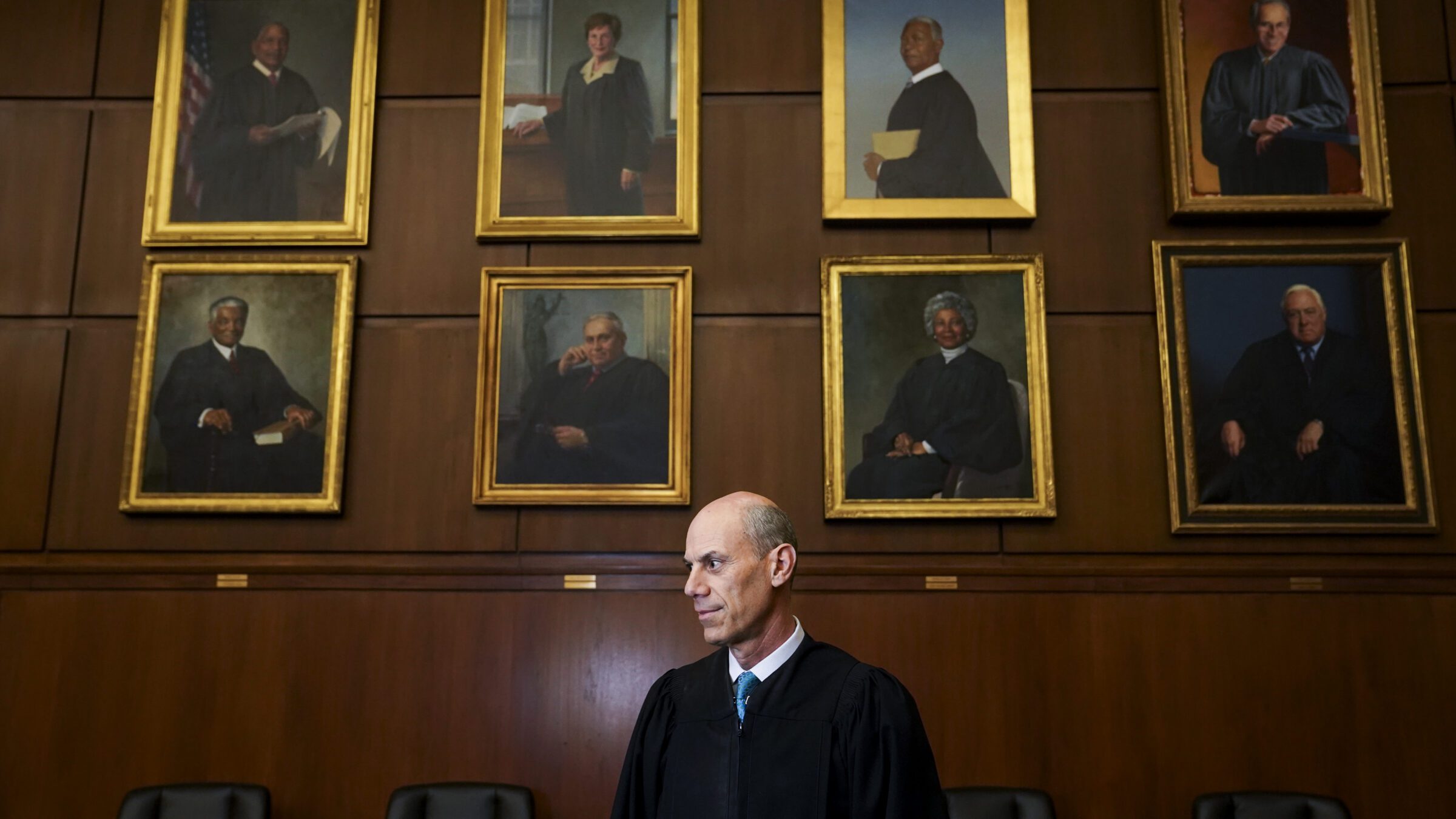
Boasberg in the federal courthouse in Washington, D.C., March 2023 (Photo by Carolyn Van Houten/The Washington Post via Getty Images)
Judges can also make compliance personal by requiring sworn testimony from agency principals, such as the Secretary of Homeland Security, the acting director of ICE, or ICE field office directors, that the agency is complying with court orders. If subsequent evidence contradicts that testimony, individual officials could face criminal perjury charges.
However, thus far, federal courts have tended to request status reports—formal documents from government counsel that allow judges to monitor compliance—rather than sworn declarations, leaving room for those government lawyers to feign ignorance or miscommunications with officials. A signed declaration or testimony under oath by an agency head changes incentives in ways that a lawyer’s status update does not.
Another underused lever over the past year has been litigation sanctions. Courts have the authority to sanction attorneys for bad-faith representations or factual misstatements. If DOJ lawyers repeatedly assert that ICE is complying with detention-related injunctions and the record later shows otherwise, judges can impose financial penalties on these lawyers. Even relatively small fines would impose both financial and reputational harm on lawyers and signal that courts will not tolerate strategic ambiguity.
Courts also control evidentiary assumptions—the rules that judges and juries follow when they decide which side of a dispute has proven their case. Federal courts generally extend to the executive branch a “presumption of regularity,” meaning that litigants opposing the government need to show “clear evidence to the contrary” to overcome the assumption that government officials have acted in good faith.
But if a court develops a record suggesting a pattern of evasive conduct—which many courts have over the last year—it can withdraw that presumption. This allows judges to weigh evidence from both parties equally, and evaluate the case with a skeptical view of officials’ statements. Judges can also draw adverse factual inferences when the government withholds information or provides incomplete disclosures—in other words, judges can assume that the government is intentionally hiding or misrepresenting evidence that would hurt its case.
Such inferences could have a tremendous impact. For example, in detention cases, judges could use an inference against the government to allow groups of detainees to join together rather than requiring them to argue their habeas cases individually; to mandate disclosure of internal enforcement guidance to assist detainees challenging government policies; or to directly prohibit specific detention practices. If ICE resists transparency about compliance, a judge could reasonably infer that ICE is not complying, and craft remedies accordingly.

Then-Border Patrol Commander-at-Large Gregory Bovino speaks at a press conference in Minneapolis, January 2026 (Photo by Brandon Bell/Getty Images)
Going even further, judges can also deploy structural injunctions and court-appointed monitors. When courts find persistent constitutional violations in carceral settings (including immigration detention facilities), they sometimes appoint special masters—court-appointed experts authorized to oversee compliance. Judges can use injunctions to intervene in detention policies to make them comply with constitutional standards, monitored and enforced by the special master. If a judge concludes that ICE cannot be trusted to follow the law without supervision, ongoing judicial oversight is a legally available remedy.
Any of these measures would trigger immediate appeals from the administration, which would characterize them as overreach from “woke judges” with “Trump Derangement Syndrome.” But judges have given the administration plenty of leeway to avoid these consequences if it had any intention of complying with the law. This is the path Trump has chosen.
Under normal circumstances, judicial caution is understandable as a strategic choice, even if it sometimes limits a court’s ability to enforce the law. Conventional wisdom has long held that courts should avoid precipitating showdowns with the executive. The judiciary’s authority depends on compliance and legitimacy, since the judiciary has no enforcement powers akin to the executive’s police powers or the legislature’s power of the purse. An overly aggressive enforcement posture carries the risk of emboldening further disregard for judicial decisions by both the government and other parties.

But restraint carries risk as well. If ICE can treat adverse rulings as obstacles to evade rather than commands to obey, judicial review becomes meaningless. Over time, the courts will lose credibility, even while the administration continues to violate the rights of detained individuals. Judicial restraint in the face of deliberate defiance makes the courts appear powerless and surrenders the field to its brazen lawlessness, which is exactly what Trump and his cronies are counting on.
Aggressive judicial action could have the added benefit of putting pressure on Congress to step in and exercise its own oversight powers. Congress, after all, funds ICE. Congress defines the scope of ICE’s detention authority. Congress has the power to hold hearings, issue subpoenas, condition appropriations, and initiate impeachment proceedings. Yet as the administration’s flagrant violations of court orders have piled up, congressional leadership has largely opted for culture-war theatrics (from Republicans) and statements of concern (from Democrats). That abdication increases the pressure on courts—and makes judicial hesitation more consequential.
If courts were to impose escalating sanctions such as fines, contempt findings, and structural oversight, and the executive branch were to resist, the conflict would not remain confined to courtrooms. It would make it even clearer to the public how lawless the administration has become. It could finally force Congress to confront whether it will tolerate executive nullification of judicial orders. Judicial escalation would attack the problem directly while also catalyzing legislative engagement and public outrage in ways that quiet frustration does not.
Judges often describe the courts as the last line of defense for constitutional democracy. But a last line of defense that declines to defend is not neutral. It is complicit.