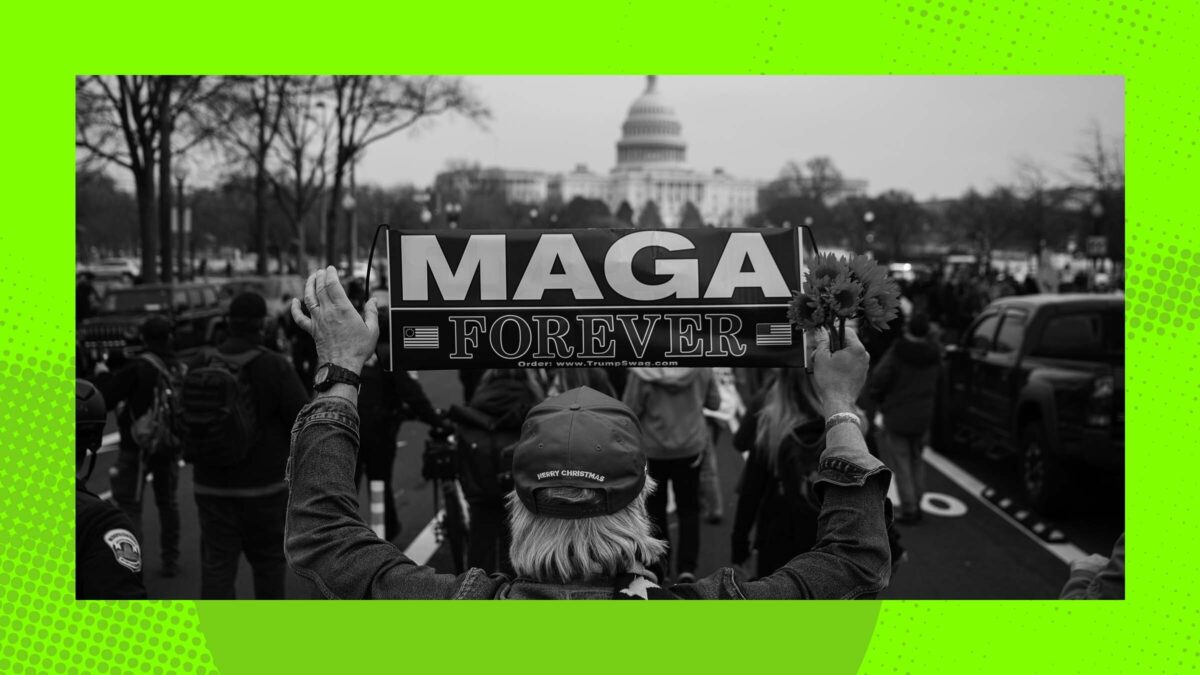
On January 6, 2021, President Donald Trump told a throng of furious supporters gathered at the Ellipse that the 2020 election was “rigged” and “stolen,” and that unless they were willing to “fight like hell” to return him to the White House, they would soon not “have a country anymore.” Several thousand of them took this warning to heart, marching down Pennsylvania Avenue to storm the Capitol in a last-ditch attempt to prevent lawmakers from certifying the results, by any means necessary.
At the time, many politicians—even many who had supported Trump to that point—decided that continuing to defend a man who incited a violent attempt to overthrow the government and murder his own vice president was a proverbial bridge too far. “There’s no question—none—that President Trump is practically and morally responsible for provoking the events of the day,” said Senate Minority Leader Mitch McConnell in February, calling the attack “a disgraceful, disgraceful dereliction of duty” on Trump’s part.
“Count me out,” said a visibly shaken South Carolina Republican Senator Lindsey Graham, in a floor speech just a few hours after police cleared the building of the last of the rioters. “Enough is enough.”
Five years later, the party line on January 6 is very different, and the first 12 months of Trump’s second term in the White House have revealed just how integral election denialism has become to the modern conservative movement. Shortly after taking office, Trump fired dozens of federal prosecutors who handled January 6 cases, and he issued a blanket pardon to the convicted rioters, whom he described as victims of a “grave national injustice perpetrated upon the American people.” Today, if you are an ambitious Republican who aspires to a career in politics, you can condemn the insurrection and acknowledge the reality that Joe Biden won the 2020 election, or you can be relevant in the Republican Party, but you cannot be both.
This is not only true for elected officials. Since last January, the Senate has confirmed 26 Trump judicial nominees to the bench. Yet during their confirmation processes, none of them were willing to tell the Senate Judiciary Committee that Trump lost the 2020 election. Instead, most nominees resorted to awkward legalese, conceding only that Congress “certified” the results for Biden, who then “served” as the 46th president. As I wrote last year, this is a bit of lawyerly sleight-of-hand that is both technically correct, and also fully consistent with the reactionary shibboleth that Trump was the rightful winner of the 2020 election, and that a nefarious coalition of Biden, Antifa, Dominion Voting Systems, Hillary Clinton, George Soros, and millions of United States Postal Service employees conspired to steal it from him.
Trump’s nominees have had an even more challenging time discussing the Capitol insurrection. In June, for example, Rhode Island Democratic Senator Sheldon Whitehouse asked a slate of Trump nominees whether a “violent mob” had attacked the Capitol on January 6. This is a simple yes-or-no question to which anyone with internet access knows the answer. Yet the nominees, aware that Trump would treat a truthful answer as an unforgivable act of betrayal, demurred: It would be “inappropriate,” explained Missouri district court nominee Cristian Stevens, for him to weigh in on such a “highly contested political issue.”
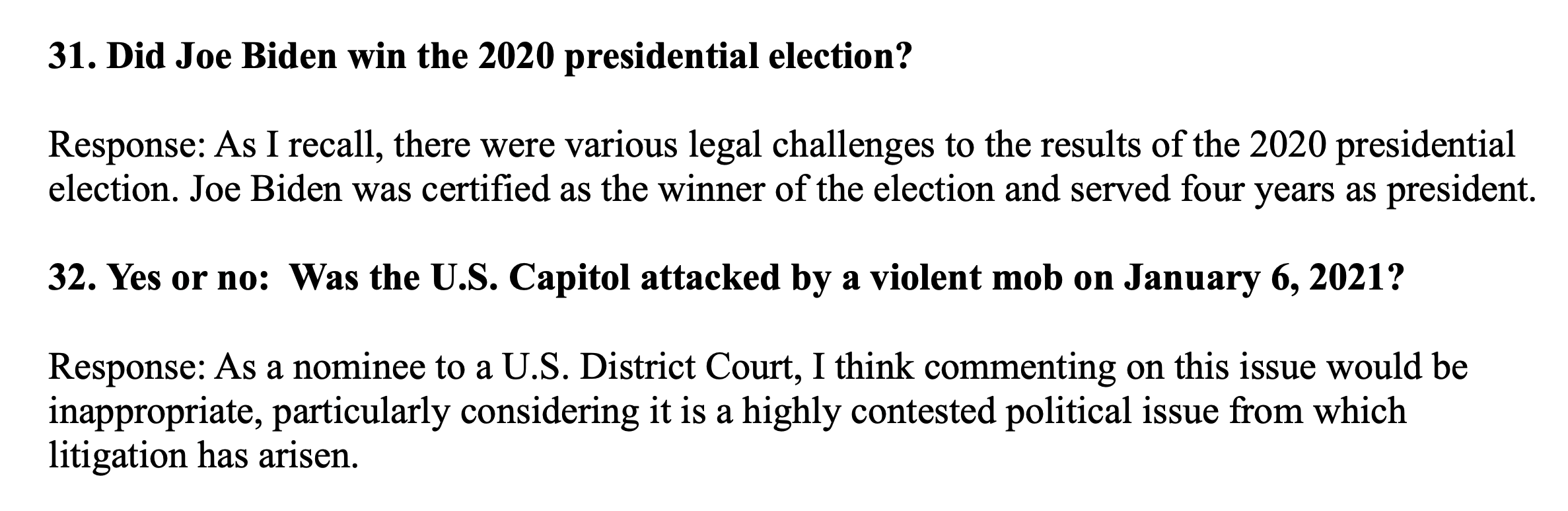
In the months before and since, other Trump nominees have answered similar questions by carefully referring to the 2020 results as the subject of an ongoing “political or policy debate.” Still others have refused to discuss the election or January 6 by citing the ethical obligations of nominees not to offer “political commentary” or draw “legal conclusions.” Of course, by declining to answer these questions directly, they made clear exactly what their answers would be.
Perhaps the most revealing demonstration of the fealty that Trump requires of his judges came from another Missouri district court nominee, Maria Lanahan, who responded to Whitehouse’s question about whether January 6 involved a “violent mob” by telling the Senate Judiciary Committee that because she was “not present at the U.S. Capitol at the time,” she lacked “personal knowledge” of the details. This is roughly analogous to expressing doubt about whether dinosaurs once roamed the planet because you, personally, never saw one yourself.
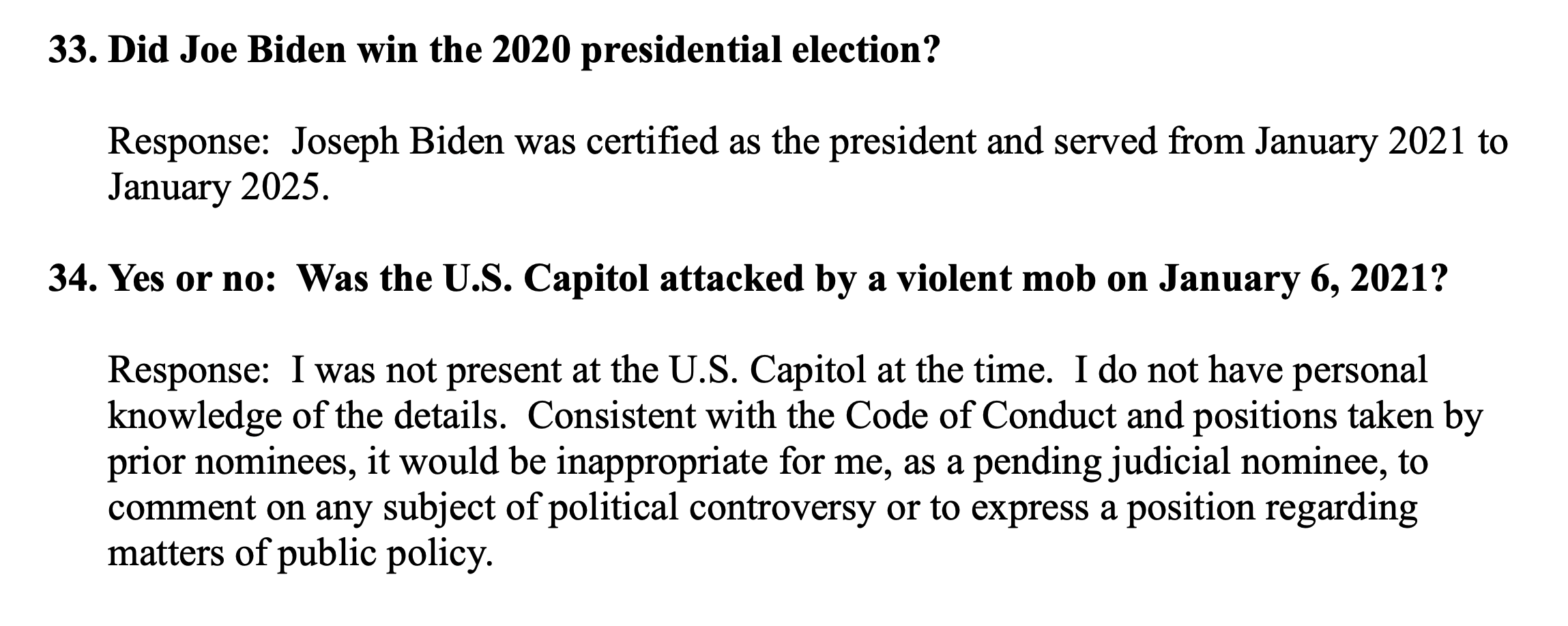
I obviously cannot know for sure whether these nominees are Trump dead-enders who sincerely believe the 2020 election was stolen, or if they are cowards debasing themselves for a fancy job, saying what they need to say to prevent an irate Trump from pulling their nominations in randomly capitalized Truth Social posts. But the answer is sort of beside the point: In a functioning democracy, no one willing to play footsie with such demented conspiracy theories would be anywhere near a life-tenured seat on the federal bench. Fortunately for them, this is the United States; all of these sycophants have since been confirmed by the Republican-controlled Senate, and are free to spend the rest of their legal careers repaying Trump for his benevolence.
During his second term, Trump has been using the powers of his office to erase any evidence of his previous efforts to overthrow the government he ostensibly led. On Tuesday, the five-year anniversary of the January 6 attacks, the White House debuted a website that recasts the prosecutions as among the “darkest wrongs in modern American history,” and the rioters themselves as “patriotic citizens who had been viciously overcharged, denied due process, and held as political hostages.” As Quinta Jurecic points out at The Atlantic, the most robust remaining collection of objective facts about January 6 is probably now on PACER, preserved over thousands of pages of filings in prosecutions that Trump’s pardons formally wiped away. Those records, wrote D.C. District Court Judge Colleen Kollar-Kotelly in an opinion last year, “are immutable and represent the truth, no matter how the events of January 6 are described by those charged or their allies.”
Kollar-Kotelly is right about this. But over the next three years, Trump will continue to replace judges who are willing to acknowledge what actually happened on January 6 with judges who owe their confirmations to their willingness to parrot craven lies about it. He has already purged the Department of Justice, the Republican Party, and the conservative movement of everyone who is not a loyalist. The federal bench is just the next institution on the list.