
On Tuesday, the Senate Judiciary Committee held its first in a series of eight “Arctic Frost Accountability” subcommittee hearings, which are ostensibly intended to provide oversight of Special Counsel Jack Smith’s investigation into President Donald Trump’s efforts to overturn the 2020 election. The real purpose, though, is to provide Republican senators with more camera time to relitigate the results of that election and the January 6 insurrection that followed.
In his opening remarks, Illinois Democratic Senator Dick Durbin, the ranking member of the Judiciary Committee, confronted his Republican colleagues over “their undying fealty to the president’s abnormal behavior” and “his attempt to whitewash history.” But he also called out another group of people who have been doing the same of late: Trump’s judicial nominees.
“Have you seen the contortions that these nominees have gone through when they’re asked the basic question, ‘Who won the election in 2020?’” Durbin asked. “They won’t answer. They go through these painful contortions. They can’t answer it because it’s an article of faith: If you’re loyal to Trump, you never accept the premise that he lost an election.”
Durbin is referring to the fact that, to date, all 37 of Trump’s second-term judicial nominees have refused to answer simple questions related to the 2020 election and the insurrection. Instead, nominees typically state only that President Joe Biden “was certified” as the victor, and they claim that as nominees, it would be “inappropriate” for them to say that the Capitol was attacked on January 6 (which they describe as a “political controversy”).
One explanation for this behavior is that nominees understand that if they don’t go along with the president’s conspiracy theories, their nominations would be immediately pulled. The other explanation is that they believe in these conspiracy theories, too.

Durbin has raised this pattern a number of times during Judiciary Committee meetings. In June, for example, he said he could not support the confirmation of Cristian Stevens, whom Trump nominated to a district court judgeship in Missouri, in light of Stevens’s inability to “acknowledge these basic facts and denounce the violence perpetrated against law enforcement on this day.”
Just last week, though, Durbin voted to confirm two of Trump’s nominees, David Clay Fowlkes and Aaron Peterson, to serve as life-tenured federal judges. And he’s not the only one: During Trump’s second term, 19 Democrats have voted to confirm at least one of Trump’s nominees. New Hampshire Senators Maggie Hassan and Jeanne Shaheen have voted to confirm six and seven nominees, respectively, and Rhode Island senator Sheldon Whitehouse, who sits on the Judiciary Committee, has voted for five. Among Senate Democrats, Durbin and Virginia Senator Tim Kaine are tied for the lead in this ignominious category with eight yes votes apiece.
In July, Maine Independent Senator Angus King, who is also near the top of that list, became the first member of the Democratic caucus to support a Trump nominee when he voted for Josh Divine, a Missouri district court nominee who had both incredibly limited legal experience and also a lengthy and alarming record on reproductive rights and LGBTQ+ equality.
Days later, King confessed that his vote for one of Trump’s most extreme nominees was an oopsie, saying that he “took Josh Hawley’s advice” without doing his homework first. “In retrospect, I think it was a mistake, from what I’ve learned about Mr. Divine since,” King said. “But sometimes, you rely on your colleagues.”
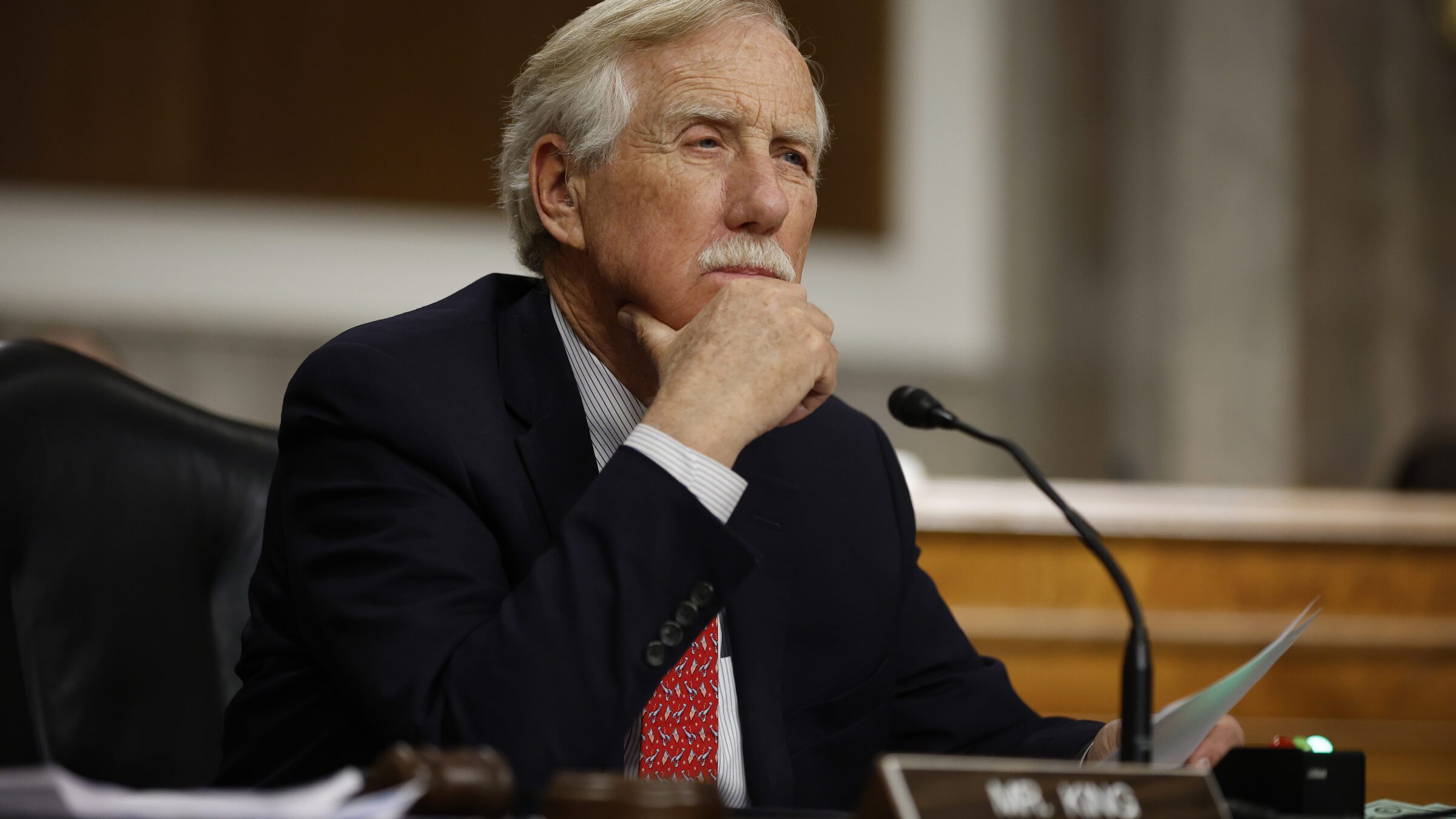
Sen. Angus King (Photo by Chip Somodevilla/Getty Images)
Since then, members of the Senate Democratic Caucus have very much been relying on their colleagues—particularly those who serve on the Senate Judiciary Committee—for guidance on how to vote. In their last 31 judicial confirmation votes in the full Senate—that is, all of the confirmation votes since Divine—Democrats who are not on the Judiciary Committee have only been willing to vote for a nominee on the Senate floor when at least some of their Judiciary Committee peers signaled their support by voting yes in committee.
This has happened eight times: Harold Mooty, for example, who was confirmed in October to the Northern District of Alabama, received six yes votes in committee, leading eight additional Democrats—for a total of 14—to support his final confirmation. Five committee Democrats voted in December to advance the nomination of Susan Courtwright Rodriguez to serve on the Western District of North Carolina, prompting 11 total Democrats in the full Senate to support her.
The influence of Judiciary Committee members makes sense: Those senators are the ones who research the records of nominees most thoroughly; who can show up and interrogate nominees under oath during confirmation hearings; and who have the power to submit written questions for the record about issues they were unable to address during the hearing.
But even when nominees offer “insulting” responses to questions about the 2020 election and January 6, as Connecticut Senator Richard Blumenthal put it last week, some Democrats on the Judiciary Committee are still indicating—with their committee votes—that they believe it’s acceptable for their caucus to support certain nominees. Even when the nominees won’t say if they agree with Trump that federal judges are “monsters” for ruling against the administration. Even when the nominees dodge questions about whether they agree with an influential conservative activist that Democrats are “relentless” and “evil.” And even when the nominees avoid directly answering the question of whether Trump, who is limited by the Twenty-Second Amendment to serving two terms as president, can run for a third White House term in 2028.
Among Democrats on the Judiciary Committee, only Blumenthal, New Jersey Senator Cory Booker, and California Senator Alex Padilla have opposed every judicial nominee in committee. Every other member of the committee has decided at least once that they are willing to lend bipartisan credibility to Trump’s judicial appointments—creating the perception that his extreme nominees might not actually be reactionary, election-denial sympathizers who are willing to say whatever it takes to get Trump to entrust them with a lifetime judgeship.
The next test for Democratic committee members will come sometime after the Senate’s Presidents Day recess, when four more Trump nominees are scheduled to receive their committee votes. How Democrats choose to vote in that moment will set the tone for the rest of their colleagues, and articulate what kinds of nominees they believe are worthy of promotions to lifetime judgeships. Their votes in committee matter. They should cast those votes accordingly.