At this point, readers of this website are well aware that the Supreme Court has, traditionally speaking, not been a friendly venue for people who are not wealthy. In December, the Journal of Law and Courts published a paper that further demonstrates the depths of the legal system’s failure to fulfill the famous promise in the judicial oath of office: to “do equal right to the poor and to the rich.”
As a general matter, people appealing their cases to the Supreme Court must pay hundreds of dollars in filing fees. But the Court waives those fees for petitions filed in forma pauperis—that is, petitions filed by people who could not otherwise afford to do so. According to Princeton University’s Jonathan Kastellec and the University of Texas’s Anthony Taboni, the number of low-income litigants filing these appeals has plummeted in recent years. In 2006, for example, there were 6,850 in forma pauperis petitions. In 2016, there were fewer than 4,500. In 2024, there were only 2,400.
Kastellec and Taboni acknowledge that the number of paid petitions has dropped over the past 20 years, too, but found that the drop in in forma pauperis petitions was “much starker.” And since 1993, the rate at which the Court grants paid petitions has increased slightly, from around 6 percent in 2016 to 8 percent in 2024. But the grant rate of in forma pauperis petitions has remained relatively stable, at 1.6 percent.
Together, the numbers show that today’s Court is getting dramatically fewer appeals from low-income people than it was even just a few years ago. Kastellec and Taboni conclude that the decline in in forma pauperis petitions is “primarily driving” the decrease in the size of the Court’s docket.
Since indigent criminal defendants are the most common recipients of fee waivers, experts have suggested that the trend might be related to the rise of plea agreements, which often require defendants to waive their rights to appeal. Others have hypothesized that public defender offices might be (understandably) reluctant to bring cases before a six-justice conservative supermajority that can be as hostile to criminal defendants as it is to poor people.
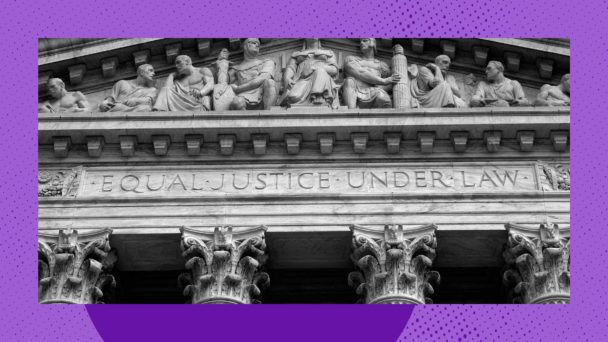
Kastellec and Taboni’s research, which examines long-term trends related to the Court’s usage of its shadow docket, hints at a few other ways in which the justices are not living up to the promises chiseled on the side of the building. As rare as grants of certiorari (whether paid or in forma pauperis) are, grants of writs of habeas corpus are even rarer: In only six of the previous 32 years, they write, has the Court granted even one habeas petition. They observed a spike in the Court’s willingness to grant requests for stays of lower court rulings during the first two years of the Biden administration, when the six conservative justices were frequently using their power to block policy decisions with which they did not personally agree.
There is also evidence that the Court’s lurch to the right over the past decade—especially since the confirmation of Justice Amy Coney Barrett in 2020—has changed how presidents view the Court as a potentially friendly venue for their policy agendas. In the first nine months after President Donald Trump took office in 2025, Kastellec and Taboni found that the administration filed 22 emergency applications for relief with the Court—an all-time high. The previous high was 2020, which was, of course, the final year of Trump’s first term in office.
The last several generations of high schoolers and law students alike have been taught the same basic lesson about the Supreme Court: that the justices serve as principled defenders of legal rights that the other two branches, left to their own devices, might be tempted to infringe at their convenience. This has never really been right, but Kastellec and Taboni’s research helps show just how wrong it is. The Court sees its job as protecting the interests of billionaires, corporations, and Republican politicians who want to gerrymander themselves in power in perpetuity. Everyone else just gets whatever is left.