The Supreme Court heard oral argument on Wednesday in Trump v. Cook, a case about President Donald Trump’s attempt to fire Dr. Lisa Cook from the Federal Reserve Board of Governors. The Federal Reserve System is the central bank of the United States, which Congress created in 1913 after a string of financial crises in the late 19th and early 20th centuries. Among the Fed’s highest-profile responsibilities is setting the interest rate for federal funds, which affects the market rates that financial institutions offer everyone else.
A foundational principle of the Federal Reserve Board, which governs the Fed, is that it should make decisions based on what’s best for the economy over time, not what’s best for the president in power at any given moment. To preserve the Fed’s independence, when Congress passed the Federal Reserve Act more than a century ago, it provided that members of the Board would serve 14-year terms, and that presidents can remove them from office only “for cause.”
In 2022, President Joe Biden appointed Cook to fill the balance of an unexpired term on the Board, making her the first Black woman ever to sit on it. In 2023, Biden again nominated Cook to the Board, this time for a full 14-year term that ends in January 2038. Yet in August 2025, Trump told her she was fired, alleging that she’d committed “mortgage fraud.” A Reuters review of loan documents suggests that Cook at most had made a trivial mistake while filling out paperwork, but that didn’t stop Trump from posting the criminal referral on social media, and citing it in a letter to Cook as grounds for her dismissal. Before that, no president had ever removed a sitting member of the Board in its 112-year history.
Cook sued, and in September, a federal district court judge in Washington, D.C. issued an order allowing her to temporarily remain on the Board while the lawsuit challenging her purported removal is pending. The Trump administration then asked the U.S. Court of Appeals for the D.C. Circuit to lift the order, which would allow Trump to fire Cook now and litigate about it later. When the D.C. Circuit denied the request, the administration filed an emergency petition asking the Supreme Court to intervene.
These facts may feel familiar, and for good reason: For basically a year straight, Trump has been removing the heads of independent agencies in violation of explicit statutory prohibitions, and then asking the Supreme Court for immediate relief when lower court judges say he can’t do that. It would be easy to confuse Trump v. Cook with, for example, Trump v. Wilcox, the case about Trump illegally firing a member of the National Labor Relations Board and a member of the Merit Systems Protection Board. Or Trump v. Boyle, the case about Trump illegally firing members of the Consumer Product Safety Commission. Or Trump v. Slaughter, the case about Trump illegally firing a member of the Federal Trade Commission.
Usually, the Supreme Court has been happy to grant the president’s requests. In Wilcox, Boyle, and Slaughter, the Court lifted the orders that had restrained Trump, allowing him to effectively take control of the agencies and either redirect their work or halt it altogether. The CPSC, for instance, is down to just one acting board member, appointed by Trump himself.
But Trump v. Cook is a little different. Since taking office, Trump has tried to seize control of the Federal Reserve, repeatedly threatening Board members, including Chair Jerome Powell, with termination, which one study estimates would wipe out $1.5 trillion from the stock market. For good measure, Trump has also threatened Powell, who Trump believes is not lowering interest rates quickly enough, with criminal prosecution; Powell responded by accusing Trump of trying to retaliate against the Fed for “setting interest rates based on our best assessment of what will serve the public, rather than following the preferences of the president.”
Against that backdrop, the Court has been less than eager to facilitate Cook’s firing as it had so many times before. Instead of jumping to grant Trump’s request in September, the Court basically left the administration on read for months, opting to schedule oral argument for January 2026. And at that oral argument today, most of the justices showed little appetite for allowing Trump to proceed with immediately removing Cook from office.
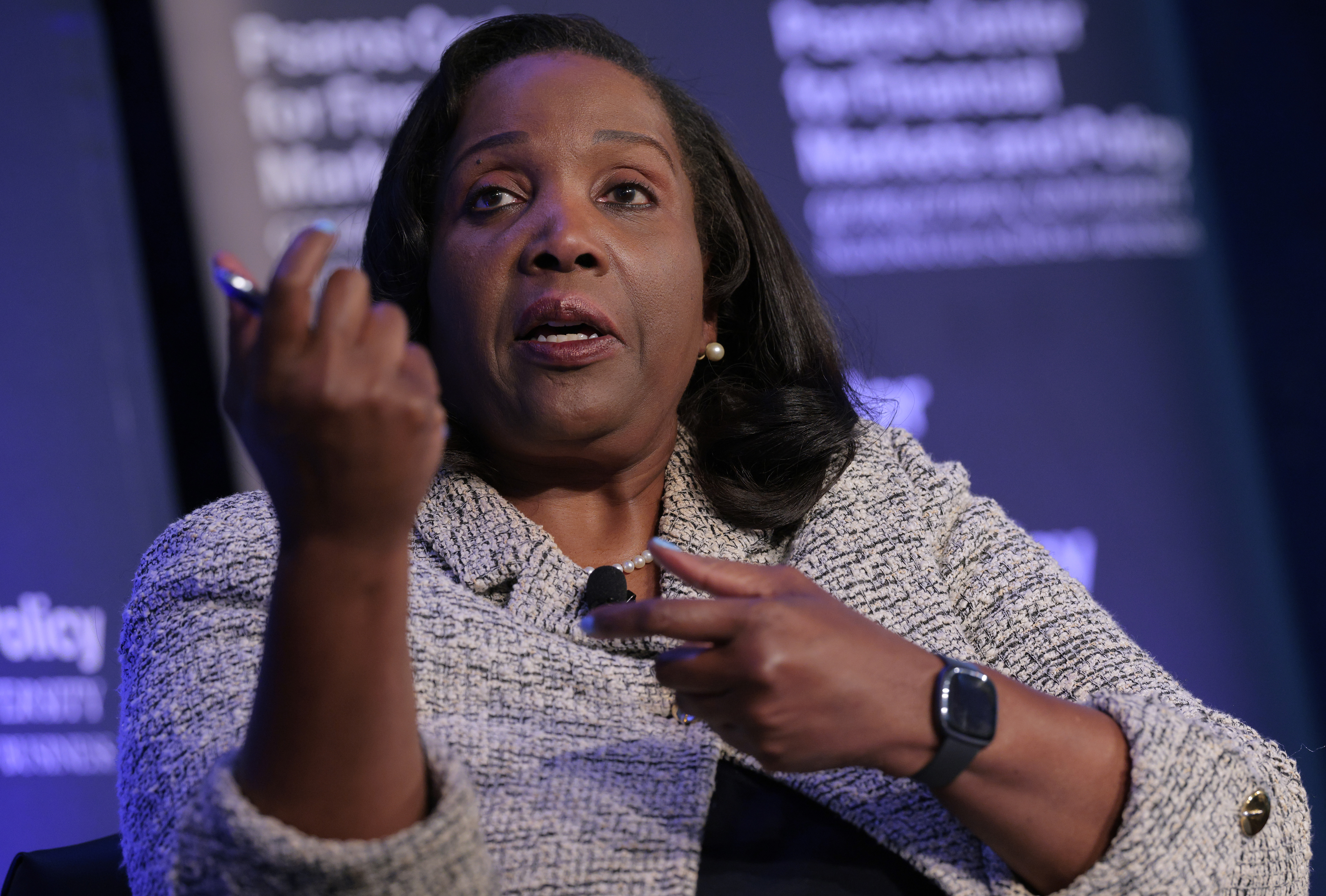
Cook delivers remarks at the Georgetown University McDonough School of Business, November 2025 (Photo by Chip Somodevilla/Getty Images)
The justices’ reasons varied greatly. Justice Samuel Alito, for example, criticized the “hurried manner” of the case, suggesting that it should work through the courts the normal way. Chief Justice John Roberts repeatedly characterized Trump’s proffered reason for firing Cook—the alleged mortgage fraud—as an “inadvertent mistake” on Cook’s part, suggesting that Roberts is ready now to say that this didn’t rise to the level of “cause” required by law. Still, these are alternate routes to the same destination: denying Trump’s request.
Some of the differences between how the justices appear to be leaning in Trump v. Cook and how they’ve dealt with the other removal cases can be explained as a legal matter. In those cases, Trump argued that he doesn’t need a reason to fire the agency heads, and that the for-cause removal requirements are unconstitutional. Here, in contrast, he claims he has a reason to fire Cook, and so he fulfilled the for-cause removal requirement.
The biggest distinction, however, is a practical matter. The firings at issue in the other removal cases compromised the work of agencies charged with protecting the rights of workers and consumers. The firing at issue in Trump v. Cook compromises the work of an agency charged with protecting the economy. And as conservative as this Court may be, its justices are less comfortable with giving Trump what he wants when his wants put their wallets at risk.
The financial motives behind ruling against Trump were not subtle. Justice Amy Coney Barrett’s first question to Solicitor General D. John Sauer focused on amicus briefs filed by former Treasury Secretaries and members of the Federal Reserve Board, which recounted how President Richard Nixon pressured the Fed to lower interest rates in the run-up to his reelection campaign. The result of the political accommodation, the briefs explain, was an inflationary boom-and-bust cycle and a years-long recession. Barrett asked Sauer how the Court should think about the public interest in this case when economists similarly warn that granting the administration’s request “could trigger a recession”; the existence of such a risk, she argued, should counsel “caution” for the Court—at least at this stage of the case.
The posture of the case matters because a major factor courts are supposed to consider when deciding whether to grant or lift a temporary order—like the one keeping Cook on the job—is the risk of harm that can’t be undone. Barrett, along with Justices Sonia Sotomayor and Ketanji Brown Jackson, expressed deep skepticism at the idea that Trump experienced any such harm. At one point, Sotomayor pointed out that keeping Cook in office would not “thwart any right he has to run the [Fed], because he has none.” When Sauer said that Cook’s continued service would inflict a “grievous irreparable injury to the public perception of the Federal Reserve,” Jackson replied, “You have evidence related to the public perception, or is this just the president’s view?”
Sauer also tried to win over the Court by appealing to the unitary executive theory—the idea, typically championed by conservative justices, that the president must have vast discretion to remove executive branch officials. But at oral argument, Justice Brett Kavanaugh defended the Fed instead, criticizing the administration for promoting a view of for-cause removal that entailed “no judicial review, no process required, no remedy available, a very low bar for cause that the president alone determines.” Siding with Trump, Kavanaugh warned, “would weaken, if not shatter, the independence of the Federal Reserve.”
It is true that getting rid of removal protections would threaten the Fed’s independence. But that was true of every other agency Trump has attacked, too—the Court just didn’t care about those. For the justices, messing with people is one thing, but messing with money is another.