Late Monday evening, the three highest-ranking attorneys at the Department of Justice filed a bizarre motion in National Trust for Historic Preservation v. National Park Service, the case concerning President Donald Trump’s attempt to build a ballroom on the site of the demolished East Wing of the White House.
In a cadence recognizable to anyone who has ever come across Trump’s social media posts, the motion claims that “if any other President had the ability, foresight, or talents necessary, to build this ballroom, which will be one of the greatest, safest, and most secure structures of its kind anywhere in the World, there would never have been a lawsuit.” According to Justice Department leadership, this “frivolous and meritless lawsuit” was only filed out of animosity towards “DONALD J. TRUMP, a highly successful real estate developer, who has abilities that others don’t, especially those who assume the Office of President.”
The lawyers responsible for this filing are Acting Attorney General Todd Blanche, Principal Associate Deputy Attorney General R. Trent McCotter, and Associate Attorney General Stanley Woodward, Jr. While those three signed the document, it reads more like they just took dictation from their boss, and peppered in a few token Bluebooked citations for the sake of appearances.
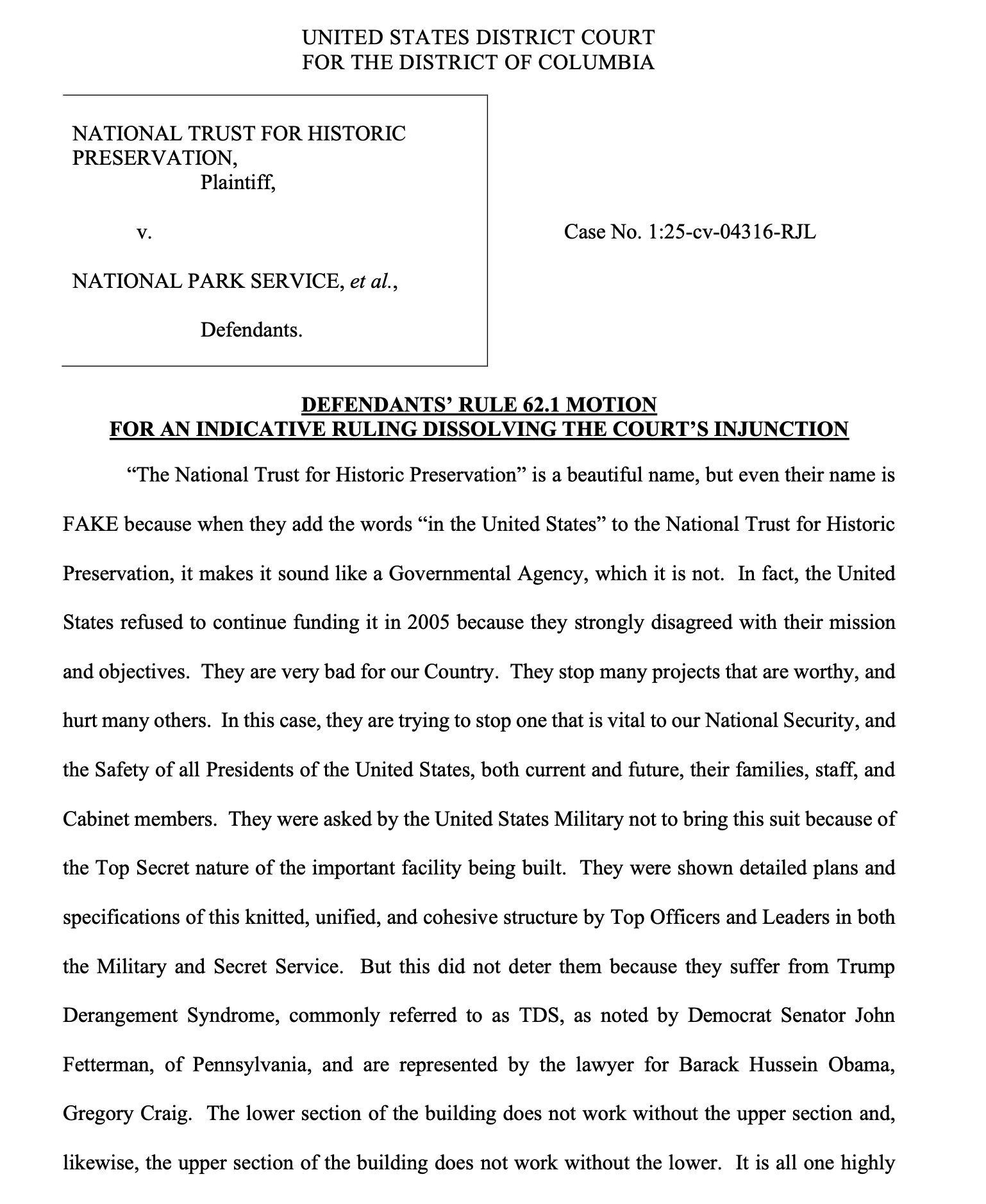
The motion goes on a scenic tour of Trumpian petulance—including repeatedly accusing the National Trust of suffering from “Trump Derangement Syndrome” and, for some reason, referring to the 44th President of the United States by his full name, “Barack Hussein Obama”—before finally making its similarly outlandish request. On April 16, 2026, U.S. District Judge Richard Leon issued a preliminary injunction ordering Trump (for the second time) to refrain from “taking any action” in furtherance of above-ground ballroom construction, while still allowing construction authorized by Congress and “strictly necessary to ensure the safety, security, and structural integrity of the White House.” The DOJ’s Monday night filing asks Leon for a ruling indicating that, in light of the shooting at the White House Correspondents’ Dinner on Saturday, he would dissolve that injunction “immediately.”
One challenge here is that Leon does not have the power to actually dissolve his injunction, since Trump’s appeal of that injunction is pending at the D.C. Circuit. However, under Rule 62.1 of the Federal Rules of Civil Procedure, if changed circumstances warrant the dissolution of an injunction on appeal, a court may issue an “indicative ruling” that says it would grant the motion, if the court of appeals were to remand the case back to it for that purpose.
Here, the allegedly changed circumstance is the shooting at last week’s White House Correspondents’ Dinner. Leon had previously concluded that no “national security justification” warranted the “immediate” construction of a ballroom. But for Trump’s DOJ, the attack is “proof” that the injunction is “intolerable,” “unsustainable,” and “must be dissolved.”
The document is, to use a technical term, totally fucking bonkers. It adopts all of Trump’s characteristic incoherence and random capitalization, and exhibits both his extreme vanity and his tenuous grip on reality. The motion says the ballroom project is a present from Trump “and other Donors,” and “FREE OF CHARGE AS A GIFT TO THE COUNTRY!” Hours before it was filed, Senate Republicans announced a plan to fund Trump’s ballroom with $400 million of taxpayer money.

It would be easy to chalk up the filing as the work product of a Justice Department that’s been hemorrhaging qualified attorneys and replacing them with loyalist hacks. But that only scratches the surface of a deeper rot. Fully understanding DOJ’s latest filing requires acknowledging the conservative legal movement’s longtime solicitousness for an expansive view of executive power teetering on authoritarianism. For decades, they’ve argued that presidents must have total control to direct the work of executive agencies. Congrats, now, legal motions filed by the government sound like Trump wrote them on the toilet.
In theory, the legal support for this idea comes from Article II of the Constitution, which vests the president with executive power. Justice Antonin Scalia once argued in a one-man dissent that this “does not mean some of the executive power, but all of the executive power.” This notion has provided the intellectual scaffolding for increasing presidents’ unchecked authority over agencies that traditionally had some measure of independence, including the Department of Justice.
Indeed, former Attorney General Pam Bondi alluded to the idea of unitary executive in her February 2025 memo to DOJ employees asserting that they work for the president, specifically, rather than the general public. “It is the job of an attorney privileged to serve in the Department of Justice to zealously defend the interests of the United States,” she said. “Those interests, and the overall policy of the United States, are set by the Nation’s Chief Executive, who is vested by the Constitution with all executive power.”
The unitary executive theory helped lay the foundation for Trump’s aggressive use of the Department of Justice as his personal law firm, which has taken on the president’s personal priorities as its own, investigating and suing anyone who displeases him—and now, even adopting his ridiculous style of speaking. When the legal system gives presidents unfettered authority over all executive branch workings, this is what the legal system gets in return.