On Monday, in a pair of decisions written by Chief Justice John Roberts, the Supreme Court effectively ruled that President Donald Trump can fire the heads of purportedly independent federal agencies at will, unless doing so would threaten the chief’s financial future.
Rebecca Slaughter and Lisa Cook are among the slew of top officials at federal agencies whom Trump has fired without cause over the past year and a half, despite numerous laws passed by Congress explicitly prohibiting groundless removals, and a century-old Supreme Court precedent upholding those for-cause removal statutes as constitutional. Slaughter and Cook both filed lawsuits in federal district courts challenging their terminations as unlawful. And both won preliminary orders that blocked Trump from removing them from office while their cases proceeded.
But Slaughter was a member of the Federal Trade Commission, the agency responsible for protecting consumers from unfair business practices. And Cook was a member of the Federal Reserve Board of Governors, the agency responsible for conducting the nation’s monetary policy and operating the central bank of the United States. While Roberts has never really cared about making sure regular people don’t get ripped off, he has long cared about making sure his investment returns keep increasing.

In September 2025, Trump filed emergency petitions asking the Supreme Court for permission to immediately remove Slaughter from the FTC and Cook from the Fed Reserve Board, even before courts ruled on whether their firings were legal. And in Slaughter’s case, the Court granted the administration’s request after only four days. With a two-sentence shadow docket order, the Court allowed Trump to go ahead and reshape the FTC as he saw fit, just like it allowed Trump to seize control of the National Labor Relations Board, the Merit Systems Protection Board, and the Consumer Product Safety Commission a few months earlier.
And today, in Trump v. Slaughter, the Court officially ruled 6-3 that FTC commissioners’ removal protections are indeed unconstitutional. The Republican majority overturned Humphrey’s Executor, a unanimous 1935 decision which declared it “plain under the Constitution” that the president does not possess “illimitable power of removal.” In Slaughter, the Court held the exact opposite: According to Roberts, the president must have the power to remove agency officials at will, or else he cannot fulfill his constitutional responsibility to “take care that the laws be faithfully executed.”
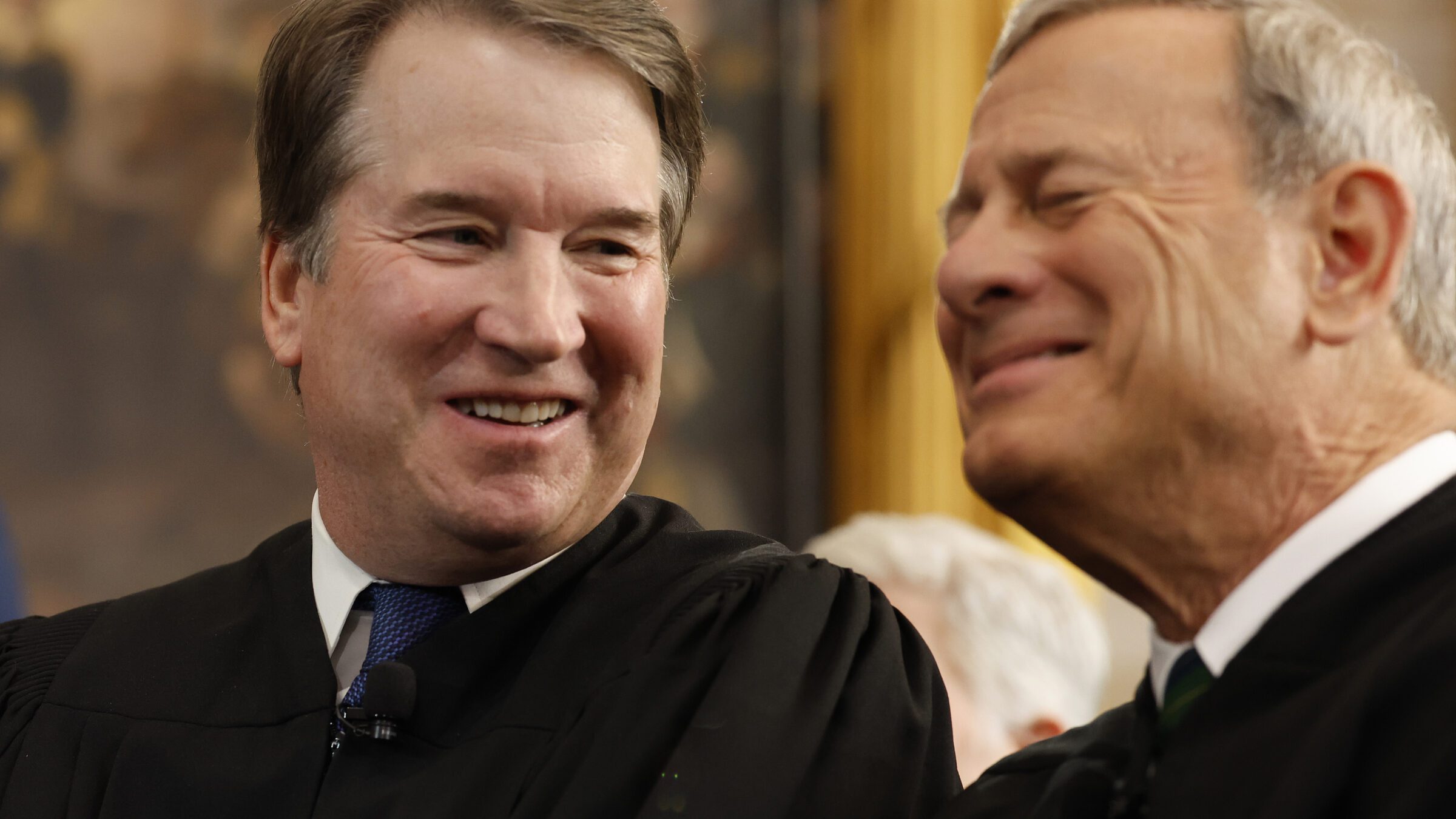
Cook’s case went quite a bit differently. Rather than immediately grant the Trump administration’s request to fire an agency head, as the Court did so many times before, the Court scheduled oral argument for January and said it would make a decision afterwards. And today, in Trump v. Cook, the Court denied Trump’s request in a 26-page opinion. This time, Roberts was joined in the majority by the liberal justices, as well as Justice Brett Kavanaugh. Roberts’ opinion firmly rejects Trump’s attempt to “transform the Federal Reserve’s for-cause protection into at-will employment,” and calls the administration’s arguments “out of step with the statute Congress enacted and our Nation’s tradition of central banking protected from political interference.”
(Photo by Chip Somodevilla/Getty Images)
Throughout Slaughter, Roberts warned that the “unity” of the executive branch would be “destroyed” if presidents could not fire agency officials at will. But in Cook, Roberts was much more worried about the destruction of the stock market. Roberts traced the development of the country’s first banking systems and asserted that the Framers knew “calamities” could arise from “even the suspicion of political manipulation of monetary policy.” The chief recounted at length how President Andrew Jackson opposed a national bank that “he could not control,” and suggested that the president’s meddling directly contributed to “an era of ruinous financial panics.”
Without an independent central bank, Roberts said, there would be “no way to contain the damage whenever a major institution fell,” “no lender of last resort,” “no elastic currency that could expand to meet demand,” and “no mechanism to ensure that small banks issued loans only within their means.” Roberts concluded that at-will removal would be “corrosive” to the Fed independence that Congress sought to safeguard. The possibility that at-will removal would be similarly corrosive to the independence that Congress sought to safeguard at dozens of other agencies seems not to have crossed his mind.

Roberts’ majority opinion in Slaughter, a diatribe against the purported dangers of agency independence, does not mention Cook. Nor does his majority opinion in Cook, an ode to the virtues of agency independence, mention Slaughter.
The dissents, however, mention both. Justice Clarence Thomas’s dissent in Cook, for example, argues that the Court “endorses a contradiction,” harping on the president’s removal power as the only way to foster democratic accountability in Slaughter but protecting the Fed’s “independence from presidential control” in Cook. Justice Amy Coney Barrett’s dissent in Cook similarly says the Court’s holding is in “serious tension” with Slaughter. In Slaughter’s case, Barrett writes, the Court announced a “categorical rule,” but in Cook’s case, the Court invented “a special exception” for the Federal Reserve.
Justice Sonia Sotomayor dissented for the liberal justices in Slaughter and highlighted all the things Cook got right: Yes, the Framers did know, for instance, that some government functions should be protected from the threat of political interference, and it is true that direct presidential control of independent agencies can destabilize the economy. But those things are just as true in Slaughter’s case as they are in Cook’s, and as they were in a whole host of other cases where the Republican justices allowed Trump to fire agency heads. Sotomayor calls it “unclear” why these principles that Roberts correctly identified “should be limited only to agencies,” like the Federal Reserve, that have a big enough impact on “monetary policy.”
Part of Roberts’s justification for the outcome in Slaughter is democratic accountability—that removal power is necessary for the president to be the one person “with whom the buck stops.” But Roberts was clear, in Cook, that he’s really just concerned about the bucks: Giving Trump unfettered control over most federal agencies could help the rich get richer, and only screw over the little people, but giving Trump control of the Fed could cause an economic crisis big enough to negatively affect Roberts and his rich friends, too.
Time and again, Roberts has been happy to ignore laws passed by Congress, and to empower Trump to mess with agencies that protect regular people against corporate abuses and broadly serve the public interest. The one thing Roberts cannot abide is Trump messing with his money.