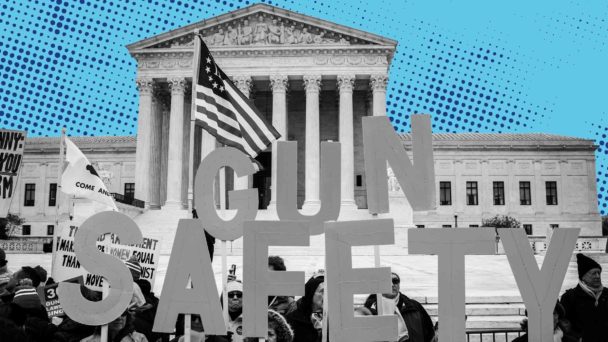
The Supreme Court’s campaign to strike down any and all gun regulations it dislikes came to Hawaii today. In Wolford v. Lopez, the Court struck down, by a 6-3 vote, a state law that barred people from carrying guns onto private property without the owner’s explicit consent.
Given that an aimless, results-driven inquiry into “history and tradition” now governs the meaning of the Second Amendment, the state of Hawaii defended its regulation in part, as Justice Samuel Alito put it in his majority opinion, by pointing to “its long history of antipathy to the private possession of firearms.” But Alito hand-waved this away, writing that “the Second Amendment has the same meaning in all parts of the United States,” and “cannot give way to ‘the spirit of Aloha’ in Hawaii any more than it can yield to the spirit of the Big Apple or the Windy City.”
The reference to the “spirit of Aloha” is a striking—and racist—jab at Hawaiian history and culture. It’s a gratuitous reference to a two-year conservative gripe with a decision from the Hawaii Supreme Court, State v. Wilson, which Alito cited in that sentence.

Wilson is a 2024 case that involved a challenge to several Hawaii laws that prohibited people from carrying weapons in public without a license. After being charged in state court with unlicensed carrying of a firearm, Christopher Wilson challenged the laws’ constitutionality, citing both the Second Amendment and Article I, Section 17 of the Hawaii Constitution, which is a near-carbon copy of the Second Amendment.
The Hawaii Supreme Court unanimously rejected both constitutional challenges. And in a detailed opinion, Justice Todd Eddins went further, excoriating the Supreme Court’s Second Amendment jurisprudence and its 2022 ruling in New York State Rifle & Pistol Association v. Bruen specifically. Bruen “unravels durable law,” and “ad-libs a ‘history-only’ standard,” he wrote. “By turning the test into history and nothing else, it dismantles workable methods to interpret firearms laws. All to advance a chosen interpretive modality.”
Eddins then engaged in a careful analysis of Hawaiian legal history and customs to conclude that the Hawaii Constitution does not protect an “individual right to keep and bear arms” in the exact same manner as the U.S. Constitution. He cited, for example, Kānāwai Māmalahoe (the “law of the splintered paddle”), a Hawaiian principle that protects non-combatants from violence. Dating back to the late eighteenth century, Kānāwai Māmalahoe provides that “every elderly person, woman and child” shall be allowed to “lie by the roadside in safety.”
The principle is codified in Article IX, Section 10, of the Hawaii Constitution, which allows the state “to provide for the safety of the people from crimes against persons and property.” Eddins proceeded through how the Kingdom of Hawaii, the U.S.-backed provisional government that had deposed it, and the territorial government under U.S. control all regulated firearms, concluding that “Hawaiʻi’s historical tradition excludes an individual right to possess weapons.”
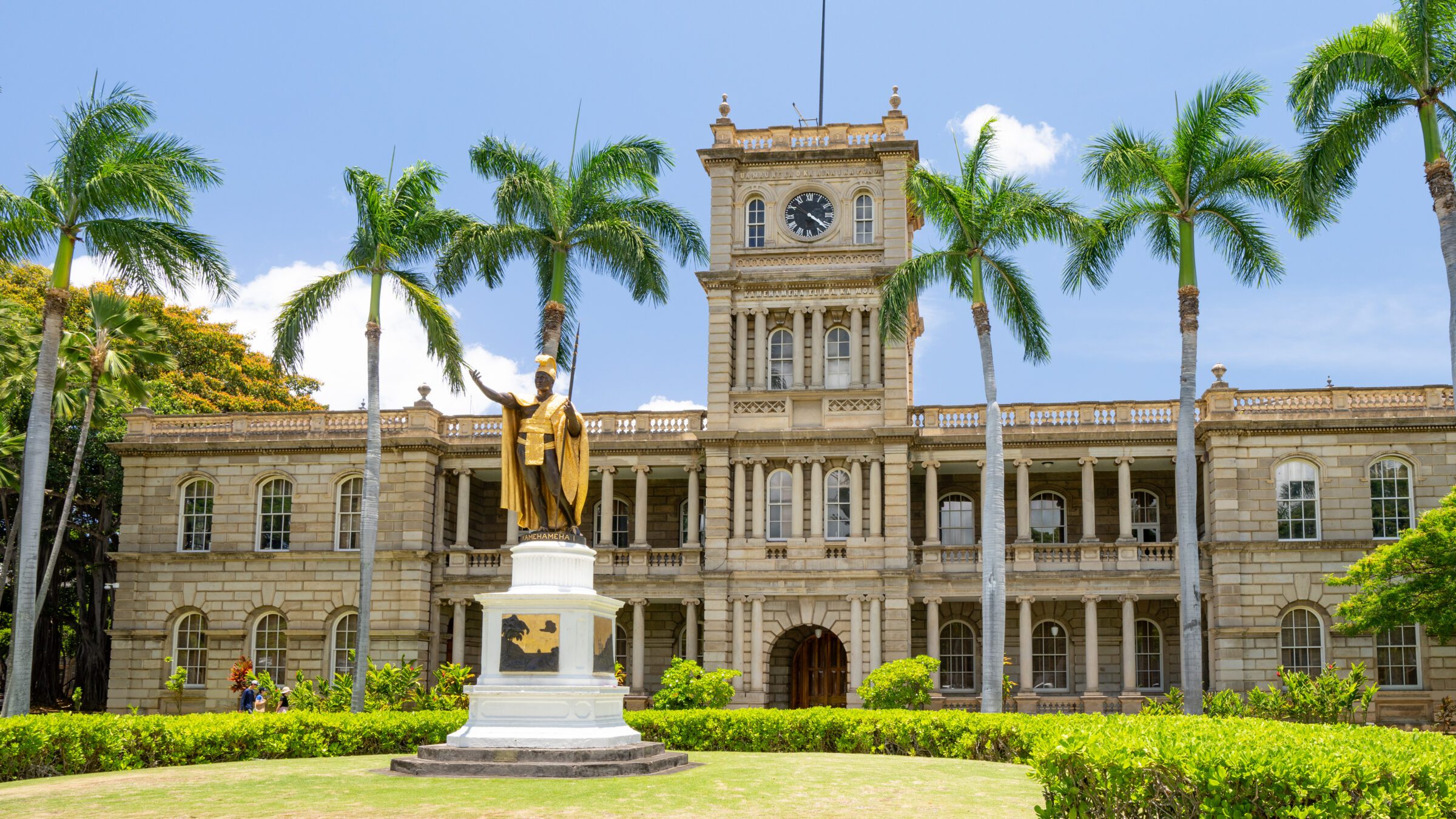
Aliʻiōlani Hale, home of the Hawaii State Supreme Court (Photo by AaronP/Bauer-Griffin/GC Images)
Eddins wrapped by discussing the “Aloha Spirit.” As state law explains, “‘Aloha’ is more than a word of greeting or farewell or a salutation,” as many people unfamiliar with Hawaiian culture might understand it. It “means mutual regard and affection and extends warmth in caring with no obligation in return.” Moreover, that same state law expressly allows courts to “contemplate and reside with the life force and give consideration to the ‘Aloha Spirit.’”
Eddins rightly noted, then, that “the Aloha Spirit inspires constitutional interpretation” in Hawaii, and “clashes with a federally-mandated lifestyle that lets citizens walk around with deadly weapons during day-to-day activities.”
It’s a powerful sentiment. And it’s a reminder that while Hawaii was violently and brutally conquered as an imperial project for the United States’ economic gain, its current government and form of laws trace back to pre-colonial times. But to the U.S. Supreme Court, this history—even though it is just as much a part of U.S. constitutional law as pre-revolutionary events in Massachusetts or Virginia—often does not matter.
The Wilson opinion drew condemnation and ridicule from conservative commentators. The law professor Jonathan Turley argued that it violated the “supremacy clause,” and sarcastically observed that the “Hawaiian Supreme Court appears to be having second thoughts” about statehood. On X, Utah Republican Senator Mike Lee wondered “what other constitutionally protected rights will be abrogated as incompatible with ‘the spirit of aloha.’”
In doing so, they advanced a bad-faith interpretation of the court’s action. All the court did here was explain what the Hawaii Constitution meant—which, as the ultimate authority on the Hawaii Constitution, is what it is supposed to do. Then, because the challenged law was permissible under the Hawaii Constitution, the Hawaii Supreme Court reviewed the law under the Second Amendment and upheld it. Its decision was apparently correct, too, given that the U.S. Supreme Court denied certiorari when Wilson appealed the decision.
The real purpose of people like Turley and Lee was to minimize the idea that Hawaiian cultural principles might be relevant in interpreting the Hawaii Constitution. And by taking a shot at the “spirit of Aloha” in Wolford, Alito did the same thing.
Wilson, a two-year-old Hawaii Supreme Court case, is irrelevant to the decision in Wolford, a case litigated in federal court. And although the Hawaii government brought up Hawaiian history in its briefing in Wolford, it didn’t cite the “spirit of Aloha.” The reference, then, is just red meat for Alito’s fellow conservatives who sneer at the idea that they would ever take Hawaiian customs, history, and legal traditions seriously.
And online conservative commentators and litigators got the point. Shortly after Wolford was released, Kurt Schlichter tweeted, “Hey Hawaiian gun grabbers, I got your ‘Spirit of Aloha’ right here.” Hannah Hill, the vice president of the National Foundation for Gun Rights, characterized Alito’s remark as “absolute FIRE.” The right-wing activist Amy Swearer said that Alito’s reference to the “Spirit of Aloha” “verbally murders the entire Supreme Court of Hawaii.”
Alito’s brief reference to Wilson, and his dismissal of the “Aloha spirit,” is another reminder that he and the other conservative justices are fully steeped in right-wing media. To those outside this universe, the reference may read innocuously enough, especially given that he linked it to the “Big Apple” and “Windy City” to refer back to the Court’s previous Second Amendment cases that came out of New York and Chicago. But the reference is a wink and nod to online conservative mockery from two years ago. Alito, who is increasingly interested in dunking on liberals, knows who his audience is and what they want.