For all the prestige accorded to the institution within the legal profession, being a Supreme Court justice is not an especially difficult job. Once confirmed by the Senate, the justices enjoy life tenure, a $300,000-plus annual salary, and the privilege of wearing oversized black pajamas to work. Every year, they get to hire a new squad of recent law school graduates to do the actual work of drafting opinions. On the rare occasions that they make public appearances, they do so before friendly (if not fawning) audiences who hang on their every word.
Best of all, for the most part, the Court gets summers off. It is a tradition that ensures that the justices have plenty of time to enjoy the little perks the position offers: teaching law school seminars convened in desirable European vacation destinations, cranking out vanity book projects, and/or yachting with reactionary billionaires who are happy to foot the bill.
For this reason, the most demanding stretch of the calendar comes in late June, when the justices are racing to issue the final opinions of the term before skipping town for the Fourth of July. On each opinion release day, which the Court designates several days in advance, the justices take the bench at 10:00 AM and announce the results in another batch of cases in which they heard oral argument several months earlier.
But the Court does not disclose in advance any specific details about its plans for a given morning: which cases it will decide, how many cases it will decide, and so on. Shortly before the justices emerge from behind the curtain, journalists waiting at the Court can see how many boxes of paper copies the Court’s press office has printed for distribution, which gives them a rough idea of the volume of opinions about to be published. (If you’ve seen posts on social media describing a “one-box” or “two-box” day, this is what they’re talking about.) But members of the press corps do not learn which cases are getting decided until Chief Justice John Roberts invites the author of a majority opinion to read aloud from it.
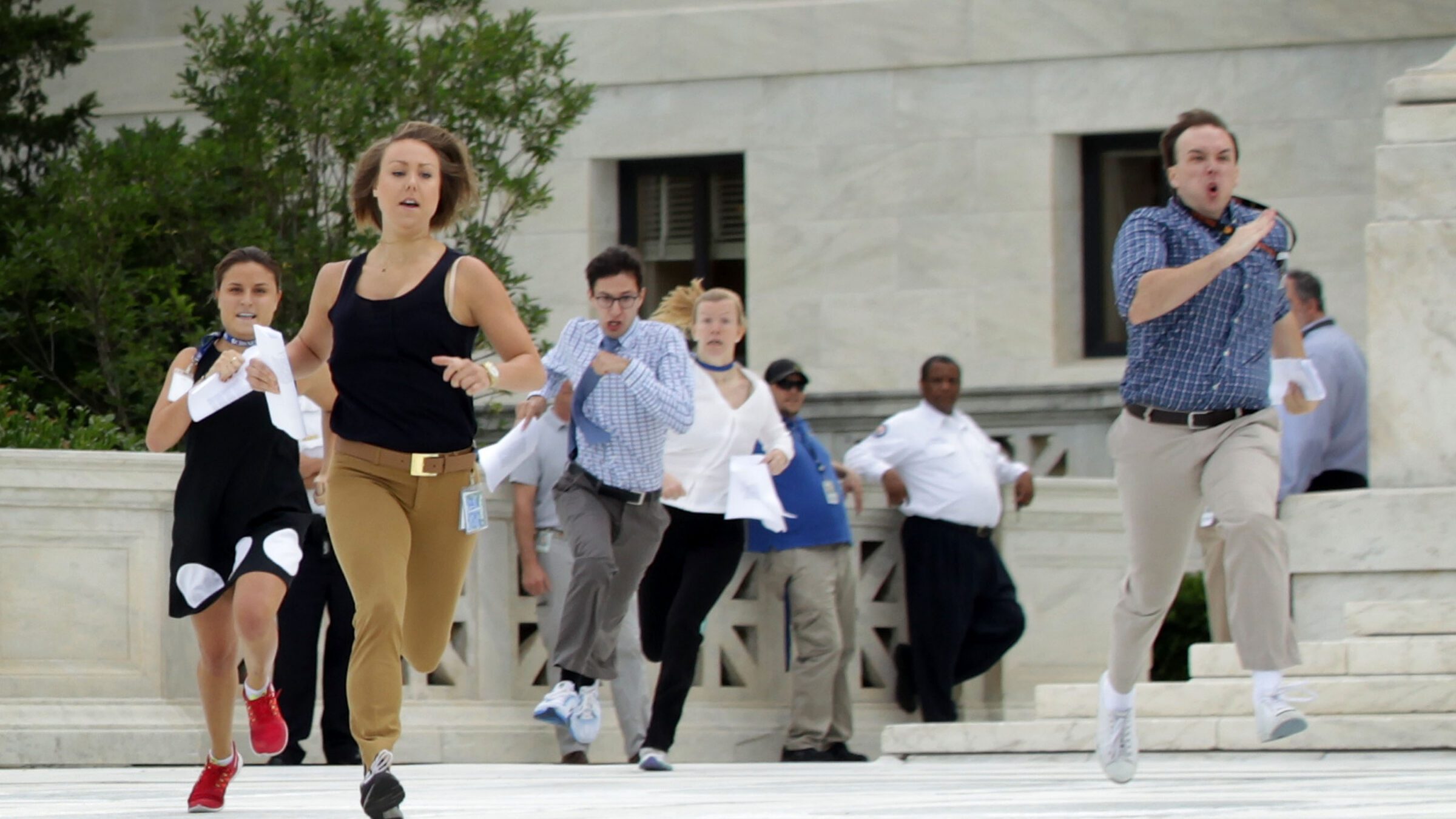
News interns run out of the Court holding their copies of the opinion in Obergefell v. Hodges, June 2015 (Photo by Alex Wong/Getty Images)
For people who are not physically present in the building, opinion days are even more opaque. Staffers post opinions to the Court’s website once the author of the majority begins reading, which means that for most people, the fastest way to find Court decisions is to furiously refresh a browser tab to see which case name magically appears next.
The only real hint about what’s going on inside the Court—the jurisprudential equivalent of the color of the smoke emanating from the Sistine Chapel chimney—comes from watching the “R” column in this table. When it is blank, there are more opinions to come; as soon as sequential numbers appear in the boxes, you know the justices are done for the day. Otherwise, the entire ritual is roughly analogous to watching Moses descend from Mount Sinai bearing the Ten Commandments, if Moses were Sam Alito, and the Ten Commandments were a PDF in which he and his colleagues decide who gets civil rights and who doesn’t.
Nothing about the Court’s work necessitates this performative melodrama. In most cases, the justices know what the bottom-line result will be just a few days after oral argument, when they meet in conference to vote. Otherwise, the time it takes to resolve a Supreme Court case is all about the time the justices need to write—to circulate drafts of the majority and dissenting opinions, to revise those drafts to respond to each other, and to write concurring opinions, if for whatever reason they are not fully satisfied with the outcome.
It is of course possible for justices to change their minds—for draft dissents to become late-breaking majority opinions, and for draft majority opinions to become indignant dissents. As is true of any workplace, during the Court’s busy season, when marked-up drafts with last-minute revisions are flying back and forth between chambers on a daily basis, all-but-finished opinions sometimes have to get pushed a day or two.
For the most part, though, the justices know well in advance how the Court will decide a case—for example, whether it is going to get rid of the right to reproductive autonomy, or stuff what remains of the Voting Rights Act in the garbage, or craft a bespoke theory of executive power that clears the way for the six-justice conservative supermajority’s preferred candidate to run for president. And even during those hectic final weeks, the justices still have a pretty good sense of how close an opinion is to being ready for public release.
What I am saying here is that it would not be especially complicated for the Court, an extremely powerful and alarmingly unaccountable government institution, to be more forthcoming about its work. (The high courts in other, better functioning countries do not seem to have a problem doing this.) If the justices so desired, they could announce with a reasonably high degree of confidence when they plan to publish a particular opinion. If the justices were hesitant to commit to a day, they could at least designate the week when, say, the parents of children whose citizenship status will be decided by Trump v. Barbara can actually expect to read it.
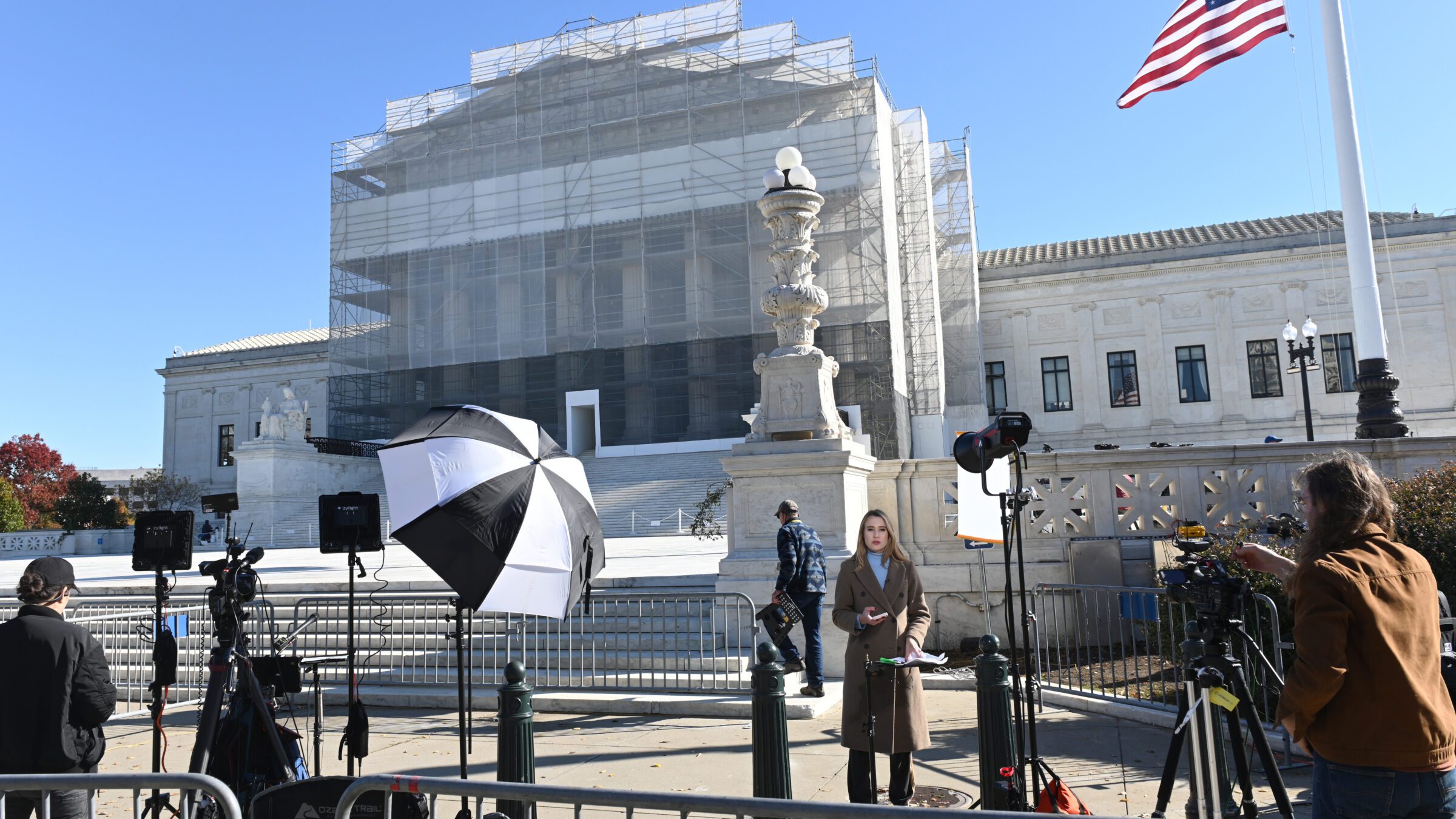
Reporters set up outside the Court before oral argument in the Trump tariffs case, November 2025 (Photo by Chen Mengtong/China News Service/VCG via Getty Images)
There are several reasons why the justices have shown no interest in doing anything like this. Both throughout its history and especially under Roberts’s leadership, the Court has treated calls for anything resembling transparency as tantamount to an all-out assault on the very idea of judicial independence. An entity whose members remain unwilling to allow cameras in the courtroom or adhere to a binding code of ethics is probably not going to voluntarily publish a schedule—even a tentative one—anytime soon.
The more fundamental reason the Court keeps you in the dark, though, relates to the justices’ strident insistence that their work is not “political.” The public position of Roberts and company is that they do not make policy choices, but instead provide objectively correct answers to discrete legal questions. When they decide cases, they do not think of themselves as political actors who disagree vehemently with one another, but as technocrats fulfilling a solemn responsibility to say what the law is. In their ideal world, whenever the justices hand down an opinion, everyone else would immediately incorporate it into their understanding of the American legal system, and no one would ask them questions about it ever again.
Treating its calendar like a state secret is one of the subtler methods the Court employs to maintain this illusion. Roberts knows that every delay—every deviation from an announced schedule—would remind people of the realities he has spent his career denying: that the justices are just people, and that the law is nothing more than an argument that manages to earn five votes. Part of the justices’ commitment to the myth of the nonpartisan majesty of the law is concealing even tiny details that would shed light on the grimy process of making it.
On Thursday, the Court is set to release another set of opinions; given that a dozen cases are still lingering as of this writing, I would guess the justices will add two or even three more opinion release days to the calendar next week, too. But the fact that the millions of people whose rights hang in the balance do not know what cases are coming and when is a choice. The justices made it. All you and I can do is wait to see what comes next.