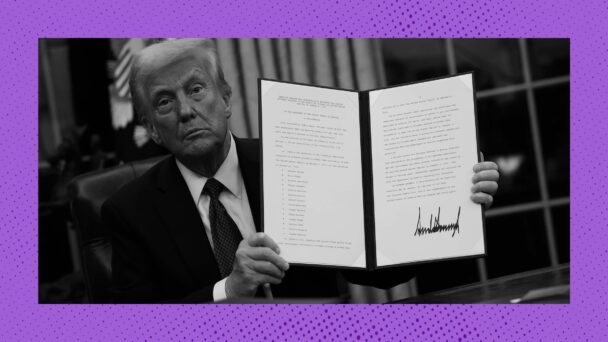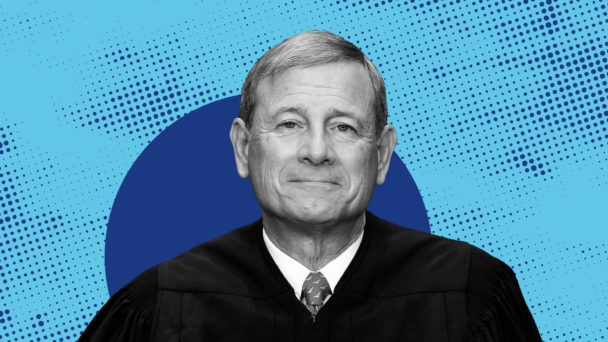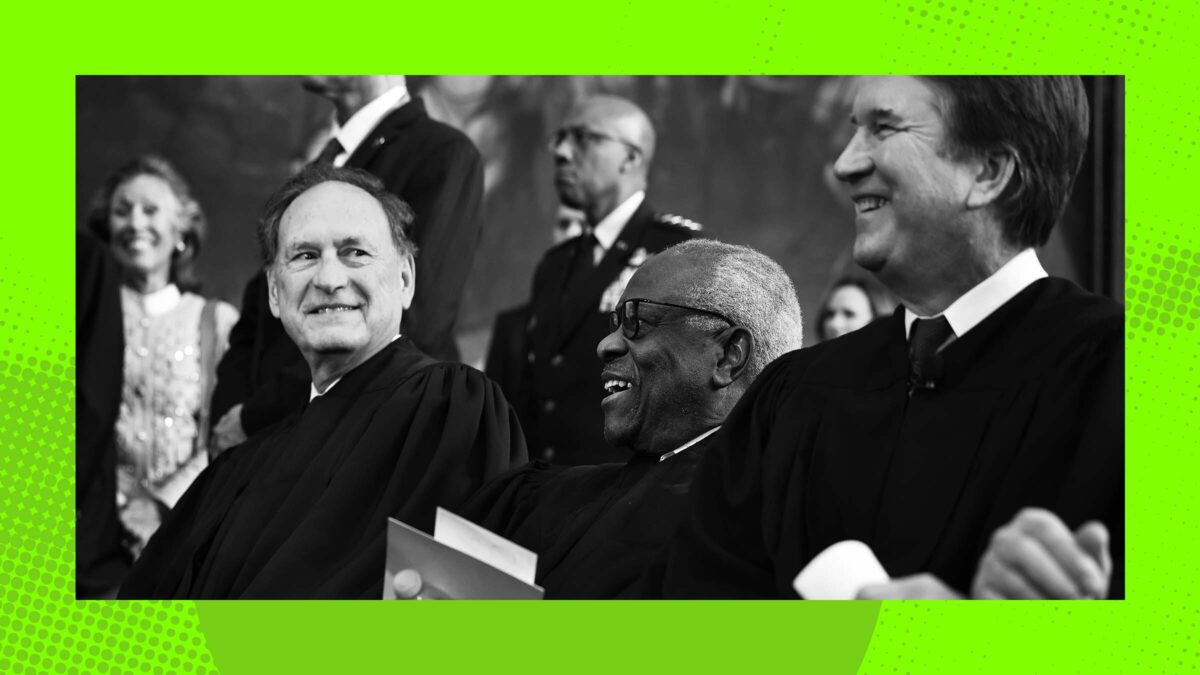
On Tuesday morning, the United States Supreme Court came exactly one vote away from holding that the Fourteenth Amendment does not mean what it says—that “all persons born or naturalized in the United States, and subject to the jurisdiction thereof, are citizens of the United States.” As outlined in their dissenting opinions in Trump v. Barbara, four sitting justices—Clarence Thomas, Samuel Alito, Neil Gorsuch, and Brett Kavanaugh—would have instead held that the Constitution has (almost) nothing to say about President Donald Trump’s racist crusade to erase the Fourteenth Amendment’s guarantee of birthright citizenship.
Trump v. Barbara is probably the highest-profile case of the term, in part because of its real-world stakes for millions of people, and in part because it is not every year that the Supreme Court has to answer a question like “Does the Constitution allow the president to ignore more than a century of Supreme Court precedent simply because he doesn’t like brown people?” Because this case received so much media attention, and went against Trump, and came down on the last morning of the term (the drama!), over the next few days, you are going to be soaked by a broken fire hydrant of fawning op-eds informing you that the result in Barbara proves once and for all the Court’s independence from Trump, and that the institution remains resolutely committed to its mission of Doing Law, Not Politics.
The decision does none of these things. Trump v. Barbara is the stupidest Supreme Court case in recent memory: the nation’s nine fanciest lawyers spending God knows how many hours pondering a question about the Fourteenth Amendment’s meaning that a bright sixth-grader could have answered without difficulty in roughly 30 seconds. The fact that a bare majority of the Court eventually arrived at the howlingly obvious, so-simple-it-feels-like-a-trick-question result—and only after months of forcing noncitizen parents to wonder if their children would soon be rendered stateless—is not evidence of the justices’ boundless intellect or analytical rigor. It is a damning indictment of an institution that is teetering on the brink of stuffing the entire enterprise of constitutional governance in the garbage.
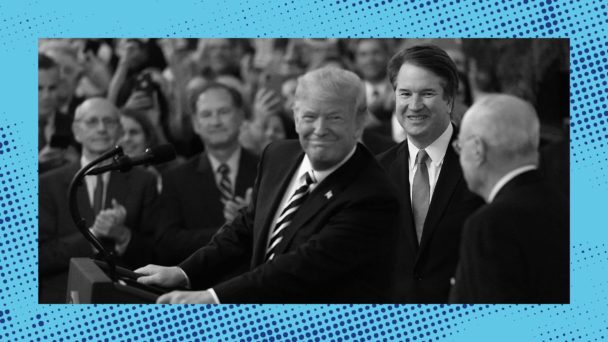
In his opinion for the majority in Trump v. Barbara, Chief Justice John Roberts, joined by Justice Amy Coney Barrett and the three liberals, wrote reverently about the vows the framers made to emancipated Black Americans, and lauded himself and his colleagues for their commitment to fulfilling it. “Citizenship, then and now, was the right to have rights—to freely participate in our political community,” he wrote. “We keep that promise today.”
Over the course of four separate opinions that spanned a combined 143 pages, though, the dissenters stridently argued that their favorite president has it right, and has had it right all along. Thomas castigated the Court’s “alternative history” of the Citizenship Clause that, in his words, rewards the children of “all foreign birth tourists and illegal aliens” with citizenship. In his view, the Reconstruction amendments protect the rights of emancipated Black people, but extend to basically no one and nothing else. Roberts’s “extraordinary” majority opinion, Thomas said, adds to the “sad history” of the Court’s efforts to “repurpose” the Fourteenth Amendment to further “political projects that the Reconstruction Congress did not support.”
Kavanaugh, who (I cannot stress this enough) styles himself as an originalist, emphasized in his dissent the importance of applying the Constitution’s “underlying principles” to “modern situations that were unknown or unanticipated” by the framers. The right to citizenship by birthright, he continued, is not necessarily absolute, because in his judgment, “significant illegal immigration” is among the “new circumstances” that allow modern-day judges to draw common-sense inferences about the scope of real-world rights that the Constitution protects. (Roe v. Wade could not be reached for comment.) Although Kavanaugh concluded that existing federal law does not allow the president to deny citizenship to the children of non-citizens by executive order, a hypothetical act of Congress that does so, he said, “would pass constitutional muster.”
Alito, who like many Republican men of a certain age has based his entire view of the world around the Behrooz Araz storyline in Season 4 of 24, warned that the decision in Barbara will foment terrorist sleeper cells and encourage “massive illegal immigration.” He also suggested that the Court had adopted an “erroneous interpretation” of the Fourteenth Amendment “simply out of fear of the consequences of ‘rocking the boat’”—basically, asserting that the majority knows it is wrong, and is too woke and chickenshit to do the right thing.
The fact that Trump’s nakedly xenophobic attack on birthright citizenship earned four votes—four fucking votes—is a national embarrassment, and a heart-stoppingly frightening signal about what may lie ahead if Trump (for any reason) gets to replace Roberts or one of the liberal justices in 2027 or 2028. The upshot of Barbara is that, as a country, we are but one MAGA dead-ender away from a Court that is willing (and maybe excited) to undo Reconstruction, just as soon as Republican politicians bring a case that will allow them to do it.
For more than two centuries, the Court has proclaimed itself to be the ultimate authority on the law, with the unreviewable power to say what it means. These days, what passes for “courage” from the Court is an opinion that makes clear to Trump that there is a limit to the justices’ willingness to allow him to unilaterally amend the Constitution, but that he is really, really close to persuading them to get rid of it.