On July 7, Lorenzo Salgado Araujo, a homebuilder in Houston, woke up before sunrise, ate breakfast prepared by his wife, and drove his construction crew to work. Around 6:50 AM, federal immigration agents surrounded Salgado Araujo’s van and shot him through an open window. Struck in the stomach, he died at a hospital a few hours later.
The Department of Homeland Security put out a statement that evening which claimed that immigration officers stopped Salgado Araujo’s van as part of a “targeted” operation, and that an Immigration and Customs Enforcement agent shot him “in self-defense” after he “weaponized his vehicle” in an attempt to run agents over. Later, DHS admitted that Salgado Araujo was not the target of an investigation. And video evidence and witness reports revealed that Salgado Araujo did not aim his vehicle at ICE agents, who shot him from the passenger side of the van.
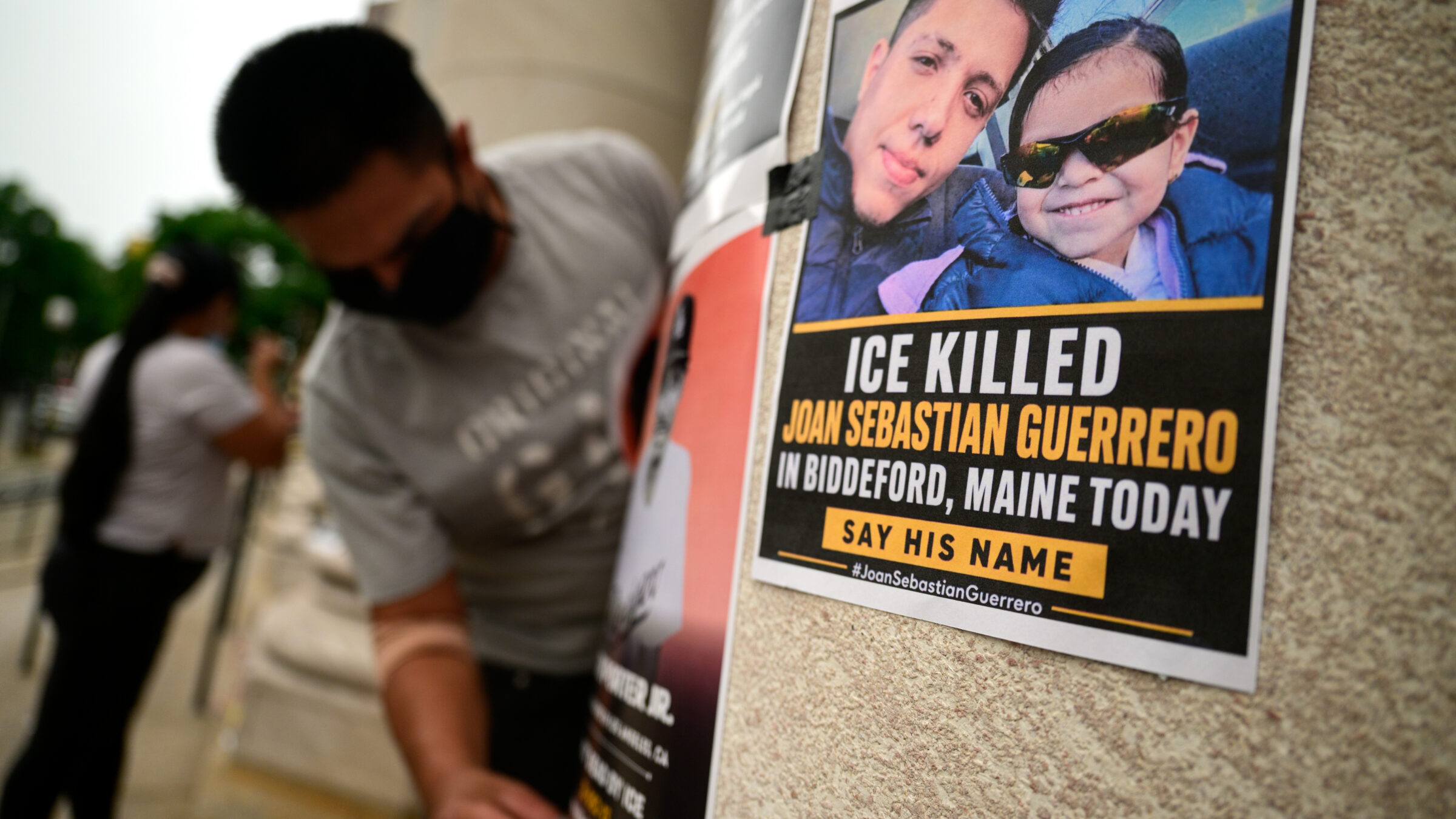
Just a few days later, the same deadly scenario played out all over again. On July 13, around 7 AM, Johan Sebastián Durán Guerrero left his apartment in Biddeford, Maine, to go to work. Mere feet from the front door, federal immigration agents fired at least four shots into his car. Nearby, his 3-year-old daughter looked on, in her Bluey pajamas, and cried.
Again, the Trump administration initially claimed that Guerrero was the “target” of an arrest warrant, and that officers shot him after he “weaponized” his car. Again, the administration later admitted that Guerrero was not the target of an investigation. An ICE spokesperson eventually abandoned the self-defense claim, too, saying only that agents shot Guerrero out of an amorphous concern for “public safety.”
The American Civil Liberties Union published a report on Thursday that examined more than 1,200 incidents of immigration enforcement across eight states that occurred during President Donald Trump’s first year back in the White House. The report concluded that in 432 of those incidents—representing more than one in three of the reviewed enforcement actions in 2025—agents used or threatened force, used intimidation tactics, or retaliated against observers. The ACLU also identified 130 instances in which agents brandished weapons and 16 incidents in which agents used lethal force.
The report stresses that the misconduct of immigration agents is not the result of “a few bad apples.” Rather, the fault lies with “a culture of abuse” encouraged by the Trump administration, and “a broken system of accountability.” Basically, when immigration agents are free to break the law without personal consequence, there are deadly consequences for everyone else.
(Ryan Caron King/Connecticut Public via Getty Images)
One might assume that the legal system would allow people to do something when the government acts illegally. And for a time, it did: Back in 1971, the Supreme Court ruled that people may generally sue federal agents, including immigration officers, who violate their constitutional rights, even if there’s no law explicitly authorizing a remedy. The majority in Bivens v. Six Unknown Named Agents reasoned that the Constitution’s guarantees would be meaningless if people couldn’t seek redress when the government infringed their rights, so the Constitution must implicitly empower people to sue for relief.
That rationale made too much sense for the conservative legal movement, which has spent the past decade putting up significant roadblocks on the path that Bivens paved toward accountability. In 2017, for instance, the Court blocked a group of people from suing prison officials and high-ranking Department of Justice officials after the government detained them for months in horrid conditions on suspicion of terrorism but without actual charges. The majority in Ziglar v. Abbassi noted that the Court hadn’t recognized an implied right to sue under Bivens “for the past 30 years,” and said that doing so “is now a disfavored judicial activity.”
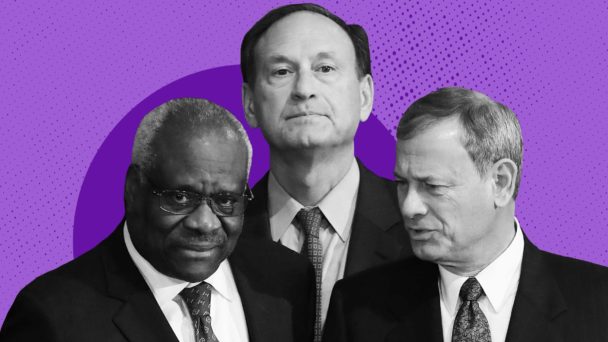
In 2020, the Court decided Hernandez v. Mesa, a case about a Customs and Border Patrol agent on the U.S. side of the border who shot and killed a 15-year-old boy on the Mexico side of the border. In Hernandez, the Court blocked the boy’s grieving parents from suing the agent. Justice Samuel Alito wrote for the majority that the lawsuit was “unlike any previously recognized Bivens claim” because a cross-border shooting claim had “foreign relations and national security implications,” and the Court should not expand Bivens to a “new context.”
Most recently, in 2022, the Court blocked a man from suing a Border Patrol agent who threw him against a vehicle and then onto the ground, and later targeted him with a tax audit. Justice Clarence Thomas wrote for the majority in Egbert v. Boule that this, too, was “a new context.” Worse still, Thomas wrote that judges should dismiss a Bivens claim if there is “any rational reason (even one)” to think that Congress—and not the Court—should decide whether there should be a remedy for a constitutional rights violation. To clear up any doubt, Thomas said the result of such an inquiry would be dismissal “in most every case.”
In each of these cases, the Supreme Court’s invocations of faux judicial modesty deprived people of legal means to vindicate their rights against the government. Congress could override the Court by passing a law to authorize Bivens-style actions, but lawmakers have yet to act on such legislation. And without accountability mechanisms, the ACLU’s report on immigration enforcement notes, abuse is “more likely to recur.”
Right now, immigration agents are terrorizing people and getting off scot-free. This is an impunity problem that the Supreme Court helped create. But a sufficiently motivated Congress could address it, in part by literally making immigration agents pay for what they’ve done.