
On August 12, Rumi Ali Ahmed was born in Dallas with hypoplastic left heart syndrome, a rare and serious condition. At just five days old, he had open-heart surgery, the first of multiple operations that he will have to undergo in order to survive. And as of August 26, he remains in critical condition.
While Rumi fights for his life, his parents have been forced to fight for custody of him in court. Rumi is the biological child of Nausheen Gilkar and Omar Ahmed, a couple in Southern California, but he was born via a surrogate in Texas. And over the past few months, a prominent right-wing law firm has filed multiple lawsuits on the surrogate’s behalf, asking courts to award her sole legal and physical custody.
Last week, at a hearing in Texas, Gilkar testified that she and her husband struggled to conceive, going through eight unsuccessful rounds of in vitro fertilization. She said that using a surrogate was not her “first choice,” but rather, her “only option.” By trying to undermine legal protections for surrogacy agreements, conservative lawyers are now threatening to take that option away, not just from Gilkar, but from anyone else who can’t have a child on their own.

Back in August 2025, Gilkar and Ahmed entered into a written agreement with the surrogate, McKenna West, in an attempt to prevent the exact kind of problems they’re dealing with now. West agreed, for instance, that she intended to help Gilkar and Ahmed “create their family,” and that the biological parents would “assume legal custody, control, and care” for the newborn “immediately upon birth.” West further agreed to “take all reasonable steps” for the baby to be born in Alaska, where she lived at the time, and to ensure that the birth certificate reflected the names of the biological parents and the name they chose for their baby.
Establishing where the baby would be born was important, the agreement acknowledged, because surrogacy law is “complicated” and varies from state to state. Basically, while one state might enforce the surrogacy agreement one way, another state might enforce it another way, or not enforce it at all.
After signing the agreement, Gilkar and Ahmed had their embryo transferred into West’s uterus. Gilkar held West’s hand during the implantation process.
For several months, West’s pregnancy went smoothly. On April 7, lawyers for the parents and the surrogate filed a joint petition in an Alaska state court to make sure Gilkar and Ahmed would be recognized as the legal parents.
Days later, a 20-week anatomy scan revealed that the fetus had a critical congenital heart defect. If the child was born, he would require at least three major surgeries within the first few years of life in order to have any chance of survival. Roughly three in 10 children who get the surgeries still die before the age of five.
Heartbroken, Gilkar and Ahmed had a difficult decision to make. They wanted the child more than anything. But they worried about whether they could afford the treatment, and if, even with the surgery, the child would only know a brief life of suffering.
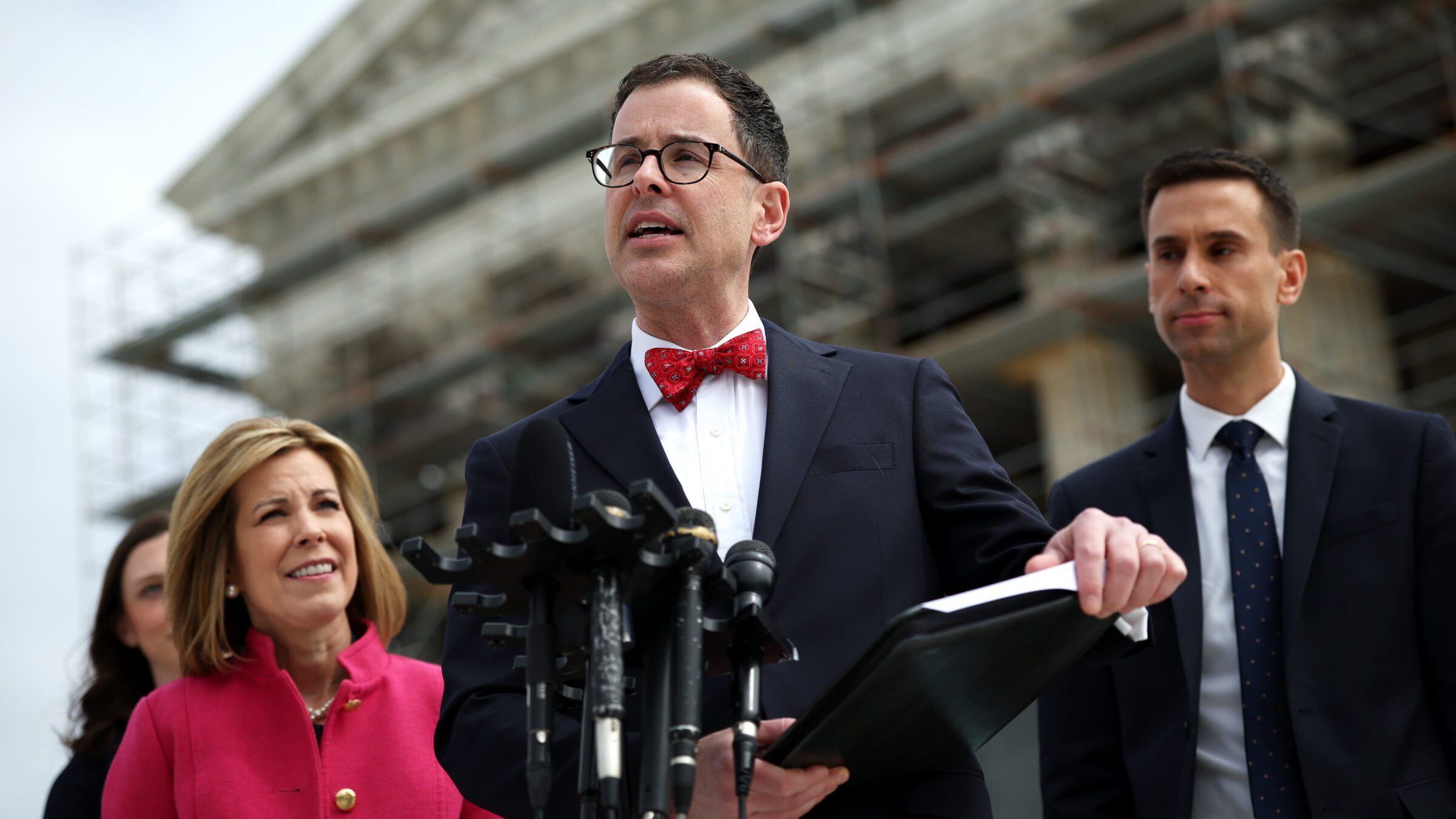
Alliance Defending Freedom lawyer John Bursch and president Kristen Waggoner outside the Supreme Court, April 2025 (Photo by Kayla Bartkowski/Getty Images)
Under the terms of the surrogacy agreement, Gilkar and Ahmed retained the right to request a termination of the pregnancy upon detection of a fetal abnormality. So, after considering the issue as a couple and consulting doctors, they asked West to get an abortion.
In the agreement, West indicated that she had “carefully considered” the possibility of abortion, and agreed that she would end the pregnancy if the parents requested in writing that she do so. She scheduled an appointment for early May, and the lawyers dismissed the legal parentage petition that was filed in Alaska the month before.
But as the appointment date approached, West changed her mind. She told Gilkar and Ahmed that, at her job as a nurse, she’d seen patients make remarkable recoveries, and that she had a friend whose teenage daughter has the same heart condition as their child. She urged Gilkar and Ahmed to reconsider their request. She also told them that if they did not, she would give birth to their baby anyway, and either put him up for adoption or raise him herself.
Gilkar and Ahmed frantically sought to reopen the joint parentage petition, but were unable to do so without West’s consent. They also told West that this was a material breach of the surrogacy agreement, and she would have to reimburse the couple for all payments made to her and on her behalf—potentially over $100,000.
Faced with West’s refusal to get an abortion, Gilkar and Ahmed were determined to raise the baby and provide for his specialized medical care, but no hospital in Alaska was equipped to handle the surgeries the baby would need. After consulting with doctors in their home state of California, Gilkar and Ahmed decided that West should give birth there. They filed a new petition in a California state court, which on June 22 recognized Gilkar and Ahmed as parents of the unborn child.
But West again made other plans. On June 24, West sued in Alaska, arguing that the entire surrogacy agreement was “void and unenforceable.” Her lawsuit further claimed that the couple’s request for an abortion created a “well-founded basis for concern” that they would “deny or delay the life-saving treatment he will need immediately upon birth.” West’s lawyers at the Alliance Defending Freedom, a Christian legal advocacy group at the forefront of attacks on abortion, LGBTQ people, and more, also argued that awarding West sole legal and physical custody would be in “the best interest of Baby Gabriel,” a name West chose for the child.

In July, West suddenly moved to Texas—where she claimed the child could receive the best medical care—and filed a lawsuit there, too. Her latest suit argues that Texas should apply its default parentage rules and conclude that the person who gives birth to a child is the child’s rightful mother. Texas Attorney General and 2026 Senate candidate Ken Paxton also intervened in the case, and sought a court order directing a Texas hospital to provide whatever care the child needed upon birth to save his life. Paxton echoed the Alliance Defending Freedom’s smear that intervention was necessary because the baby’s biological parents may “refuse consent to the surgery and allow the child to die.”
On August 11, the Texas court granted Paxton’s request, issuing an emergency order indicating that the baby must receive life-sustaining medical treatment upon birth, and may not be removed from the hospital unless necessary for the newborn’s care. That same day, the court also issued a temporary order siding with Gilkar and Ahmed, authorizing the biological parents to make medical decisions on behalf of their baby while the court case over his parentage continues. The order also prohibits West from making medical decisions for the child or otherwise interfering with Gilkar and Ahmed’s parental rights.
Rumi was born the following day, and his parents, Gilkar and Ahmed, consented to surgery for him soon thereafter. But the legal struggle continues: At a hearing on August 25, a Dallas judge extended the temporary order for another two weeks.
In court filings and conservative media appearances, West insists that her only concern is Rumi’s safety. She has said that she would drop the cases if Rumi’s parents “commit,” to her satisfaction, that they will get him “life-saving care.” As a reminder, Rumi has already undergone his first open-heart surgery, and his mother testified under oath that they were committed to pursuing additional surgeries as well. West nevertheless said that she doesn’t trust Gilkar and Ahmed, and at the hearing, one of West’s attorneys asked Gilkar if she would “trust somebody to care for your child that wanted your child dead.”
It appears, then, that Rumi’s surgery is not the real issue; if it were, West would allow Rumi’s parents to remain at his side in the hospital, rather than forcing them to confront her in court. The real issue in this case is whether a stranger’s disapproval of your process for making intimate decisions should have any legal bearing on your ability to start a family. Every year, thousands of American households welcome the births of children carried by surrogates. By challenging the enforceability of surrogacy agreements, the Alliance Defending Freedom is necessarily implying that those parents are not as entitled to legal and physical custody of their children as they might think.
The argument that only West is entitled to parental rights because she gave birth promotes an exceedingly narrow view of who counts as a real parent—ruling out anyone with fertility problems, LGBTQ people, and more. And it suggests that the legal ability to build a family is contingent on the approval of right-wing activists. What West and the Alliance Defending Freedom are fighting for is not care, but control.