For decades, the Department of Justice has been perhaps the legal profession’s most prestigious employer, leveraging its reputation for principled independence in order to recruit top-end talent. Now, as the first half of President Donald Trump’s second term comes to a close, it is functionally a shambolic fraternity house of Republican law school graduates who would otherwise be advertising flat-rate divorce packages on the men’s rights subreddit.
The DOJ’s latest attempt to publicly disgrace itself is unfolding in Alaska, where its lawyers are trying to get a federal court order blocking state officials from certifying the results of this year’s U.S. Senate election if the Republican incumbent, Dan Sullivan, ends up losing. There might not be a better distillation of this administration’s conception of “election integrity” than a lawsuit asserting that a possible outcome of a future election will be legally invalid if Donald Trump does not personally approve of the result.
The two main contenders in the Alaska race are Sullivan and Mary Peltola, a Democrat who previously represented the state in the House of Representatives. Polling suggests that Peltola has a slight advantage, although her leads are typically small and within the margins of error.
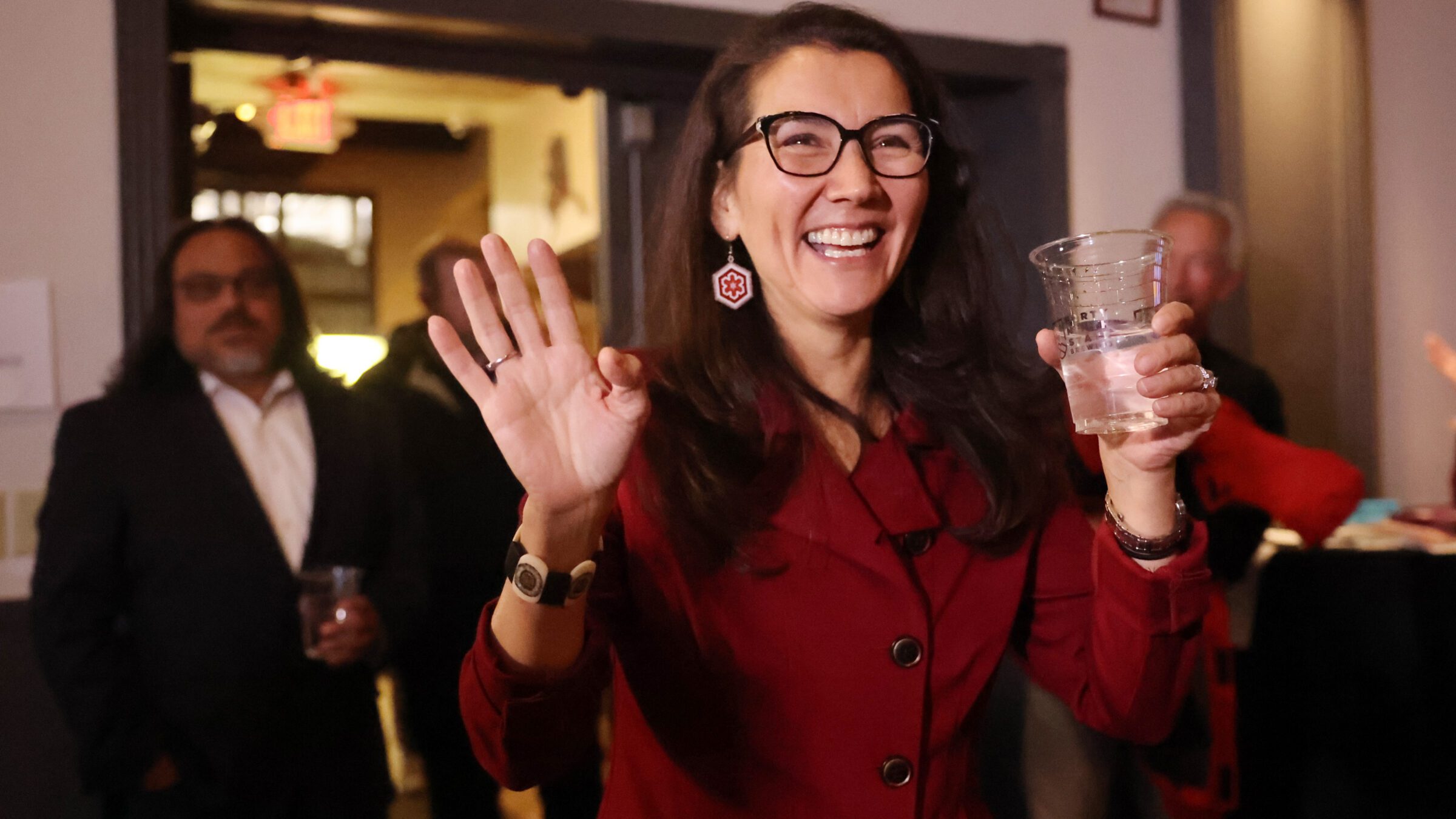
Peltola in 2022 (Photo by Spencer Platt/Getty Images)
What vexes Republicans about this election, other than the nightmarish possibility of a lady taking a seat they consider rightfully theirs, is the fact that also running to represent Alaska in the Senate is Daniel J. Sullivan, Jr., a guy who had not been affiliated with the GOP before this year, and who voted for Peltola in 2022 and 2024. In its lawsuit, the DOJ contends that the presence of Daniel J. Sullivan, a political novice, on the ballot next to Dan S. Sullivan, a sitting U.S. senator, risks “confusing” voters “in what most observers believe will be a close race.”
Further exacerbating Republicans’ concerns are the results of Alaska’s nonpartisan primary in August, in which Daniel J. Sullivan earned 2.5 percent of the vote. This was nowhere close to the eight-point gap between Peltola, who received the most votes, and Dan S. Sullivan, the runner-up. That said, given how many polls have her running ahead of him by two or three points, 2.5 percent of the vote could be the difference between a win and a loss.
Republicans in Alaska have previously tried to get Daniel J. Sullivan kicked off the ballot, but in June, the Alaska Supreme Court affirmed a lower state court ruling that put him back on it. This lawsuit represents the Trump administration’s last-ditch attempt to intervene, and in the boldest manner imaginable: by asking a federal judge to prevent the certification of the results in the event that (1) Dan S. Sullivan loses the election on November 3, and (2) would have won the election if all of the votes cast for Daniel J. Sullivan had gone to Dan S. Sullivan instead.
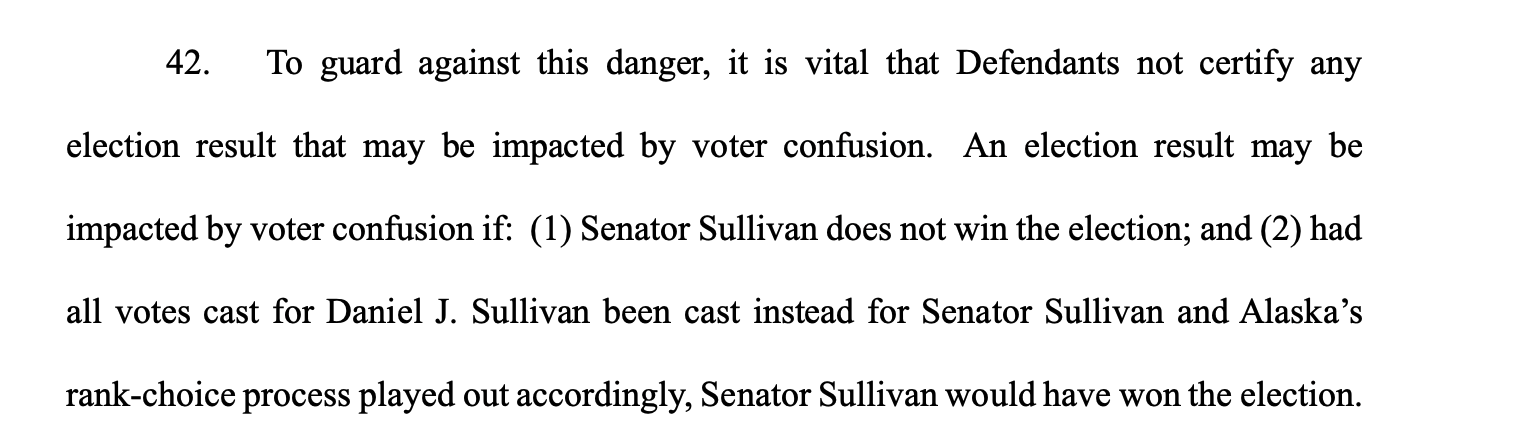
If you are a plaintiff filing a lawsuit—any lawsuit, not just deranged assaults on the concept of representative democracy—one very basic requirement is that you include a citation to some provision of law that would entitle you to relief. Even if the most honest answer is something like “I do not like this thing and find it very unfair,” that is not enough. You need to show a judge that there are actual legal grounds for giving you the real-world result you want.
Here, the Justice Department is bringing its claim under the National Voter Registration Act of 1993, which, the Justice Department says, requires states to “protect the integrity of the electoral process.” And since the NVRA allows the Attorney General to “bring a civil action” to enforce the NVRA, the DOJ concludes, Todd Blanche and his lackeys are allowed to demand the removal of the lesser Dan Sullivan from the ballot.
If the idea that a statute called the “National Voter Registration Act” would empower federal courts to set aside election results has your bullshit alarm ringing loudly, you have done a good job calibrating it. The “protect the integrity of the electoral process” language that the DOJ cites is not a substantive provision of the NVRA. It is instead selectively quoted language from the preamble to the NVRA, a fairly anodyne Clinton-era law that requires states to streamline the processes of getting a driver’s license and registering to vote. Here, look for yourself: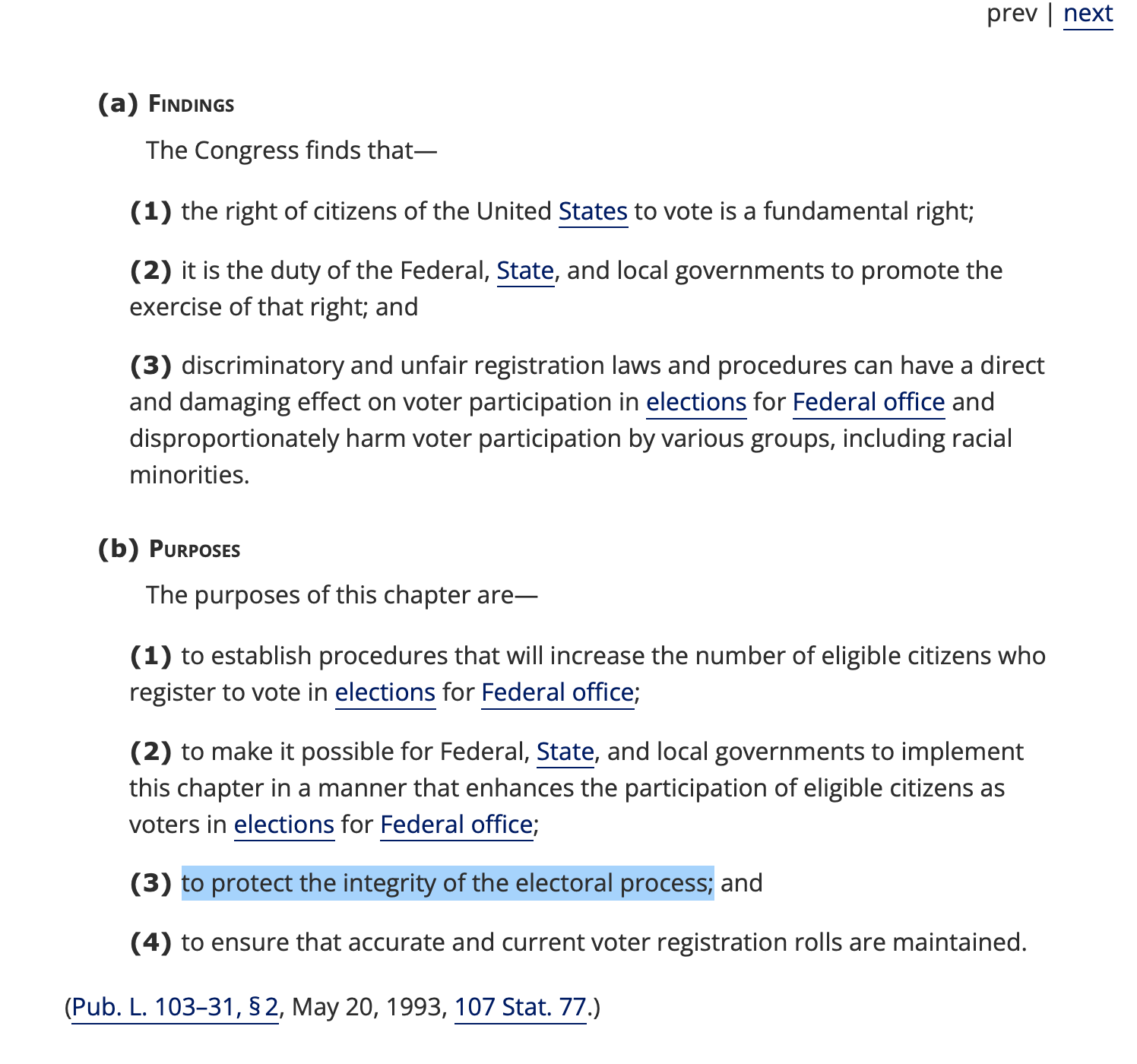
This is not a cause of action that allows the executive branch to conditionally meddle in a state-administered election before that election even takes place. This is a restatement of the general belief of the Congress that passed the NVRA that removing bureaucratic hurdles to registering to vote is good for democracy. It provides context for all the things that the NVRA’s subsequent sections actually require: that states allow people to register by mail, and do away with duplicative paperwork, and so on. By invoking the preamble in this way, the Justice Department is more or less writing a new law and hoping that the judge assigned the case of the Dan Sullivans simply doesn’t notice.
Presumably to the immense relief of whoever taught their legal writing classes in law school, the DOJ lawyers who signed the complaint, Associate Attorney General Stanley Woodward and federal prosecutor E. Bryan Wilson, did manage to cite a case: Bullock v. Carter, which the Supreme Court decided in 1972. Bullock, they say, makes clear that an essential aspect of “safeguarding” the “integrity” of the political process is keeping “frivolous” candidates like Daniel J. Sullivan from interfering with the electoral process.
Again, though, a quick skim of Bullock reveals just how irrelevant its holding is to what Trump wants to do in the Alaska Senate race. Bullock struck down as unconstitutional a Texas state law that required candidates for local office to pay filing fees as high as $8,900. In his opinion for the Court, Chief Justice Warren Burger acknowledged that a state has a “legitimate interest” in “regulating the number of candidates on the ballot” in order to prevent the “clogging of its election machinery.” But this does not mean that a state can do whatever it wants; Texas’s imposition of exorbitant filing fees, he continued, was “extraordinarily ill-fitted to that goal.”
In the years since, courts tasked with examining the state-law hoops through which candidates must jump have often cited Bullock for the basic proposition that states have at least some power to decide how many names appear on a ballot. To the best of my knowledge, though, no federal court has interpreted Bullock to preemptively authorize overturning a whole-ass election if a historically unpopular president’s preferred candidate does not come out on top.
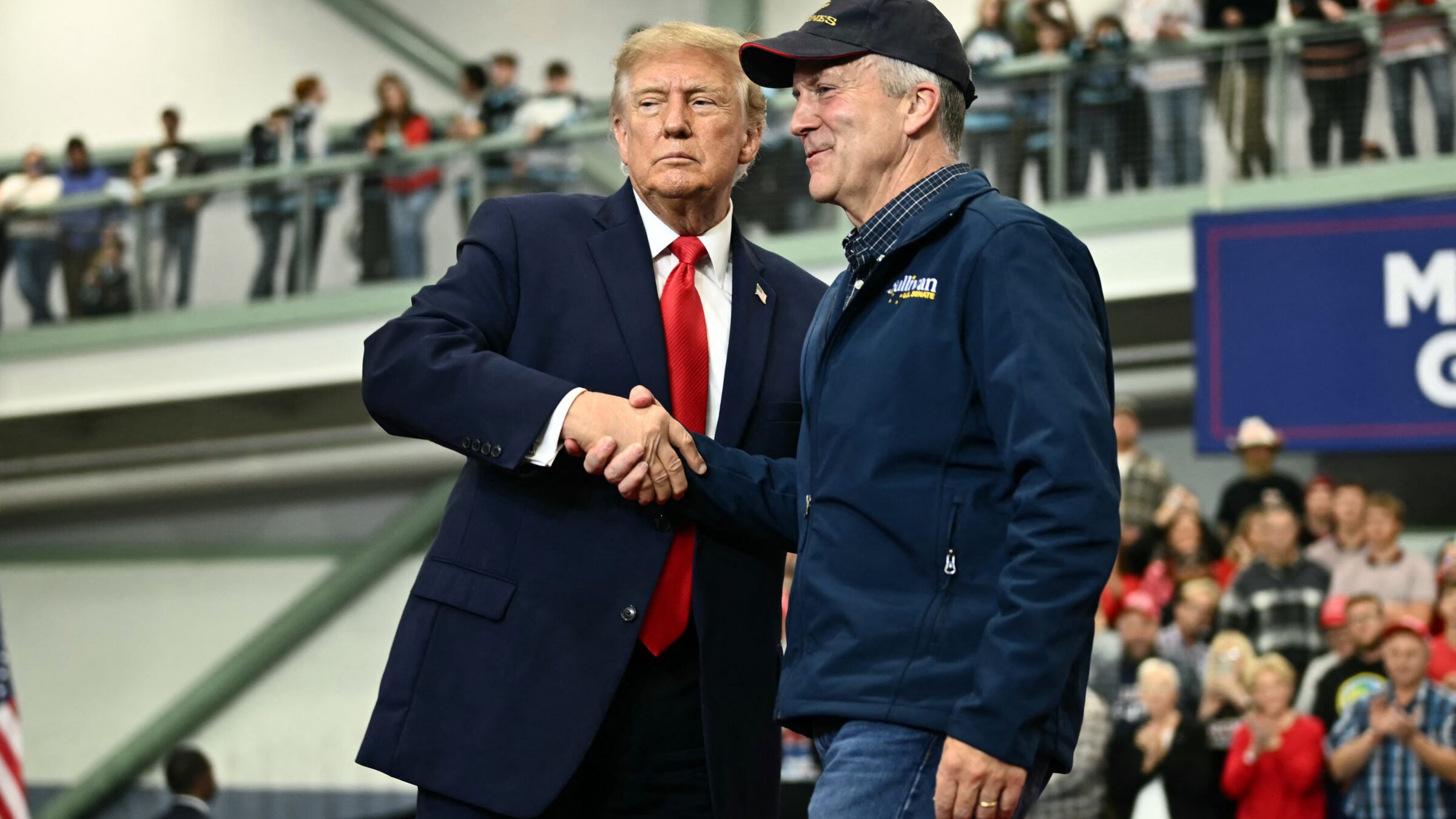
Trump and Sullivan (the sitting senator), October 2026 (Photo by Kent NISHIMURA / AFP via Getty Images)
It is hard to overstate how stupid and lazy all of this is. The DOJ’s reliance on the vague, aspirational language in the NVRA’s preamble here is roughly analogous to me explaining to a Southwest Airlines gate agent that the “you are now free to move about the country” slogan means that I have a legal right to direct the pilot to land the plane in whichever city I would like. A junior law firm associate who wrote something like this would be immediately stripped of their Westlaw credentials and gently asked if they were getting enough sleep at night. The law professor Derek Muller, who has argued in favor of excluding Daniel J. Sullivan from the ballot, called the government’s argument in this case “one of the worst ones I’ve ever seen.” Given how things have gone at the Justice Department of late, this will be fodder for the Homer-comforting-Bart meme by the end of the week.
As I’ve written before, the transformation of the agency charged with enforcing federal law into a taxpayer-funded pro-Trump law firm is disastrous for the legal system, and a mistake that future presidents will need decades to correct. But if there is a silver lining as the 2026 midterms approach, it is that the lawyers who occupy these positions of power are barely pretending to be serious people anymore. For as long as Trump remains in office, this is what the job of a Justice Department lawyer will be: cobbling together random bits of legalese that will make the boss happy, and hoping that you don’t have to be the one to put your name on it.