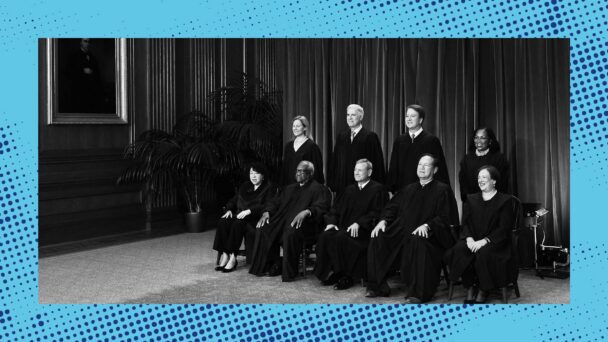
On Monday, the Supreme Court agreed to hear a case about what might feel like well-trodden ground for this six-justice conservative supermajority: a school admissions policy designed to improve the ability of students of color and low-income students to access rigorous academic programs.
The challengers, a group called the Association for Education Fairness, and their right-wing allies frame their lawsuit as a natural outgrowth of the Supreme Court’s 2023 ruling in Students for Fair Admissions, a pair of cases that struck down race-conscious admissions programs at Harvard and the University of North Carolina. But this case is very different: The policy is race-neutral, and the students are in middle school. When the Court rules on Association for Education Fairness v. Montgomery County Board of Education next term, it could make it harder for communities to take even small steps to provide children with quality, integrated education.
The public school system in Montgomery County, a largely suburban area in Maryland bordering Washington, D.C., is one of the biggest and most diverse public school systems in the country. But its magnet schools, four specialized schools that serve the entire county, don’t reflect that diversity. In the 2013-2014 school year, for example, Black and Latino students made up 47.4 percent of the total district student body, but only 13.5 percent of middle school students enrolled in the magnet programs, according to a study commissioned by the school board in 2015.
The study bolstered the advocacy of families and community groups who had long argued that the existing selection process, which relied on parent-initiated applications and teacher recommendations, was failing to identify all qualified students. And in the years that followed, the school system made several major changes to its admissions process in order to give students a fairer opportunity to compete for spots.
Most recently, in response to the COVID-19 pandemic, the district implemented a system in which all fifth-grade students are universally screened, and students who meet defined eligibility criteria are then entered into a random lottery. In the first year of the lottery process, the share of Black and Latino children admitted to the middle school magnet program jumped to over 33 percent.

The Association for Education Fairness alleges that this policy violates the Fourteenth Amendment, which prohibits the government from discriminating on the basis of race, and guarantees all persons “the equal protection of the laws.” The group’s attorneys, a libertarian law firm called the Pacific Law Foundation, contend that Montgomery County intentionally “sought a way to reduce the number of Asian American students” in order to “make room” for “other ‘underrepresented’ racial groups—like black and Hispanic students.”
To be clear, Montgomery County’s lottery policy is, by definition, racially neutral on its face. So in order to prove that the policy is still unconstitutionally racist, plaintiffs need to show that the policy was motivated by a discriminatory intent and has a racially discriminatory impact. And in July 2022, a federal district court concluded that plaintiffs failed to overcome either of these hurdles. There was no discriminatory intent because the lottery “emerged in response to COVID-19, not to address racial disparities of the magnet middle school student body.” The court also found “nothing” in the record to suggest that the plan was “designed to favor one racial group over another.”
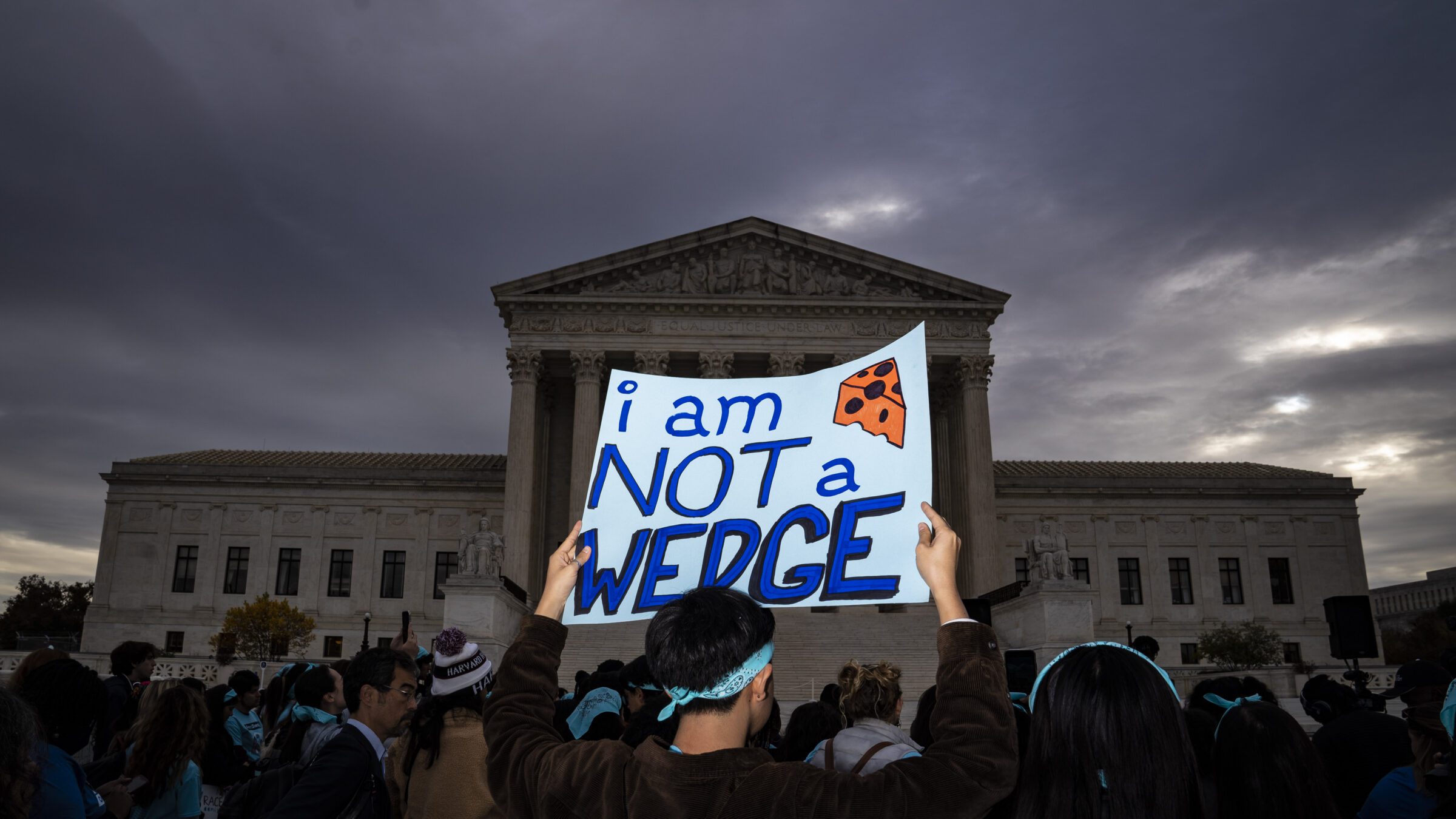
People rally in support of affirmative action in college admissions, October 2022 (Photo by Jabin Botsford/The Washington Post via Getty Images)
The court also found that the policy did not have a disparate impact on Asian American students, because many Asian American students are still being admitted to the program, even if their overall proportion of the admitted student pool isn’t as high as it used to be. In her opinion, Judge Paula Xinis wrote that she “cannot see how” the lottery system disproportionately burdened Asian American students when “the percentage of admitted Asian American students so substantially outpaces the percentage representation among all applicants.”
Xinis also credited the argument, made by civil rights organizations in amicus briefs, that a disparate impact analysis should not be based on a simple “before-and-after” comparison. To do so would effectively transform any existing racial inequality into a constitutional baseline from which new policies can’t deviate. “Disparate impact jurisprudence does not require such a counterproductive result,” the civil rights groups argued. Xinis concluded that the Association for Education Fairness offered “no meaningful response to this point.”
After the district court dismissed their complaint, the Association for Education Fairness appealed, but the Fourth Circuit affirmed. Then the group appealed to the Supreme Court, which will decide what plaintiffs alleging disparate impact have to show in order to prove their case. In other words, do plaintiffs like the Association for Education Fairness have to actually show that a racial group is being disproportionately harmed by a policy, or can they just say that the group used to have some of something and now it has less?
Justices Samuel Alito and Clarence Thomas have already given their answers. In February 2024, when the Supreme Court declined to take up a case similar to this one, Alito and Thomas called the lower court’s decision “indefensible” and said it amounted to a declaration that “intentional racial discrimination is constitutional so long as it is not too severe.” In another dissenting opinion that year, Alito railed against another facially race-neutral policy designed to promote equitable access to education, describing it as “racial balancing by another name” and “undoubtedly unconstitutional.”
Montgomery County is trying to eradicate racial barriers to education. If the Court takes the opportunity in Association for Education Fairness to adopt Alito’s approach, it would likely take away opportunities from children of color who only received those opportunities after years of community advocacy. For the conservative legal movement, the only constitutional response to inequality is to perpetuate it.
If you enjoyed this post, please consider supporting the work of Balls & Strikes with a monthly or annual subscription. Click here to learn more and sign up.