
After Republicans’ drubbing in the 2026 midterm elections, many Democrats are discussing significant legislative plans and congressional investigations of the Trump administration. It is right for Democrats to think big about what they can accomplish in Washington, but they shouldn’t overlook the significance of their victories in state-level executive offices.
In particular, winning attorney general offices in previously red states means the end of right-wing targeting of marginalized groups, as well as legal protections for harmful corporations and corrupt politicians. Victories in Georgia, Iowa, Kansas, Ohio, and Texas offer incredible opportunities for Democratic AGs not just to reshape their own offices, but also to set the standard for what a truly pro-people attorney general’s office looks like.
Republican attorneys general have spent decades developing a robust (if horrifying) vision of the office. In the hands of politicians like Ken Paxton in Texas and Kris Kobach in Kansas, AG offices became the legal arms of the conservative grievance factory, using public resources to enforce conservative social values, target perceived political enemies, and advance Republican priorities in their states and across the country.
Paxton’s record in Texas shows just how much damage that approach can do. Even when women had court orders allowing for medically necessary abortions, Paxton’s office sent letters to hospitals threatening criminal prosecution if doctors performed them. These threats have forced women to leave the state to receive care and caused delays that have led to multiple deaths. His efforts to charge parents of trans children with child abuse for supporting their identities has led transgender people and their families to flee the state. His intervention in a challenge to an Austin sick leave ordinance contributed to every worker in the city losing a guaranteed 64 hours of paid time off. And when Harris County developed a program to provide $500 a month to some 2,000 families in some of its poorest neighborhoods, Paxton successfully sued to stop it.

Texas isn’t the only state where Republicans have been up to this sort of thing, though. In Georgia, Chris Carr fought to keep the state’s six-week abortion ban in place after a state court ruled it unconstitutional. In Iowa, Brenna Bird cut rape survivors out of the state’s program providing emergency contraception, saying that her office needed to audit whether those payments were in the public interest. In Kansas, Kobach sued the state’s licensing agency to prevent transgender people from updating gender markers on their driver’s licenses. In Ohio, Dave Yost’s defense of the state’s ban on gender-affirming care for minors forced families to choose between receiving the care they need and remaining in their home states.
But incoming Democratic AGs can begin dismantling this machinery as soon as they take office. They can withdraw their states from lawsuits attacking abortion access, stop pursuing providers who help patients obtain abortions across state lines, and stop defending restrictions on gender-affirming care and protections for transgender students. They can also abandon lawsuits challenging environmental and labor regulations that protect people from corporate misconduct, as well as efforts to restrict immigrant rights and voting access. Often, this is as straightforward as a decision by the incoming AG to withdraw the state from an ongoing lawsuit. In cases where the AG is defending the state, they can change the state’s litigation position rather than defending the challenged law.
Ending their participation in harmful litigation is just the first step. New AGs can use the power of their offices to go after corporations that cheat consumers, steal wages, pollute communities, and engage in anticompetitive business practices. By aggressively enforcing laws against predatory lending, wage theft, worker misclassification, price fixing, and environmental violations, they can reorient their offices toward protecting the people of the state, as they are meant to. And in states that lack these protections but have newly elected Democratic legislative majorities, AGs can use their public platforms to make the case for stronger laws, working with legislators to draft and advance legislation.
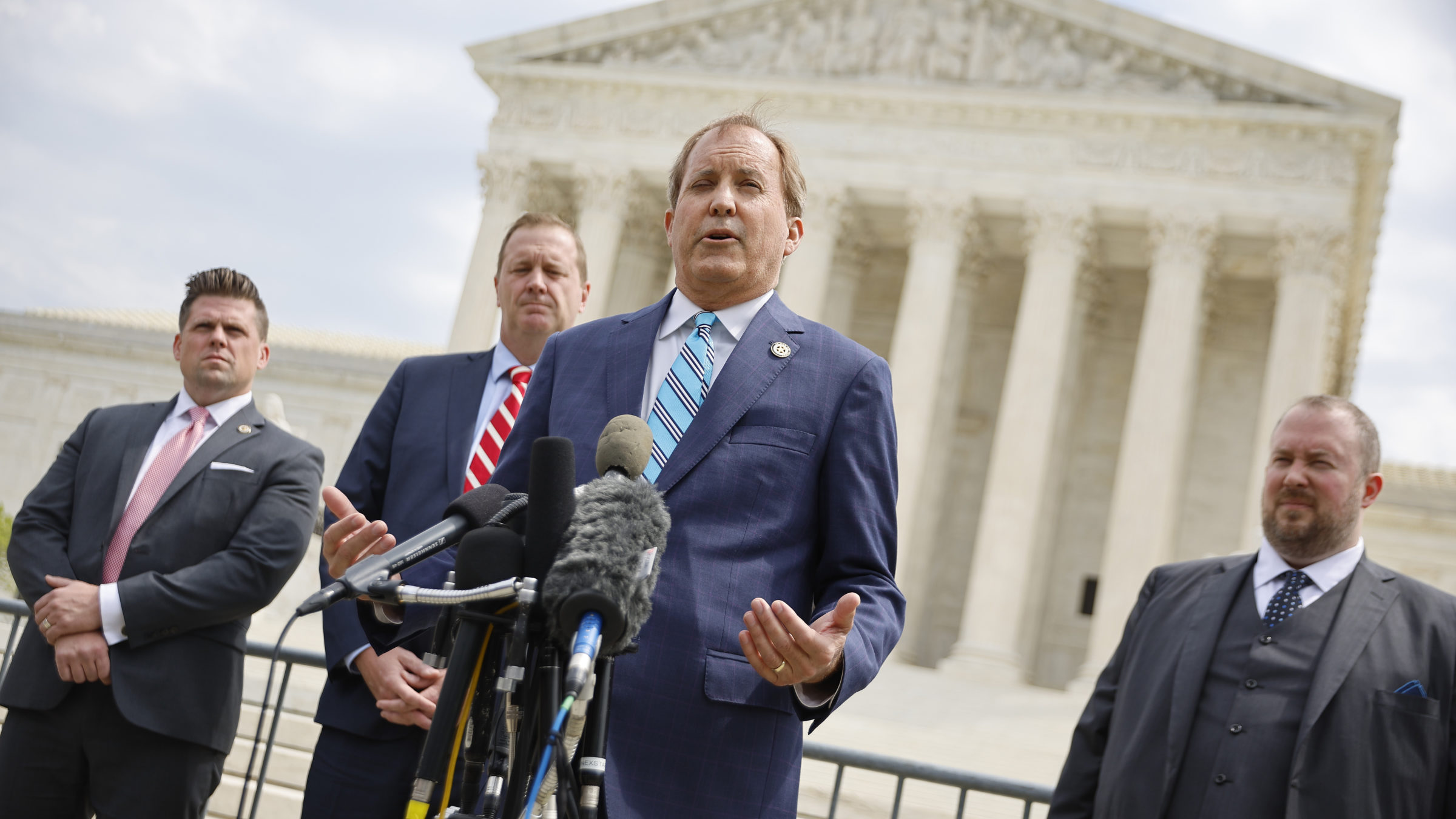
Paxton in 2022 (Photo by Chip Somodevilla/Getty Images)
This sounds like a no-brainer, but it hasn’t historically been how AG offices have approached civil enforcement. For decades, state enforcement of workers’ rights was so far outside the ordinary work of AG offices that as recently as 2013, only three had dedicated workers’ rights units. (That number has since increased to 12, as some states try to fill the gaps left by Trump’s do-nothing National Labor Relations Board). This cannot be the model going forward. An AG’s office for the people should aggressively pursue anyone harming the people of its state, even when it impacts businesses in their home states.
Beyond traditional litigation and civil enforcement, Republican losses will also eliminate opportunities for coordinated litigation and settlements between Republican AGs and the federal government. Over the last several years, President Donald Trump’s Justice Department has developed a novel and legally dubious strategy of suing red states over state laws that Republicans don’t have the votes to overturn, then quickly settling with a movement-friendly Republican AG to effectively repeal the law without involving the legislature. Using this collusive litigation-settlement strategy, Republicans stripped in-state tuition from tens of thousands of undocumented students in Texas, and reached similar settlements in Oklahoma, Kansas, and Nebraska.
Virginia provides an example of the first step in reversing this trend. Immediately after replacing a Republican as Virginia Attorney General in 2026, Jay Jones announced that his office would back out of settlement negotiations with the DOJ, and would instead defend the state’s law providing in-state tuition to undocumented students. Jones’ office prevailed in October 2026, when a federal judge upheld the policy.

Finally, to build offices that truly prioritize people, attorneys general also need to reexamine their litigation defense strategies when people sue the state. Far too often, AGs treat their duty to represent state agencies and officials as an obligation to defeat claims against the government using every available procedural defense—regardless of the underlying conduct or the harm to the people bringing those claims.
This approach can create a two-track justice system in which victims can get compensation much more easily when they are harmed by private actors than when they are harmed by state employees, even when the substantive conduct is identical. For example, in New York, the office of Democratic Attorney General Letitia James recently sought to dismiss over 500 prison sexual abuse lawsuits under strict pleading rules that only apply to people suing the state. Judges have now dismissed complaints of horrific sexual abuse in prison because of long-forgotten details or typos in the reported dates of assaults. By fighting off lawsuits at this early stage, the AG’s office has kept cases from even getting to discovery, where the plaintiffs could obtain some of this missing information. For hundreds of survivors, this denies them a meaningful opportunity to be heard or receive compensation.
An AG’s duty to represent state agencies does not require them to fight every case by any means necessary. If AGs can decline to defend state laws challenged by the DOJ, they can certainly decline to raise specific procedural defenses against people suing the state. The guiding question should be whether a litigation position serves the people, not whether it minimizes the government’s liability.
Republicans spent decades building attorney general offices into powerful instruments for advancing their political agenda. Democrats have an opportunity to build something just as ambitious. They can pursue corporations that exploit workers and consumers with the same intensity Republicans brought to attacking reproductive rights and LGBTQ people. They can think of the real-world impact of their litigation positions, not only on offense challenging the Trump administration and enforcing civil laws, but also when choosing which cases to defend and how. And they can hold agencies and officials to the same standards to which the law holds private parties. The true measure of Democrats’ victories in 2026 will be how much better they make people’s lives—and how consistently they hold the powerful accountable.