As Republican state legislatures have pursued ever more extreme policies on issues like abortion, gender-affirming care, and voting rights, they have occasionally run into a surprising obstacle: conservative supreme courts, which have dealt Republicans in several states a string of high-profile losses on key conservative priorities. In response, Republican-controlled legislatures have supercharged their efforts to bring these courts to heel. Whether by expanding supreme courts, stacking judicial selection commissions, or changing judicial selection mechanisms altogether, these red states have become innovators in ensuring that only Republican priorities receive the protection of the law.
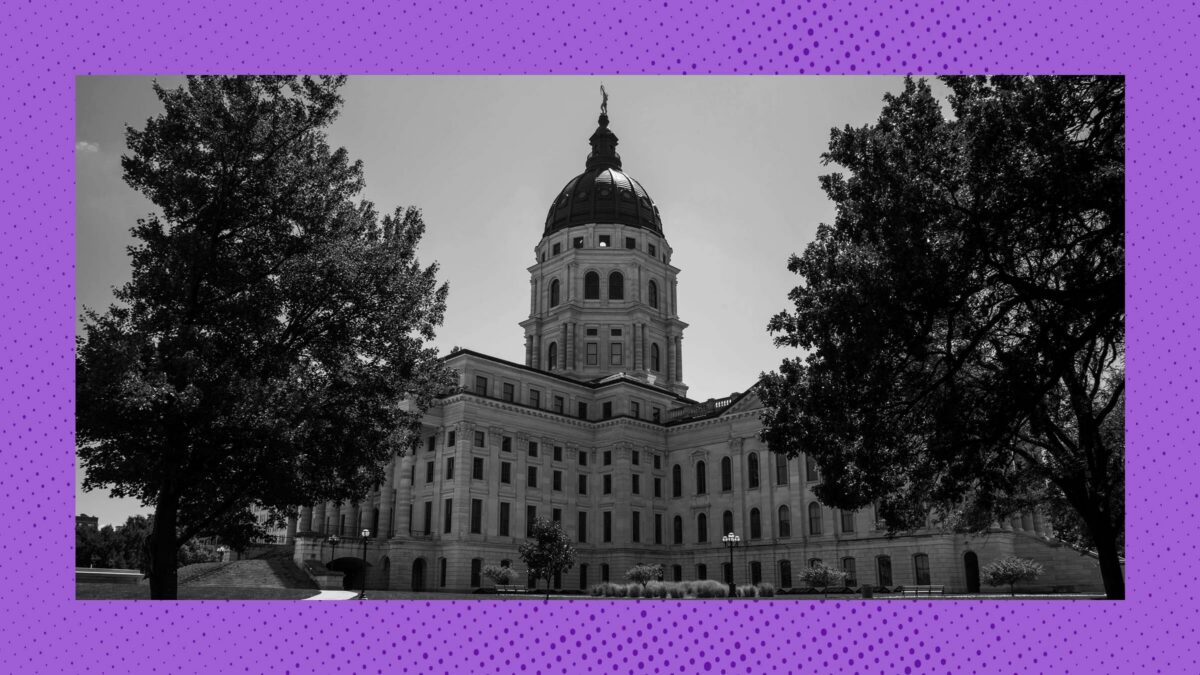
A newer front in this assault on constitutional democracy involves pushing legislation that channels politically sensitive litigation into courtrooms in which judges are more favorable to conservative outcomes. Republican lawmakers in Kansas have been particularly brazen, and in February, they introduced a bill that, going forward, would force all election law challenges into a GOP-friendly court.
Normally, plaintiffs in Kansas (and anywhere else) must file lawsuits in the district in which the conflict arose, or in which one of the parties resides. Kansas House Bill 2569 would change this default rule, requiring people to bring any constitutional challenges to state election laws in Shawnee County District Court.
Clay Barker, general counsel to Secretary of State Scott Schwab, said that the bill’s purpose is to curb “forum shopping” by voting rights groups. Representative Pat Proctor, a Republican, singled out the American Civil Liberties Union, Loud Light, the League of Women Voters of Kansas, and Kansas Appleseed as some of the alleged perpetrators. One proponent who testified in support of the bill argued that designating specific venues for election cases would enable judges to develop a special expertise in election law.
But why Shawnee County? Does it have more capacity than other courts? Nope; there are only three judges in the county who handle civil cases, compared with the four in Douglas County, which Republicans have singled out as a problem district. Special expertise? No again; right now, election cases are filed proportionately to county population.
What Shawnee County does provide, though, is a sympathetic venue for conservative priorities. A majority of its civil judges were appointed by Republicans, who have an especially good friend in Judge Teresa Watson. Last year, the Kansas Court of Appeals castigated Watson for abusing her discretion when she blocked residents from changing gender markers on their driver’s licenses, and it took the extraordinary step of transferring the case to keep Watson from rehearing the case on remand.
The political motivation behind House Bill 2569 is unmistakable. The Kansas legislature’s recent election-related bills have included early voting and ballot-drop box restrictions, voter identification requirements, mechanisms that make it easier to challenge individual ballots, and other measures that make voting—and ensuring that all votes count—more difficult, especially for Democratic voters. The person who suggested that the bill would allow judges to develop a practical expertise in election law? J. Christian Adams of the conservative Public Interest Legal Foundation, who spent much of his testimony warning lawmakers about the left-wing cabal targeting elections in Kansas with “hundreds of millions of dollars” in spending.
Kansas’s strategy is an escalation of what Republicans have tried in other states. Since at least 2021, the Kentucky legislature has repeatedly sought to allow litigants to remove constitutional challenges to state laws from the state capital of Frankfort, where judges tend to be more liberal than judges elsewhere in Kentucky because of the higher percentage of Democratic voters in the city. Republicans have publicly expressed frustration with Franklin County judges, who they claim issue too many rulings unfavorable to the legislature.
The Kentucky Supreme Court struck down the law as unconstitutional in 2023. The legislature responded by passing a bill that was so similar to the first one that Democratic Governor Andy Beshear’s veto statement mostly just referred to the Kentucky Supreme Court’s ruling that the original scheme was unconstitutional. Republicans, however, overrode his veto, demonstrating that when courts reach decisions that legislators find politically unacceptable, venue rules become a lever that legislators can use to change which judges resolve legal claims.
In Missouri, the Republican legislative majority is also seeking to change where high-profile legal challenges are heard. A bill filed by state Senator Rick Bratton would mandate that lawsuits challenging the constitutionality of Missouri statutes be tried in Cole County, where a majority of judges were appointed by Republican governors. The bill then goes even further by moving Cole County out of the Missouri Court of Appeals’s Western District, which has struck down conservative-backed ballot initiative language as “overly partisan” in several abortion-related cases, and into the Eastern District. And surprise, the majority of Eastern District judges were appointed by Republican governors.
Bratton has suggested that the bill is a practical tweak to the administrative process. “The Eastern is more robust. There’s more judges. There’s more solicitors general,” he said during a hearing in January. Lobbyists have been more open about the reason for the change: “We think [the Western District has] been unfair, we think they’ve been biased, and there are a lot of people who agree with us on that,” said the Campaign for Life’s Sam Lee.

Over the last decade, North Carolina Republicans have taken a similar approach, adapting the strategy as necessary to match shifts in power in the state. In 2014, when Wake County judges represented relatively reliable votes for conservative priorities, the legislature passed a bill to ensure that Wake County would hear all redistricting cases and facial challenges to state law. (Facial challenges assert that a law is unconstitutional regardless of how it is applied, and are the most potent tools for civil rights organizations challenging legislative violations of individual rights.) Shifting these cases to conservative judges essentially gave Republicans a trump card to ensure that their priorities remained law, regardless of their constitutionality.
However, by 2023, changes in the composition of the judiciary in Wake County made this strategy no longer effective, so the legislature created new “special district court judgeships” appointed by the Republican legislature. By saturating the Wake County panels with these new judges, the legislature ensured their continued advantage in key cases.
Finally, as Democrats picked up more judicial seats, both in elections and through interim appointments from Democratic Governor Roy Cooper, Republicans created another two new special district court judgeships—appointed only by the Republican-controlled legislature. The same bill also eliminated two superior court judgeships held by Judges L. Todd Burke and Bryan Collins, who issued rulings against Republican legislative power grabs in 2017 and 2019. Lawmakers also routed appeals from these panels directly to the Republican-held state supreme court—but only in cases where the Republican legislature lost. By getting rid of unfavorable judges, channeling election cases to their pet courts, and jumping appeals straight to their co-partisans on the supreme court, the legislature eliminated basically any obstacle to their plans to lock in Republican rule.
The trajectory of North Carolina’s manipulation is a preview of what to expect from lawmakers in Kansas and elsewhere, who are trying to ensure that the highest-stakes cases go before friendly courts. When one party decides that adverse rulings are not constitutional guardrails but simply partisan challenges to overcome, it can manipulate the system to get its way, insulating conservative policy priorities from meaningful judicial review. These efforts have the trappings of law, but they are nothing more than efforts to ensure that power remains in the right hands.