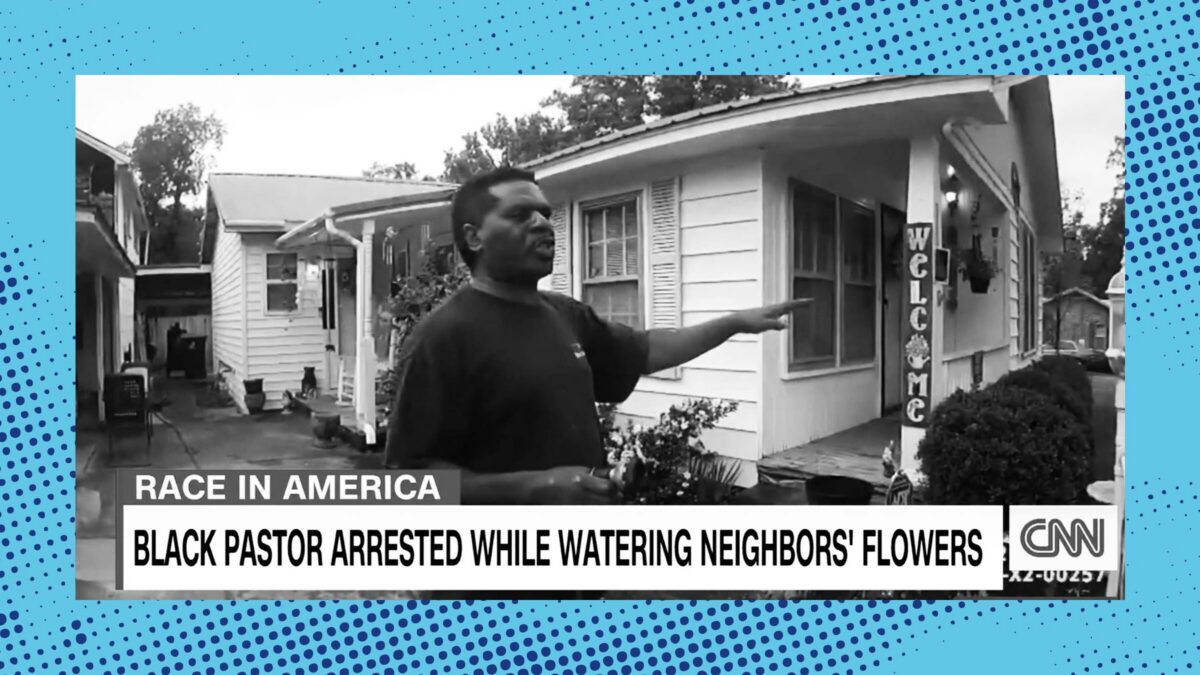
On May 22, 2022, three police officers for the city of Childersburg, Alabama, responded to a 911 call from a woman requesting they check on her neighbors’ house. The elderly white residents were out of town, she said, and she saw an unfamiliar “younger Black male” near the home. Cops arrived to find Michael Jennings, a 56-year-old Black man who is the pastor of a nearby church, watering the flowers with a garden hose.
When officers told Jennings that they got a call about someone who wasn’t supposed to be at the house, he clarified that he was, in fact, supposed to be there. “I’m Pastor Jennings. I live across the street,” he said. “I’m looking out for the house while they’re gone, I’m watering their flowers.”
Then officers asked for Jennings’ ID. And Jennings refused. “You have no right to approach me if I ain’t did nothing suspicious or nothing wrong,” he said. “I’m not gonna show y’all anything. I’m gonna continue to water these flowers.”
Under Alabama law, cops are allowed to stop a person in a public place and demand “his name, address and an explanation of his actions” if they “reasonably suspect” the person of a “felony or other public offense.” Watering flowers is not a felony. Officers nevertheless arrested Jennings, alleging that his failure to show them his ID amounted to obstruction of governmental operations. The Childersburg Municipal Court dismissed the charge with prejudice a few days later.
Clip via YouTube
Jennings then sued the officers and the city in federal court for violating his constitutional right to be free from unreasonable searches and seizures. But his lawsuit has taken peculiar turns. Initially, the district court dismissed the case before Jennings could even take his claims to trial, finding that the officers had qualified immunity, a controversial legal doctrine that shields cops from consequences if judges think it is remotely plausible that the cops believed their actions were lawful.
Then, the Eleventh Circuit Court of Appeals reversed, concluding that the officers were not entitled to qualified immunity because they had no probable cause to arrest Jennings. In a per curiam opinion, the three-judge panel expressly noted that, although they considered it “always advisable to cooperate” with cops, Jennings was “under no legal obligation to provide his ID.” The Eleventh Circuit sent the matter back to the district court so that Jennings could make his case.
The district court again denied Jennings that opportunity. In a May 2025 opinion, R. David Proctor, a senior judge appointed by President George W. Bush, claimed that it was “an open question” under Alabama law as to whether the state’s “stop-and-identify” statute allows cops to demand a physical ID “in a non-driving context”—a question which Alabama’s highest court needed to answer before Jennings’ federal case can proceed. Proctor certified the question to the Alabama Supreme Court, asking them to weigh in, and explained that their answer “may determine the outcome” of Jennings’s case, because it would “resolve whether there was probable cause (and thus qualified immunity).”
What Proctor is saying here is that, if the Alabama Supreme Court were to hold that state law permits officers to demand a physical ID, he would again find that the officers had qualified immunity and again dismiss Jennings’s claims, despite the Eleventh Circuit’s ruling. Effectively, Proctor was inviting a state supreme court to overrule a federal appeals court decision and restore his authority to protect police officers who treated “Watering Flowers While Black” like an arrestable offense.

And last month, the Alabama Supreme Court did exactly that. Justice William Sellers wrote for the six-justice majority that, under state law, “the suspect bears the burden to completely identify himself,” so if the officer thinks “a suspect provides an incomplete or unsatisfactory response,” the cop can demand a physical ID and arrest the person if they don’t hand one over.
As a reminder, the text of the Alabama statute only says that officers can demand the “name, address and an explanation of his actions” from someone they suspect of a felony. The law makes no mention of a physical ID. Jennings v. Smith thus transforms the state’s stop-and-identify law into a show-me-your-papers regime.
As another reminder, Jennings literally provided the three things the statute authorizes officers to demand: He’s Pastor Jennings, he lives across the street, and he’s watering his neighbors’ flowers while they’re away. Despite this fact, Sellers wrote that Jennings refused to identify himself “properly,” and that he was only “subsequently identified” as Michael Jerome Jennings. What Sellers is arguing here is that because Jennings provided his title and last name, but not his first name, it was reasonable for police to put him in cuffs for watering his neighbor’s flowers.
Justice Brad Mendheim authored a dissent, joined by two other justices, that focused on how weird it was for the court to be hearing the case at all. The dissent stressed that Proctor openly asked the state supreme court to reevaluate the law in direct response to an Eleventh Circuit ruling he didn’t agree with—the jurisprudential version of asking dad if you can protect cops who harass Black people after mom said no. “We should decline to answer,” he said.
The Alabama Supreme Court’s new reading of the statute raises serious concerns for the constitutional rights of people in the state. Nearly 1 million Alabamians don’t have drivers licenses, and over 3 million Alabamians don’t have passports. Yet now, apparently, they can be arrested any time a cop deems their verbal self-identification deficient in some way and they don’t provide a physical ID. Jennings told the police who he was, where he lived, and what he was doing—watering flowers, as if they couldn’t see that for themselves—and they put him under arrest anyway. The Alabama Supreme Court’s ruling further empowers bad cops to keep arresting good neighbors.