Across the country, Republican legislators have been hard at work devising innovative ways to punish state court judges who rule against them. From expanding supreme courts to channeling jurisdiction over key issues into friendly courts to reworking judicial nomination and oversight commissions, red state lawmakers have increasingly asserted their dominance over this other, ostensibly co-equal branch of government.
In Kentucky, the legislature is keeping things simple by just going straight for individual judges they don’t like. In January, the Republican-controlled Kentucky House took up impeachment proceedings against two more liberal members of the state judiciary, Kentucky Supreme Court Justice Pamela Goodwine and 22nd Circuit Court Judge Julie Muth Goodman.
Republican legislators have not been shy about their enmity toward the state judiciary. As Republican state Representative TJ Roberts put it, “The Kentucky judiciary is very liberal and the judicial and executive branches work together to ensure that the super-majority Republican legislature in Kentucky is kneecapped.”
Republican legislators have also not been shy about the fact that the impeachment inquiries were responses to the judges’ rulings. Goodwine, whom voters elected to the Kentucky Supreme Court in 2024, cast the decisive vote in a 2025 ruling that invalidated a Republican-backed law to restructure governance of Jefferson County Public Schools, which includes Louisville and heavily favors Democrats. The law, which Republicans passed over Democratic Governor Andy Beshear’s veto, would have shifted authority away from the locally elected board of education and toward the superintendent, who was more aligned with state Republicans on “school choice.”

Goodwine’s vote preserved the existing governance structure, and for that, she became a target. In October 2025, two months after Goodwine sat for oral argument in the case, a state Republican official, Jack Richardson, filed the impeachment petition over Goodwine’s decision to participate in the case despite receiving campaign donations from political action committees associated with Beshear and with the state teachers’ union.
Neither the union nor the governor were parties to the case, and Richardson barely remembered to mention them when he discussed his true motivations. “There needs to be radical judicial reform in this country, and it’s going to have to start with the courts and start with the judges,” he said. “We’ve got a slew of judges that are psychotic. That is, they’re totally detached from reality, and this has got to stop.”
In March, the House impeachment committee announced that it would not pursue the petition against Goodwine any further. But comments like Richardson’s are revealing: In Republicans’ minds, the real problem here is not Goodwine’s judicial approach, but voters’ choice to elect her in the first place. As House Speaker David Osborne put it when Goodwine decided to hear the case, “Kentuckians would be better served to keep politics out of the court, and the court out of politics.”
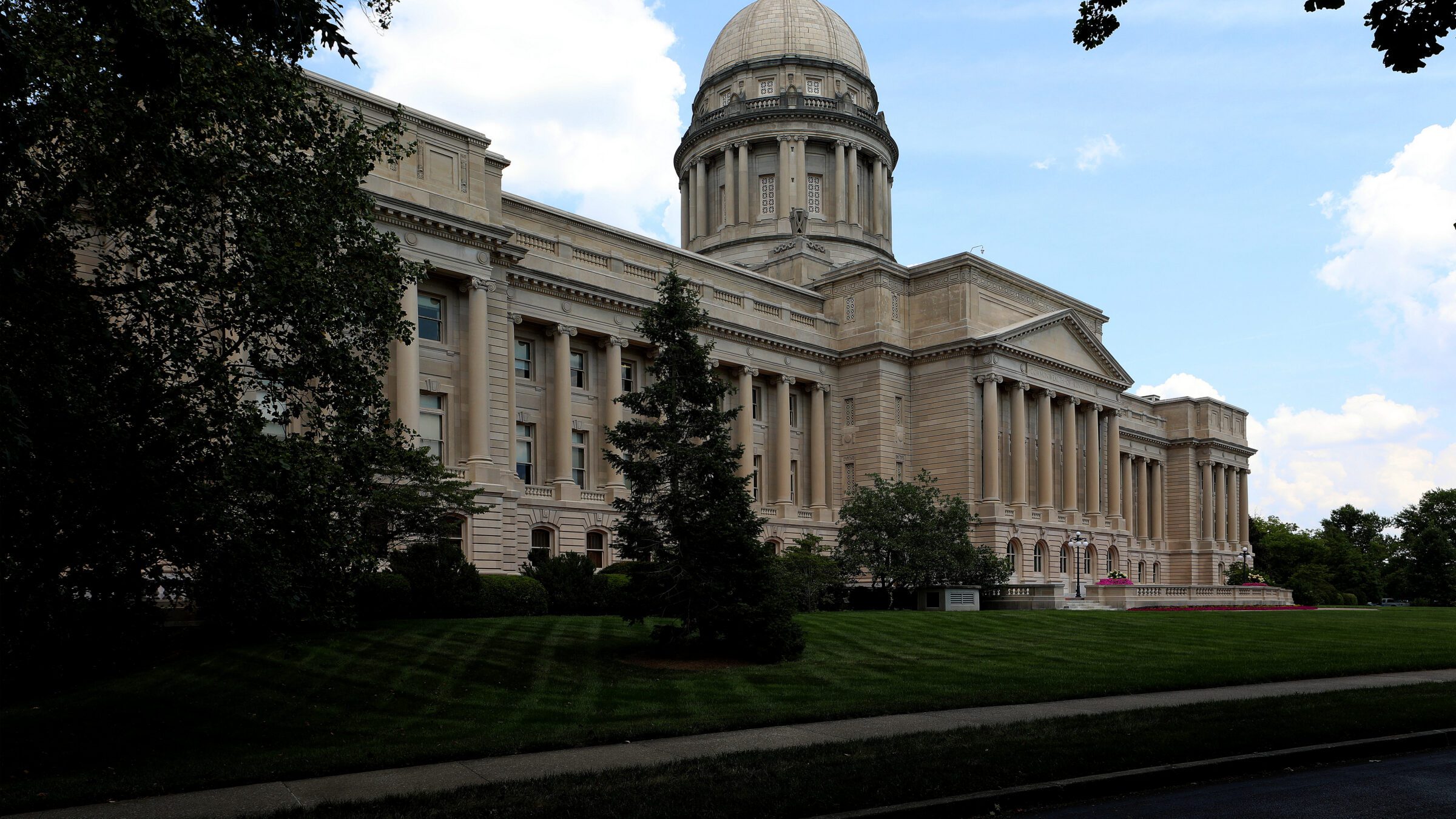
The Kentucky State Capitol in Frankfort (Photo By Raymond Boyd/Getty Images)
While Republicans at least gestured toward accountability in their case against Goodwine, they made clear that their impeachment of Goodman was about her rulings. Goodman, a Jefferson County circuit judge, was impeached by the Kentucky House on charges that she abused her authority in certain criminal sentencing and civil rulings. Much of the petition, submitted by former state Representative Killian Timoney, is related to Goodman’s statements about racial disparities in the justice system—for example, a case in which she noted a “clear pattern of disparate charging decisions by the Commonwealth in which white defendants are charged with lesser offenses and given better offers than defendants of color.” Timoney’s petition charged that statements like this are evidence of Goodman’s bias in favor of Black defendants.
The petition also alleged that Goodman gave out criminal sentences that were too lenient, and that she was overly skeptical of claims by lawyers representing the University of Kentucky in employment discrimination cases. Lawmakers pointed to six specific cases that were later reversed by the conservative Kentucky Court of Appeals that they said demonstrate bias.
Before this year, Kentucky has only impeached two judges in its history. In 1806, the House impeached and the Senate removed Judge Benjamin Sebastian for receiving a foreign pension, and for his part in the “Burr Conspiracy” to push states in the then-southwest of the country, including Kentucky, to secede from the United States and form an independent nation. In 1916, the House impeached Judge J.E. Williams for misusing public funds, but the state Senate did not remove him. Now, a century later, the Senate will consider whether to remove Goodman from office, too, for her crime of being too conscious of systemic discrimination.
The House voted to impeach Goodman in March, but she has appealed to the Kentucky Supreme Court. In late March, she got some support when Franklin Circuit Court Judge Phillip Shepherd nullified the impeachment resolution, stating that under Kentucky’s constitution, “the legislative impeachment power does not extend to a judge’s rulings or court administration unless such conduct involves criminal acts beyond the scope of lawful judicial duties.”
Clip via YouTube
It remains to be seen how these appeals will be resolved, but whether the Senate ultimately convicts Goodman may matter less than the chilling effect the process exerts. When lawmakers demonstrate a willingness to scrutinize and remove judges over the substance of their decisions, it signals to the entire judiciary that certain lines of reasoning carry personal risk.
That dynamic is not unique to Kentucky. The state’s actions echo earlier efforts in Pennsylvania, where Republicans in 2018 sought to impeach the entire state Supreme Court majority in a case that struck down a Republican-proposed congressional map as an illegal partisan gerrymander under the state constitution. That effort ultimately failed, and subsequent attempts to unseat some of the same justices in retention elections backfired when voters reaffirmed their positions on the bench.
Still, the impulse persists. In multiple states, conservative lawmakers have increasingly framed courts not as coequal interpreters of the law, but as mere roadblocks to their legislative priorities. What distinguishes the Kentucky cases is how directly these lawmakers tie impeachment to judicial reasoning. In Goodwine’s case, the mere act of casting a decisive vote in a politically salient case was enough to prompt an inquiry. In Goodman’s case, her acknowledgment of racial disparities was enough to get her charged as biased.
Taken together, these efforts amount to a test of how far legislatures can go in reshaping the boundaries of judicial independence. Courts derive their legitimacy from the expectation that judges can apply the law without fear of reprisal. Undermining that expectation risks transforming the judiciary into a rubber stamp for other branches of the government. This result would mark a profound shift in the balance of U.S. governance, normalizing a system in which courts serve not as a check on legislative power, but as an extension of it.