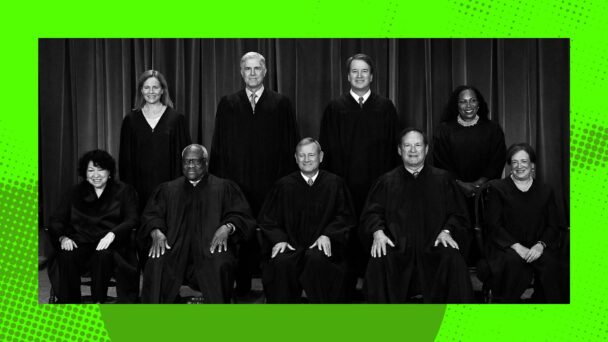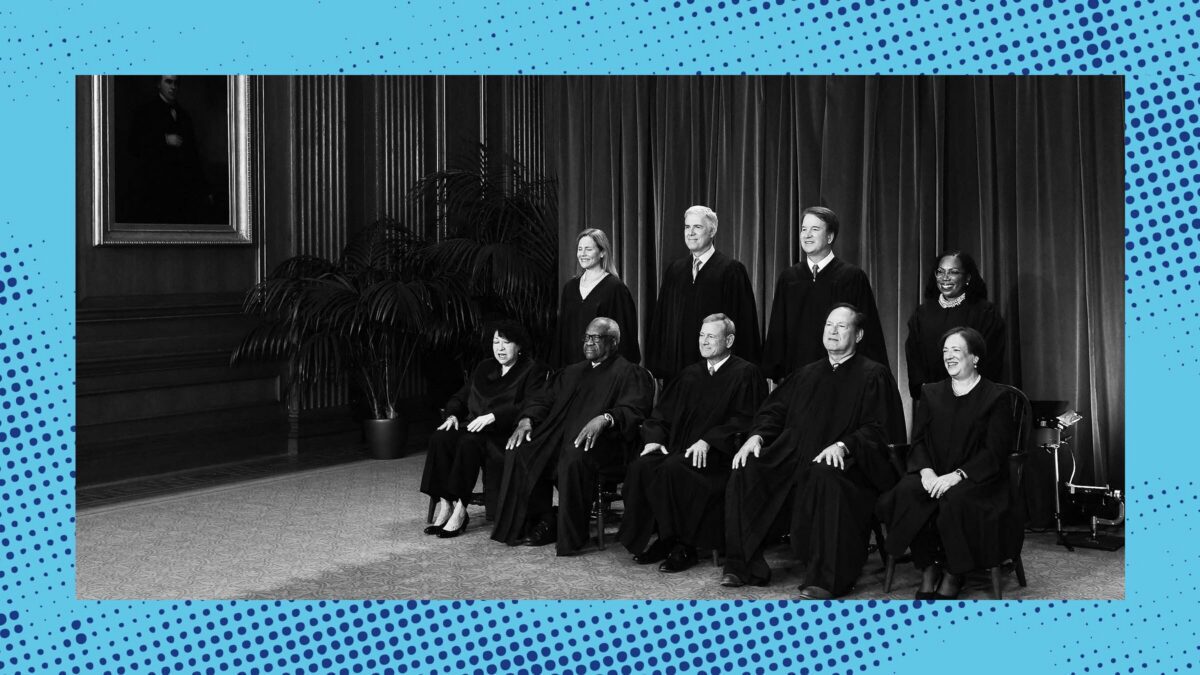
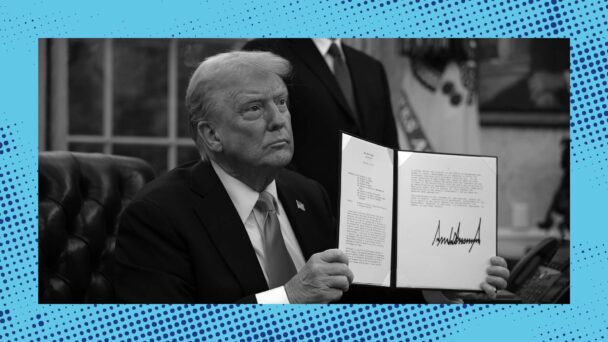
On January 20, 2025—his first day back in the White House—President Donald Trump issued an executive order purporting to override the Fourteenth Amendment’s guarantee of birthright citizenship. Tomorrow, the Supreme Court will hear oral argument in Trump v. Barbara, a direct challenge to the constitutionality of that order.
That the birthright citizenship argument is scheduled for April Fool’s Day makes a grim sort of sense, because the argument itself is a sick joke. Trump is claiming that he has the unilateral power to create a permanent, hereditary legal underclass unseen in America since before the Civil War. In doing so, he is rehashing grotesque legal arguments that every branch of government has rejected for generations, and placing himself at odds with the plain text, history, and purpose of the Fourteenth Amendment.
Congress adopted the Fourteenth Amendment after the Civil War in significant part to repudiate the Supreme Court’s ruling in Dred Scott v. Sandford. That 1857 case held that the longstanding principle of citizenship by birth categorically did not apply to Black Americans, whether free or enslaved, and that they could never become citizens of the United States. Eleven years later, in order to reject this holding and to place the citizenship of disfavored minorities beyond political dispute, Congress declared in the first sentence of the Fourteenth Amendment that “all persons born or naturalized in the United States, and subject to the jurisdiction thereof, are citizens of the United States and of the State wherein they reside.”
In 1898, 30 years after the enactment of the Fourteenth Amendment, the Supreme Court was called upon to decide whether “all persons” really meant “all persons.” Wong Kim Ark was born in San Francisco to Chinese parents who, under the Chinese Exclusion Act passed by Congress in 1882, were “subjects of the Emperor of China” and could not legally immigrate to the United States. After a visit to China, customs agents denied Wong Kim Ark reentry into the country, claiming that he wasn’t a citizen. But in United States v. Wong Kim Ark, the Supreme Court ruled that he was, and affirmed “the ancient and fundamental rule of citizenship by birth within the territory,” with only a narrow exception for the children of diplomats and members of sovereign Indian tribes.

Now, more than a century later, the Trump administration’s legal strategy is to pretend that this history does not exist. In the first paragraph of its brief, for example, the White House argues that the Fourteenth Amendment only extended birthright citizenship to “freed slaves and their children,” and not the “children of temporarily present aliens or illegal aliens.”
This is demonstrably false. The Reconstruction Congress explicitly debated the breadth of birthright citizenship during the drafting process, as some politicians, like Trump, feared the country would be “overrun” by immigrants. West Virginia Senator Peter Van Winkle, for instance, lamented that the Fourteenth Amendment would extend citizenship to “not only the negro race,” but also to “other inferior races that are now settling on our Pacific coast, and perhaps involves a future immigration to this country of which we have no conception.” Pennsylvania Senator Edgar Cowan fretted that it “would have the effect of naturalizing the children of Chinese and Gypsies born in this country.”
Those legislators lost, and Congress adopted the Fourteenth Amendment anyway. “The native born is a citizen, and a citizen by virtue of his birth alone,” said Vermont Senator Justin Morrill.
The dissent in Wong Kim Ark bemoaned this outcome, decrying the fact that such a rule would mean the federal government has no power to deport “children who are aliens by descent, but born on our soil.” Justice Melville Fuller contended that the Fourteenth Amendment did not allow “the children of aliens” whose parents remained “subject to a foreign power by virtue of the tie of permanent allegiance” to become citizens by birth.
Again, his view lost. Only one other justice joined him in dissent.
The Trump administration nevertheless claims in the third paragraph of its brief that the Fourteenth Amendment only extends citizenship to people who are “completely subject” to the country’s “political jurisdiction” and “owe direct and immediate allegiance to the nation”—a condition presumably dependent on parentage.
This, too, is demonstrably false. Over a decade prior to the Civil War, a New York court ruled that a child born in the state to a visiting Irish couple was an American citizen by virtue of her birth. Ohio Representative William Lawrence invoked that case on the House floor in support of the Fourteenth Amendment, and affirmed that “all children born here are citizens without any regard to the political condition or allegiance of their parents.” Illinois Senator Lyman Trumbull similarly referenced this case on the Senate floor, and explained that the Fourteenth Amendment was drafted so that “there might be no cavil” that the Constitution embraced this expansive rule, and not Dred Scott’s exclusionary rule.
Conservative law professor Ilan Wurman has recently taken it upon himself to defend the Trump administration’s ahistorical view of birthright citizenship. In an amicus brief, Wurman claimed that birthright citizenship “almost certainly excluded the children born to unlawfully present aliens,” and is “at best unsettled” with respect to the children of “temporary visitors.” This too is demonstrably false—a sloppy revival of the dissent in Wong Kim Ark, which insisted that there is “an essential difference between birth during temporary, and birth during permanent residence.”
Tomorrow’s oral argument in Trump v. Barbara will not tell us whether the Constitution guarantees birthright citizenship. We already know that it does, and we have known it for a long time. The Trump administration’s argument is at odds with 128 years of Supreme Court precedent, decades of reputable academic scholarship, and the concept of multiracial democracy itself.
What it will show, though, is how far gone this Supreme Court is. In a functioning legal system, Trump v. Barbara would not get anywhere near the highest court in the land. But Trump has been able to get it there because of the complicity of the conservative legal movement, whose thirstiest legal academics are trying to rewrite Fourteenth Amendment by recasting its settled meaning as mere “conventional wisdom.” The Trump v. Barbara oral argument will reveal nothing new about the law. All it will reveal is how willing the justices are to set the law aside in furtherance of Trump’s white nationalist project.