Priscilla Villarreal probably did not think twice about sending the texts that got her arrested, handcuffed, and perp-walked through a room full of jubilant, laughing cops. After all, Villarreal, a citizen journalist in Laredo, Texas, was just doing one of the more mundane tasks of her job: On two separate occasions in 2017, she texted a longtime source in the city’s police department, asking him to corroborate two bits of information she’d already learned from her reporting—the identity of a border agent who had died by suicide, and the name and condition of a person who had been involved in a fatal car accident.
On both occasions, the officer she texted confirmed those details, and so Villarreal, who goes by Lagordiloca, went ahead and published her stories on Facebook, where she had more than 100,000 followers. By all accounts, Villarreal is very good at what she does: Although she is not employed by a traditional media outlet, a 2019 New York Times profile detailed her knack for scooping the competition on major stories about corrupt local officials, and described Villarreal as “arguably the most influential journalist in Laredo.”
Like many journalists, Villarreal has, on occasion, reported stories that reflected poorly on law enforcement, and she says that at some point, the powers that be in Laredo decided that they’d had enough. Several months after she sent those texts, police arrested her for violating a section of the Texas Penal Code that makes it a felony for any “person” who seeks to “obtain a benefit” to “solicit or receive” information “that has not been made public” from a “public servant.” Villarreal says she was the first person in Webb County to be arrested for an alleged violation of the statute in the 23 years since Texas lawmakers enacted it.
If you read the previous three paragraphs and are a little confused about how Texas could possibly have a statute that makes it a crime for a journalist to ask routine questions of public officials, you are right to be skeptical. Section 39.06(c), which governs the “misuse of official information,” is a pretty straightforward anti-public corruption law. The first two subsections are concerned with preventing elected officials and public employees from using inside information to make money—for example, a city councilmember who invests in a business they know is about to win a lucrative government contract. Here, read it for yourself:
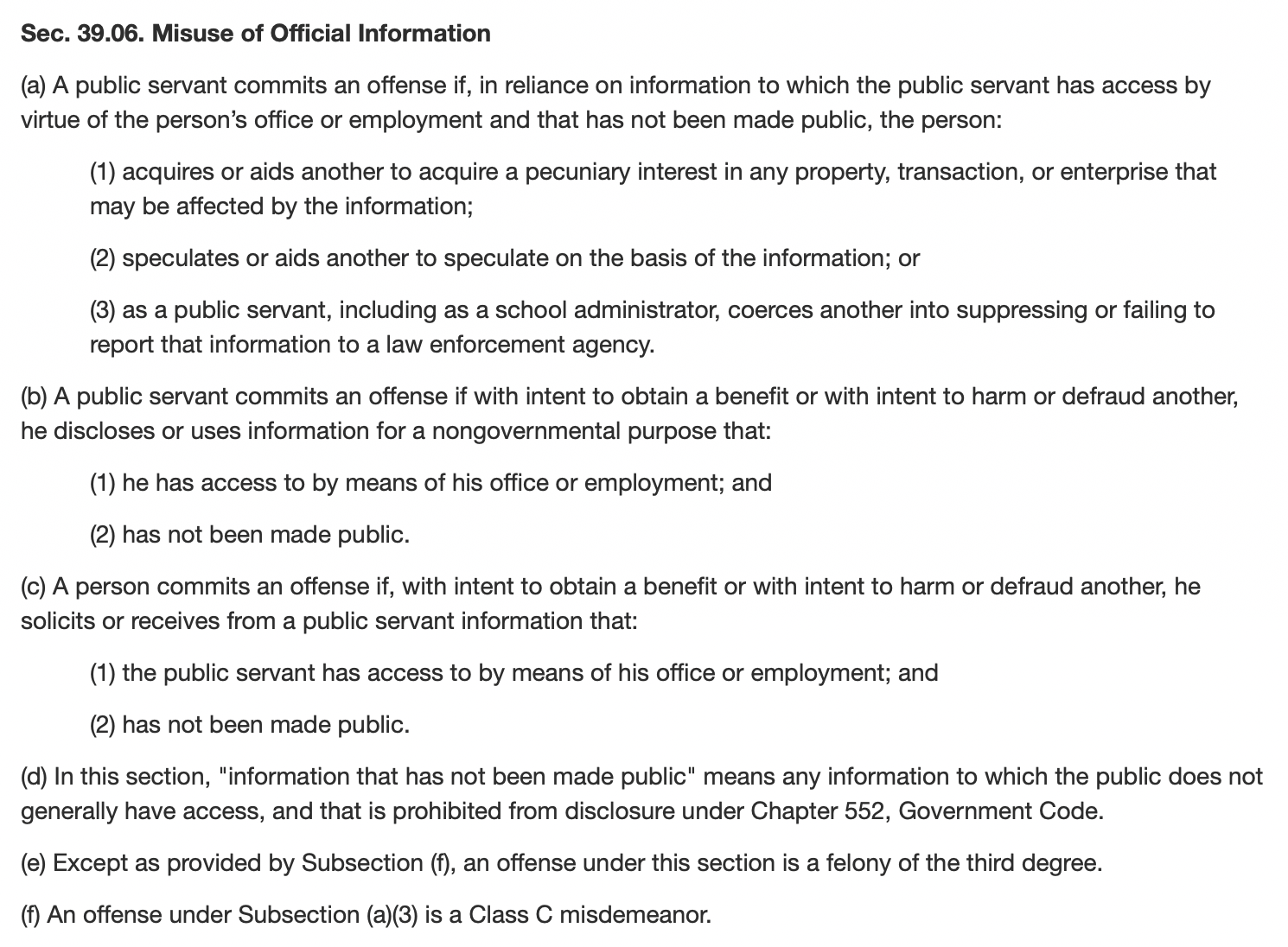
You can also see that subsection (c), which Laredo police accused Villarreal of violating, just takes care of the other side of these corrupt transactions, by prohibiting any “person”—that is, anyone who is not a public servant—from getting a public servant to give them inside information that they can use to get rich. In other words, this is not a law that is supposed to muzzle journalists. It is, ironically enough, a law that is supposed to prevent abuses of the public trust.
To fit the square peg of Villarreal’s texts into the round hole of Section 39.06(c), police and prosecutors got creative: In the affidavit submitted with the application for Villarreal’s arrest warrant, an officer wrote that Villarreal had “solicited” information by texting her source, and sought to “benefit” by using that information to make her Facebook page more popular. The affidavit did not address how the information qualified under the statute as “information to which the public does not generally have access,” which would have been a tricky argument to make, given that Villarreal, a member of the public, already had it in hand.
With this oafish little rhetorical parlor trick, police and prosecutors managed to transform an obscure anti-corruption law into a bespoke tool for punishing a journalist whose work made them upset. At the station, Villarreal says, officers surrounded her, laughing and taking pictures of her with their phones, celebrating that they’d gotten to her at last.
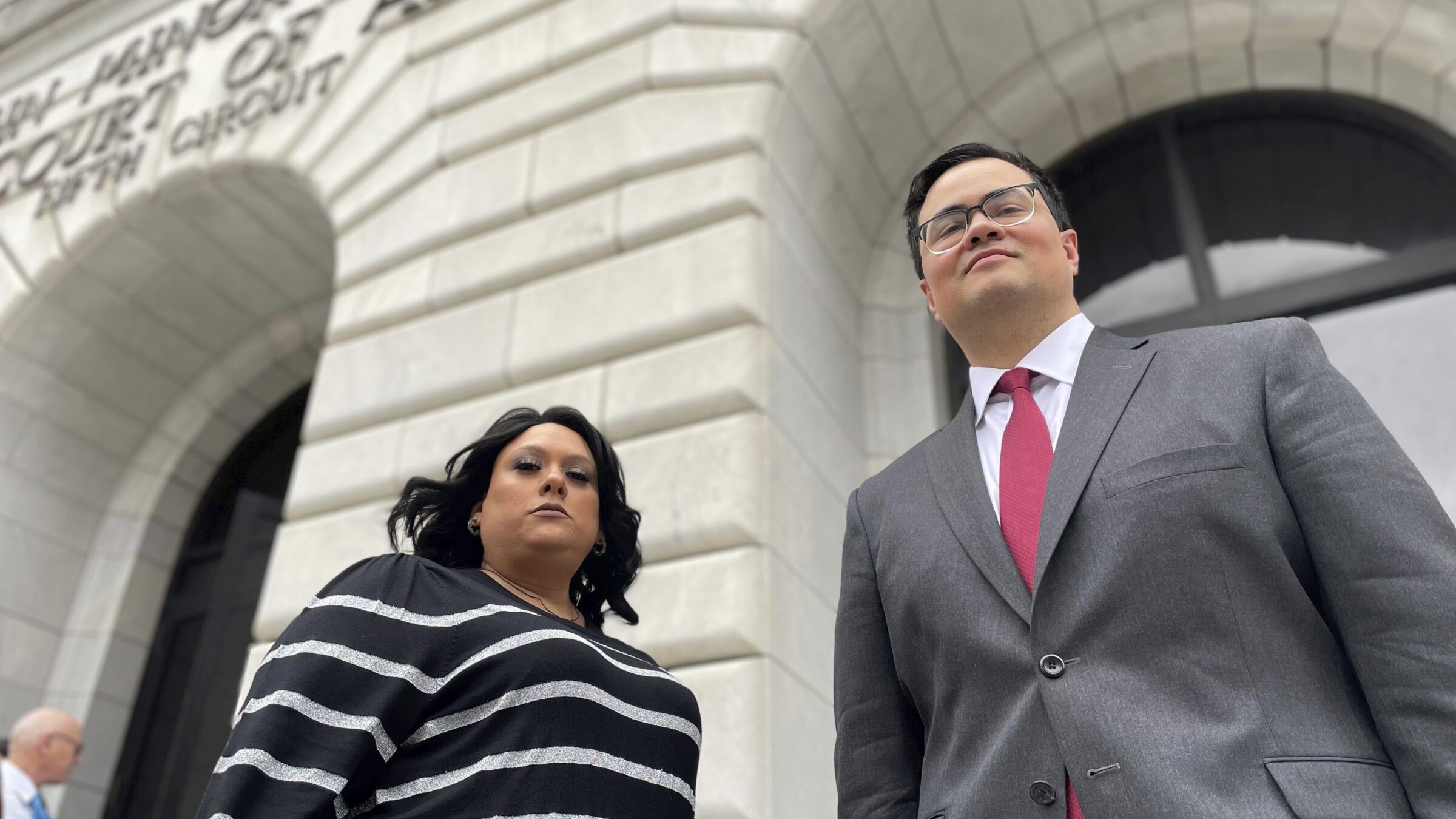
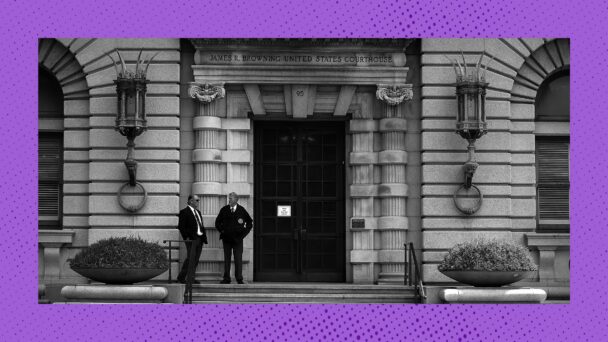
Priscilla Villarreal and her attorney outside the Fifth Circuit Court of Appeals, January 2023 (AP Photo/Kevin McGill, File)
After she was released on bond, Villarreal sought a writ of habeas corpus, which a Texas state court judge granted after finding Section 39.06(c) to be unconstitutionally vague. Villarreal then filed a federal lawsuit against the officers and prosecutors involved, arguing that arresting a reporter for the crime of reporting violated her First Amendment rights.
As far as legal questions go, this one feels as if it should have a thuddingly obvious answer. But the district court found that the officers were entitled to qualified immunity, a judge-made doctrine that generally prevents people from suing agents of the government for violating their constitutional rights, as long as the agent’s conduct did not violate “clearly established” law.
The ostensible purpose of qualified immunity is to ensure that government officials and employees have “fair notice” of what is and is not legal for them to do. But in practice, for decades, courts have read this “clearly established” requirement narrowly to make it functionally impossible for people to hold cops and other bad actors accountable. In the typical qualified immunity case, a court will search for a previous decision that declares a specific, extremely particular course of conduct unlawful. Then, after the court parses these cases in excruciating detail and does not find a fact pattern it deems sufficiently analogous, it will conclude that the unlawfulness of the conduct at issue, no matter how egregious, was not “clearly established.”
Eventually, Villarreal’s case arrived at the Fifth Circuit Court of Appeals, which upheld the lower court’s qualified immunity finding last summer. On Monday, the Supreme Court denied Villarreal’s petition for review, which means that nearly a decade after cops nursing a grudge cobbled together a harebrained legal theory that would allow them to drag a journalist down to the station and humiliate her, Villarreal has no further recourse.
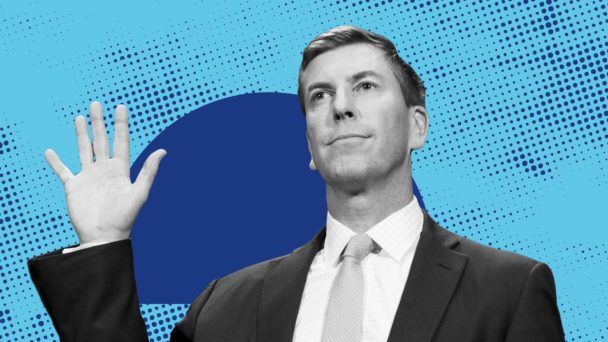
In a solo dissent, Justice Sonia Sotomayor called the Court’s decision not to hear Villarreal’s case a “grave error,” since no reasonable police officer with a passing familiarity with the First Amendment would ever think it legal to handcuff a reporter ”for doing something journalists do every day: posing questions to a public official.” By continuing to require a previous, basically identical case in order to establish “unlawfulness,” even in an “obvious” case like this one, Sotomayor pointed out that the Court creates an impossible predicament for journalists whom the government targets for harassment: In turning Villarreal away, the Court extends the strongest version of qualified immunity to a stunt that is so flagrantly, cartoonishly illegal that, at least until now, no cop had been foolish enough to try it.
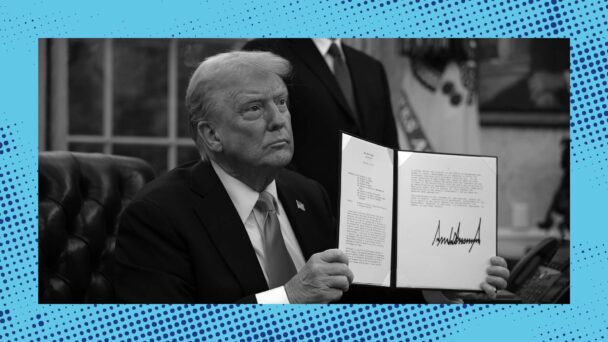
No Supreme Court case gets decided in a vacuum. The denial of certiorari in Villarreal comes as President Donald Trump, who has called the press the “enemy of the people,” continues to chip away at the foundations of the First Amendment. In his personal capacity, he has filed multibillion-dollar lawsuits that seek to silence journalists who cover him critically; in his official capacity, he has banned reporters from the White House for asking him questions, for reporting unflattering stories, and for simply being employed by an outlet that doesn’t refer to the Gulf of Mexico as the “Gulf of America,” as he would prefer. The decision in Villarreal sends a message to every other petty tyrant who finds the press annoying: that their right to retaliate against journalists is just another perk of the office they hold.
Villarreal’s case also has serious implications for the fractured and fracturing journalism industry, especially in areas where traditional newspapers are barely hanging on, if they exist at all anymore. Against all odds, Villarreal, armed with her iPhone and a Facebook page, has found a way to do real journalism in Laredo, breaking stories that people in power did not want their constituents to know about. She was punished twice for it: Once by what cops did to her, and a second time by a legal system that could not be bothered to do anything about it.
In an amicus brief filed in 2024, a coalition of media outlets warned the Court that the Fifth Circuit’s decision “exposes journalists in Texas, Louisiana, and Mississippi to the risk of arrest for carrying out their daily work,” and provides “a safe harbor for officials who would happily criminalize ordinary acts of journalism.” This is especially dangerous for those journalists, like Villarreal, who do not have institutional support: When the Court shows so little interest in protecting the rights the First Amendment guarantees, at least some journalists will (quite reasonably) conclude that reporting the news just isn’t worth the trouble anymore.
As Sotomayor put it on Monday, the Court’s refusal to hear Villarreal’s case “leaves standing a clear attack on the First Amendment’s role in protecting our democracy.” And it makes it all the more likely that, wherever they are, the next police department that goes after the next Priscilla Villarreal will never face any consequences for it.