Even Supreme Court watchers could be forgiven for overlooking Seven County Infrastructure Coalition v. Eagle County, Colorado, which the justices decided in May 2024. Seven County was an 8-0 decision rejecting a procedural challenge by environmental groups and a neighboring county to an 88-mile railroad project in Utah—hardly the stuff of Supreme Court blockbusters.
But fans of the regulatory state, as well as anyone concerned about climate change, ignore Seven County at their peril. After overturning Chevron v. Natural Resources Defense Council in 2024 and embracing judicial supremacy over federal agencies, the Court’s right-wing majority has now signaled that it won’t let consistency stand in the way of its anti-environmental policy preferences. In his majority opinion in Seven County, Justice Brett Kavanaugh provided legal and political fodder for attacks on the federal statute that compels the federal government to consider the climate impact of its actions, at a moment when that law is particularly vulnerable.
To explain why a unanimous decision like Seven County can be so ominous, we need to begin with Loper Bright Enterprises v. Raimondo. That 2024 Supreme Court decision upended decades of precedent by holding that judges no longer had to defer to agencies when agencies interpret their authority under federal statutes. Under the previous rule, known as the Chevron doctrine, where a federal statute was ambiguous, agencies—staffed by experts and subject to democratic checks via presidential elections—could interpret the statute itself, as long as the interpretation was “permissible.” Four decades later in Loper Bright, the Court rejected the Chevron doctrine and found that judges could reverse agency rules and decisions if the judge decided he or she preferred a different statutory interpretation.
Although Loper Bright is widely regarded as a dagger to the heart of federal regulation, for environmental advocates, all was not lost. Environmental advocates challenge federal regulations as well as defend them, suing to compel agencies to live up to statutory obligations in the face of polluter lobbying and resource constraints. Chevron was a Clean Air Act challenge brought by the Natural Resources Defense Council to a rule that would make it easier for large polluters to modify their facilities without triggering more stringent emission requirements. So in Chevron, agency deference benefitted not environmental interests, but polluters.
NEPA, however, is different. NEPA, or the National Environmental Policy Act, was the first major federal environmental statute of the modern era, signed by President Richard Nixon in 1970. NEPA requires all federal agencies, before building infrastructure, issuing grants, approving permits, or undertaking anything else classified as a “major project,” to prepare an environmental impact statement in which the agency considers the effects of the proposed action, how the agency can mitigate those impacts, and whether there are alternatives that could reduce or eliminate those impacts entirely.
The structure of NEPA protects both the environment and democratic accountability: Before using its authority or spending taxpayer funds, the federal government must consider the environmental consequences of its actions and make those consequences public. In doing so, agencies attempt to avoid accidentally causing harm, and make clear who is responsible for unavoidable or unavoided harms. If a court finds that an agency failed to adequately disclose the “reasonably foreseeable” results of its action under NEPA, the action is unlawful, and generally (but not always) the agency must pause the project until it has complied with NEPA.

That is what happened in Seven County. As the name suggests, seven counties in Utah planned to build an 88-mile railroad to transport waxy crude oil from the Uinta Basin to the national rail network, where it could be shipped to refineries in Louisiana and Texas. To build the railroad, the counties needed the approval of the U.S. Surface Transportation Board. The Board estimated that the greenhouse-gas emissions from the increased oil production made possible by the railway would be significant—comparable to the emissions produced by Ireland or Sweden. But the Board did not study the impacts of increased drilling in the Basin to produce the waxy crude that would be transported by the railroad (known as “upstream” impacts). It also did not examine the impacts of refining the waxy crude once it reached the Gulf Coast (known as “downstream” impacts).
As a result of these omissions, the D.C. Circuit found that the Surface Transportation Board had violated NEPA. The developers appealed to the Supreme Court, and presented the six-justice conservative supermajority with a test: Would the Loper Bright majority apply its principle of judicial supremacy over agencies in a case where judges favored increased regulation, or play a game of heads-I-win-tails-you-lose with environmentalists?
It will probably not shock you to learn that the Court sided with the developers, holding that the Surface Transportation Board complied with NEPA and that construction of the railroad could proceed. But Kavanaugh, who authored the majority, went further, using the opinion as an opportunity to air long-held grievances against NEPA, as well as the general principle that the government should study environmental impacts before it acts. Fully half the opinion is devoted to attacks on NEPA as a hindrance to development, accusing judges of trying to “micromanage” agencies. The first half of the decision culminates in the assertion that the “bedrock principle of judicial review in NEPA cases can be stated in a word: Deference.”
Having declared only a year prior in Loper Bright that the APA “prescribes no deferential standard for courts to employ,” the Seven County majority now insists that when it comes to an environmental check on agency actions, deference is the watchword. (Justice Neil Gorsuch, who wrote Loper Bright, did not join the opinion in Seven County, but only because he recused himself, as one of his former clients is a billionaire who controls a mining company that submitted an amicus brief in favor of restricting NEPA.)
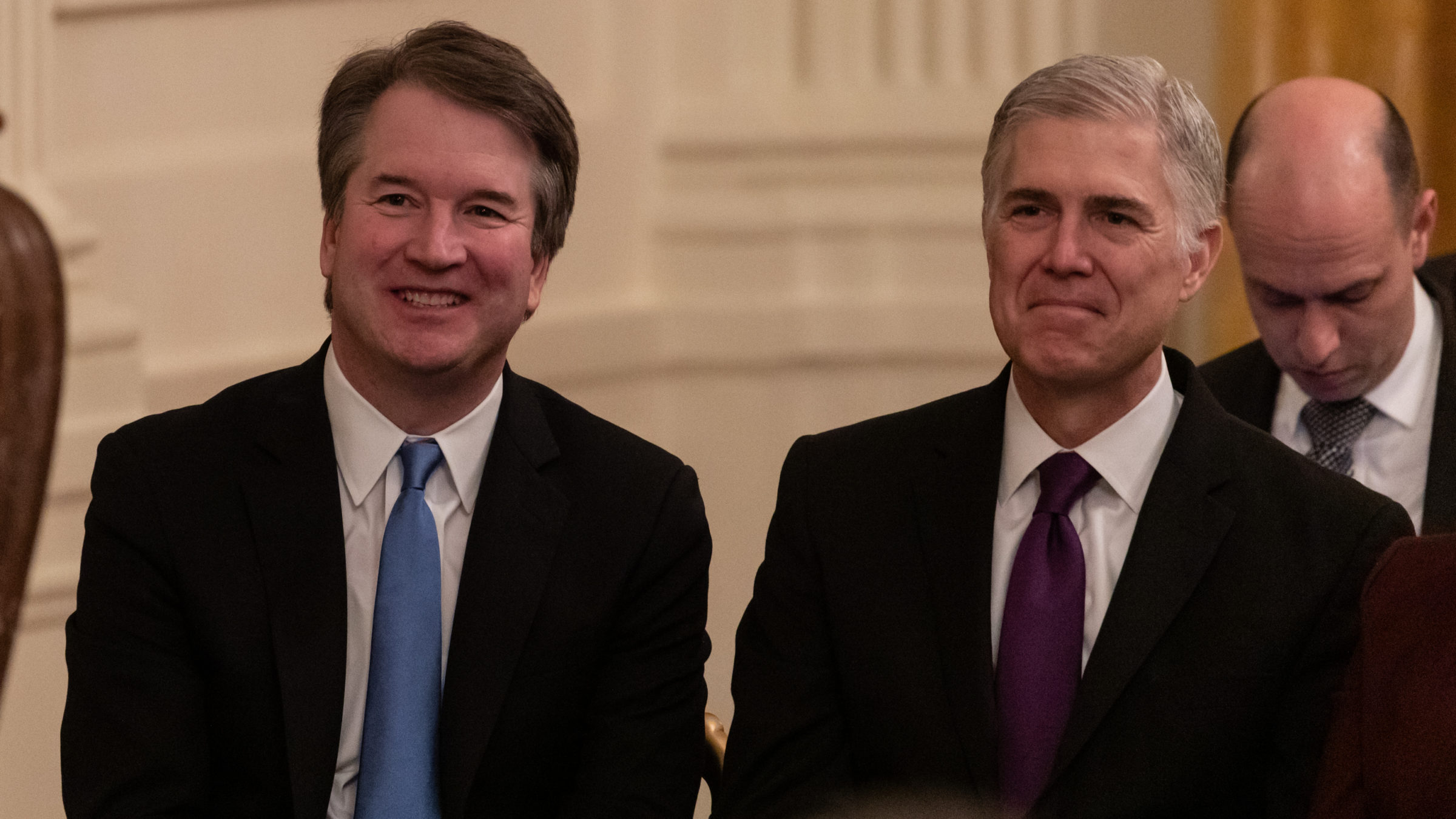
(Photo by Cheriss May/NurPhoto via Getty Images)
So how does the majority justify requiring deference to agency NEPA decisions while protecting courts’ authority to interpret statutes? NEPA requires agencies to consider any “reasonably foreseeable environmental effects.” Loper Bright assigns to judges, not to agencies, the job of deciding what “reasonably foreseeable” means in the context of NEPA. But when an agency decides, in the context of a particular project, that indirect impacts or impacts arising from separate but related projects need not be considered, judges must defer. Once an agency has decided that a particular impact is or is not “reasonably foreseeable,” that’s a factual determination to which the judge must defer.
The workability of this distinction—between the interpretation of statutory language and the application of that statutory language to facts—is debatable, to say the least. One of the reasons Chevron deference made sense and lasted as long as it did is precisely because this is a hard distinction to implement in practice.
But how the majority drew the line in Seven County has ominous implications for future administrative law cases. After eliminating agency deference as a general principle in Loper Bright, the Court in Seven County introduced a little twist: that some statutes require judges to defer to agencies, but other statutes do not. As a result, the Court was able to decide in 2024 that although agencies get deference under NEPA, the Court, not the EPA, gets to decide what counts as a “limitation” on wastewater under the Clean Water Act. This pick-and-choose approach favors corporate interests with a surgical precision that Loper Bright alone could not achieve.
For all Kavanaugh’s fulminating in the first part of the opinion, it’s the second part of Seven County that will empower the federal government to do real harm. Although it is only mentioned once in Seven County, it was clear from oral argument that Kavanaugh had in his crosshairs a 2017 D.C. Circuit opinion known as Sabal Trail. Sabal Trail held that the Federal Energy Regulatory Commission had to consider the greenhouse gas emissions caused by burning the fuel transported in a pipeline prior to approving its construction. Since Sabal Trail, climate advocates have argued that before approving fossil fuel infrastructure, the federal government must consider the climate impacts of burning the oil and gas it authorizes private companies to extract or transport.
A quirk of the Surface Transportation Board’s authority makes Seven County a little different: Unlike the Federal Energy Regulatory Commission, which can reject a pipeline proposal on the basis of its environmental impacts, the Surface Transportation Board is prohibited from considering the type of cargo to be transported when deciding whether to permit the construction of a railroad. Because the Board could not consider the nature of the cargo, it could not consider the climate impacts of that cargo. In other words, the Court could have decided Seven County without discussing agency deference under NEPA at all, let alone revisiting the scope of what counts as a “reasonably foreseeable” harm.
And that is exactly what the three-justice concurrence in Seven County, written by Justice Sonia Sotomayor and joined by Justices Elena Kagan and Ketanji Brown Jackson, argued. But not the majority. Not satisfied with taking potshots at NEPA in general, Kavanaugh went on to find that although increased drilling and refining were the foreseeable result of the railroad’s construction, because the drilling and refining were “separate projects,” the Board need not consider the increased pollution they would cause. Not content to dismantle federal regulation without indulging in self-righteousness about it, Kavanaugh describes a railroad necessary for expanding production in the Uinta Basin as a “scapegoat” for increased drilling and refinery emissions.
Fortunately, the doctrinal impacts of the decision may be less dire than Kavanaugh would hope. Nowhere in the opinion does he discuss the D.C. Circuit’s decision, explain how the lower court failed to adequately defer to the Surface Transportation Board, or say what appropriate deference to the agency would be. And where the project at issue involves not transportation but fossil fuel extraction itself, nothing in Seven County suggests federal agencies are free to ignore the emissions associated with burning those fuels.
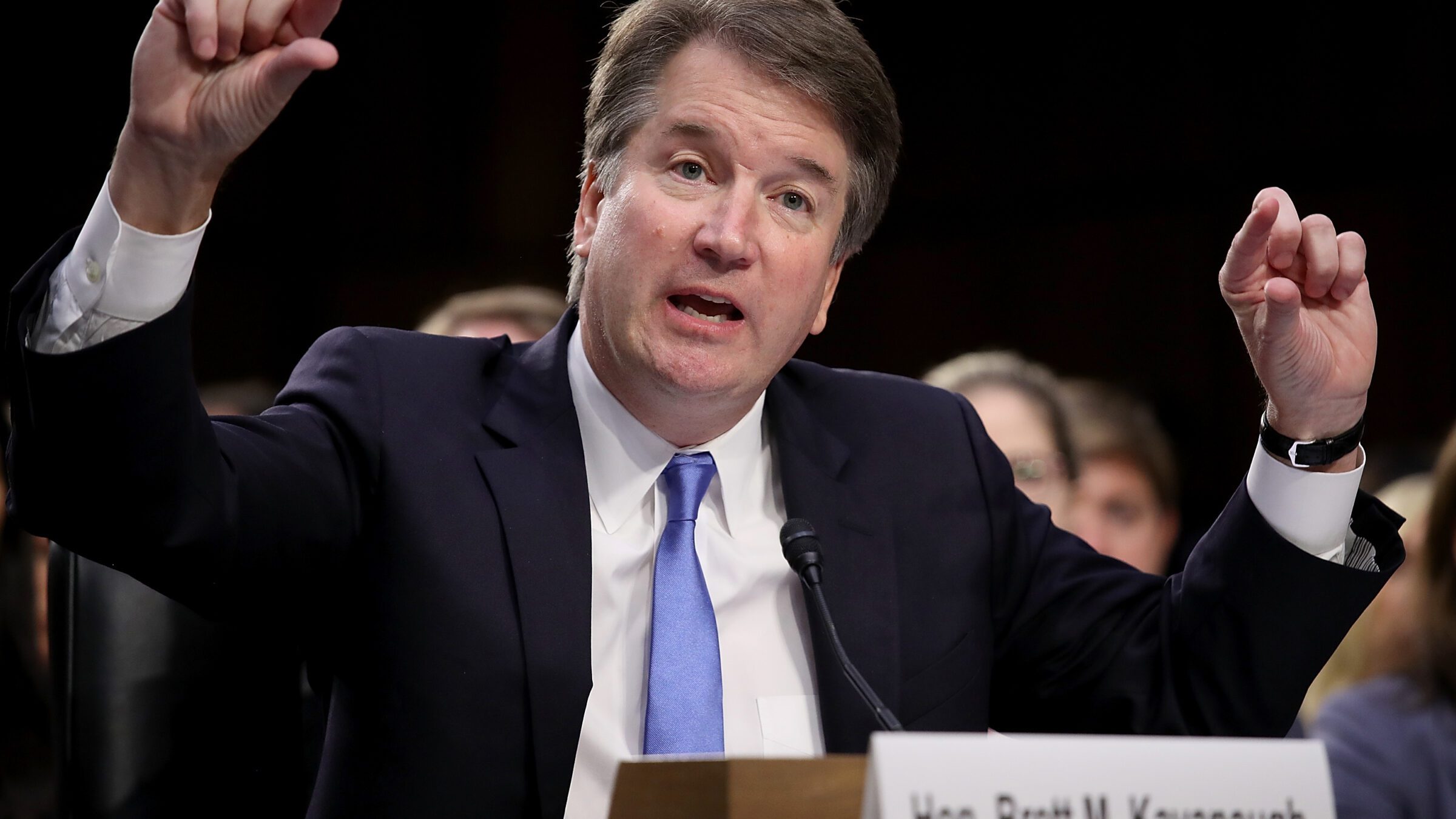
(Photo by Win McNamee/Getty Images)
But that may not stop lower court judges from viewing Seven County as a license to ignore NEPA’s climate mandate. Sure enough, when Judge Justin Walker, a 2020 Trump appointee to the D.C. Circuit, authored an opinion earlier this year concluding that Seven County is inconsistent with Sabal Trail, he used Kavanaugh’s deference-as-bedrock-principle quote as an epigraph—in bold, so that no reader could miss it.
Kavanaugh is not the only NEPA skeptic with a national platform these days. Advocates of the so-called “abundance agenda” have identified the permitting requirements of NEPA as a barrier to clean energy deployment. Fossil fuel advocates and conservative judges have wasted no time in leveraging this convergence: In Seven County, Kavanaugh pointedly refers to several “clean-energy projects” that were purportedly delayed by NEPA challenges—examples provided by the U.S. Chamber of Commerce via amicus brief.
What these “abundance” advocates overlook is that NEPA can be a tool for assessing whether a project will have net climate benefits or costs, and that environmentalists are increasingly using NEPA to force federal agencies to do precisely that. Right-wing judges, unfortunately, have not missed this point.