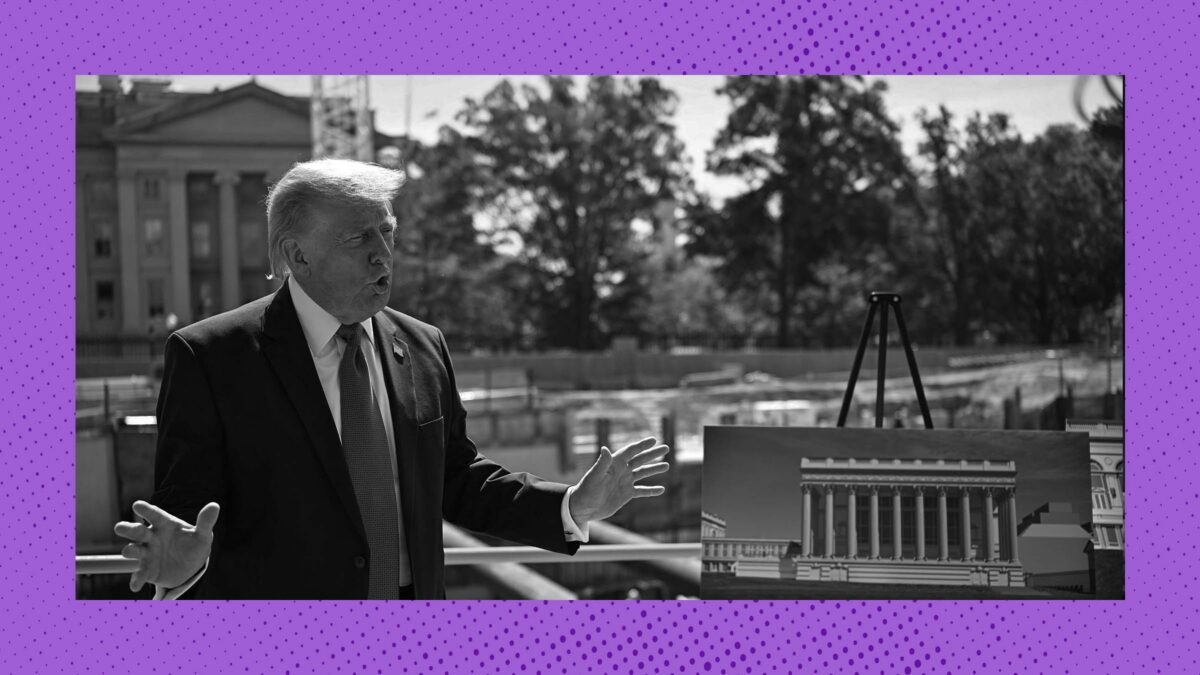
Last fall, President Donald Trump demolished the East Wing of the White House so that he could build a gigantic honking ballroom in its place, using a conspicuously fuzzy combination of private donations and hundreds of millions of dollars in taxpayer funds that lawmakers very much did not appropriate for that purpose. Federal law prohibits the construction of any new buildings on federal property in Washington, D.C., without the “express authority” of Congress, which, in news I am sure will astonish you, Trump did not bother obtaining first.
In an unsigned 5-4 opinion published on Monday, though, the Supreme Court decided that a president’s unilateral decision to bulldoze part of the White House was totally fine. The justices in the majority strained to avoid saying as much; in the final paragraph of their opinion, they expressly stated that it does not “pass upon the legality of the government’s East Wing project.” Throughout, the majority assiduously characterizes the ballroom as an initiative of the “federal government,” as if the fact that the subject matter is a flagrantly illegal stunt initiated by a specific president who is famous for not giving a shit about the law is an unimportant coincidence.
But the upshot of National Park Service v. National Trust for Historic Preservation is that whether or not Trump’s already-in-progress ballroom is “legal”—something that, in my view, the Supreme Court of the United States really ought to weigh, but whatever—no one has the power to stop its construction, even temporarily. As a result, if a federal court eventually rules on the merits that, no, Trump can’t build the ballroom, that conclusion will be academic. The ballroom will already be complete, and Getty Images will be awash in photos of Justice Clarence Thomas attending the ribbon-cutting ceremony, cocktail in hand, having an absolute blast.

This case started back in December, when the National Trust for Historic Preservation filed a lawsuit arguing that an array of federal statutes prohibit the ballroom’s construction. To show that it had standing—the legal right to sue—the Trust provided a declaration from Alison K. Hoagland, a history professor who sits on the organization’s board of trustees. In it, Hoagland explained that along with many others, she would “suffer both professional and personal injuries, including to my aesthetic, cultural and historical interests, if a ballroom of the proposed form and scale were constructed.”
In March, D.C. District Court Judge Richard Leon, an appointee of President George W. Bush, agreed, finding that “no statute comes close to giving the President the authority he claims to have.” Leon then entered a preliminary injunction allowing only construction on a below-ground “military installation”—a protective bunker beneath the planned ballroom—to continue while litigation continued, in light of the bunker’s putative importance to national security. Until Trump beat the Trust in court or Congress authorized the ballroom, though, that portion of the project would have to wait.
“The President of the United States is the steward of the White House for future generations of First Families,” Leon wrote. “He is not, however, the owner!”
Leon stayed his order to allow the Trump administration to appeal, and as anyone who has observed construction activity near the White House of late knows, it never took effect. The Supreme Court’s opinion on Monday ensures that it never will.
The thrust of the majority opinion is that Hoagland and the Trust probably do not have standing to sue over the ballroom, since “mere offense, disagreement, or distaste does not qualify” as the sort of “concrete and particularized injury” necessary to establish standing. The majority also found that Trump would suffer “irreparable harm” if he were not allowed to build the ballroom right now, based on the sworn declarations of various Trump gremlins who solemnly attested that their boss’s vanity pet project is very, very important, and that each passing day that he can’t complete it is both a national security risk and a grave injustice.
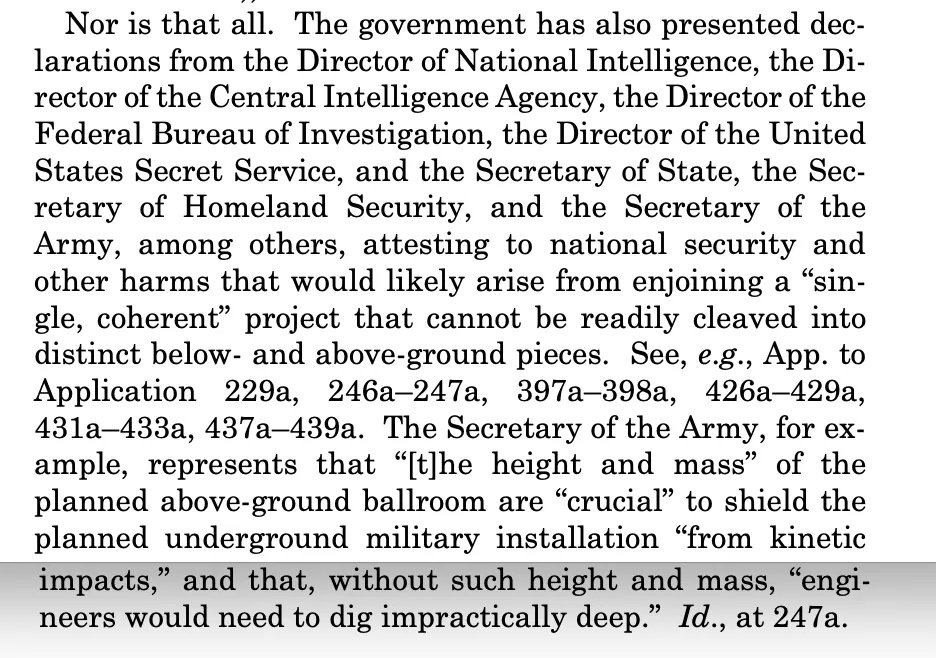
In a dissent joined by the three liberals, Chief Justice John Roberts argued that under Supreme Court precedent, the Trust has done enough to show that it has standing. As a “historical preservationist,” Roberts argued, Hoagland “can be aesthetically injured in a concrete, particularized way by the transformation of a historic building that she frequently enjoys.” By barring the Trust from suing, he concluded, the majority was allowing “the Executive’s likely infringement of the Legislature’s power of the purse…to continue.”
This part is of course descriptively right. But the problem with the dissent is that it accepts the majority’s framing—that technically, doctrinally, legally, the case is not about whether Trump can tear down part of the White House to build the Altria Coinbase Palantir Technologies Ballroom Presented By Truth Social, which is a real thing happening right now. Instead, the dissent is as focused as the majority on the intricacies of Article III standing, as outlined by the Court in (among other cases) Lujan v. Defenders of Wildlife and Spokeo v. Robins in 1992 and 2016, respectively—stuff that is interesting to civil procedure professors and basically no one else.
National Trust for Historic Preservation is yet another entry in the canon of cases in which the conservative justices, eager to implement their policy agenda yet reluctant to say so explicitly, cobble together some half-assed gibberish to assert that The Law compels their preferred result. An abstract concept like standing doctrine is especially useful in this context, since its contours are flexible enough to allow judges and justices to greenlight lawsuits from parties with whom they sympathize and, as here, to block lawsuits from parties with whom they do not.
The fight over the ballroom lays bare the absurdity of the Court’s strategy of “resolving” Trump-adjacent cases by pretending to do something (anything) else. For Trump and the Trust and everyone else watching this case, the only thing that matters here is whether the conservative supermajority’s favorite president gets to build what he wants. The answer is yes, at least until the next Democratic president promises to raze the ballroom at their earliest opportunity, at which point the Court will suddenly rediscover its passion for preserving both D.C. landmarks and the separation of powers, and decide that before anyone goes tearing anything down here, it really ought to let the legal process play all the way out.