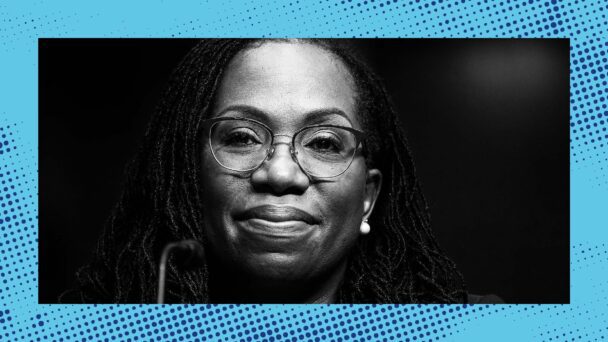
On Thursday evening, Justice Ketanji Brown Jackson delivered the annual lecture held at the University of the District of Columbia, one of the nation’s few historically Black law schools, on the ability of the law to serve the public interest. She used the opportunity to denounce the Supreme Court’s new approach to the shadow docket, which is now how the Court makes most of its decisions. “Our modern methods are not serving the court or the country well,” Jackson said.
Generally, when the justices issue orders on the shadow docket, they do not have a full lower court record, briefing, or oral argument. They do not provide opinions explaining their rationale and citing precedents. And, Jackson argued, they do not consider whether the facts reflect the existence of “actual emergencies” that warrant the Supreme Court’s intervention.
Jackson argued that, in emergency proceedings, “the equitable balance of the competing harms” should be the primary factor in the Court’s analysis. The Supreme Court’s decisions can cause “significant real-world harms,” she said, and shadow docket orders in particular “seem oblivious and ring hollow” when they fail to “acknowledge that reality.”
The very next day, the Supreme Court issued yet another shadow docket order, in Department of Homeland Security v. League of Women Voters. The unsigned order allows Trump’s DHS to access confidential Social Security records, and facilitates the administration’s push for states to use the federal government’s notoriously unreliable immigration database to conduct voter roll purges.
Writing for the liberal justices in dissent, Jackson castigated the Court for focusing solely on “the harms that the government will purportedly suffer” if its conduct is blocked, and omitting any consideration of the harms that the government’s conduct already “caused, and will likely continue to cause, to lawful voters.” Claiming to weigh the equities while only looking at “one side of the scale” was “the judicial equivalent of expecting a seesaw with weight applied on only one side to work properly,” she wrote.
In places like Thursday’s speech and Friday’s dissent, Jackson has continuously sought to call attention to the deeply perverse ways that the Court is exercising its equity jurisdiction on the shadow docket. Under the Court’s precedents, emergency applicants are supposed to show that they’re “likely to succeed on the merits” of their appeal from a lower court’s ruling, that they will be “irreparably injured” without immediate relief, and that the balance of the equities tilts in their favor; in other words, fairness is both the explicit purpose and the explicit standard. But the Republican justices have repeatedly abandoned those standards in service of their own purposes. And when the people empowered to wield equitable jurisdiction are actively hostile to the concept of equity, they produce injustice instead.
Hours before Jackson gave her speech, she received another shadow docket petition from the Trump administration that aims to restart “third-country removals,” the sanitized term for deporting people to countries they are not from, and where their lives may be in danger. It was the 40th such application the Trump administration has made over the past year and a half. For comparison, the George W. Bush, Barack Obama, and Joe Biden administrations made a combined total of 25 shadow docket applications over the course of 20 years.
At a public appearance in March 2026, Jackson attributed the spike to a corresponding “uptick” in “the court’s willingness to get involved.” Indeed, the Court has granted more than 70 percent of the administration’s requests. In her speech on Thursday, Jackson talked about what those grants look like in practice. She specifically highlighted the Court’s shadow docket orders allowing Trump to slash the Department of Education’s workforce, cancel hundreds of millions of dollars in government grants, and, as she put it, authorize “roving ICE patrols to conduct race-based searches and seizures of Latino residents in Los Angeles.”
With these grim examples, Jackson illustrated how transforming the emergency docket into a “special avenue that certain privileged litigants can use selectively” puts people in danger, and compromises both the functioning of the judiciary and the Court’s credibility with the public. And in Friday’s dissent, she similarly rejected the idea that the government is injured and requires emergency response services from the Supreme Court “whenever it is prevented from violating the law.”
The shadow docket did not always work like this. In years past, Jackson said, emergency powers were reserved for emergency situations. Otherwise, justices “waited humbly until the facts were established and the lower courts had fully and fairly assessed the law.” Today’s justices, in contrast, are impatient, imperious, and unjust.
Equitable powers are supposed to protect people from harm. But the Court is simply unwilling or unable to honestly weigh harms experienced by people who aren’t like them.