Roundup is the most widely used herbicide in the United States. Since 2015, over 65,000 people diagnosed with non-Hodgkin’s lymphoma after repeated exposure to Roundup have sued its manufacturer, the Monsanto Company, which is a subsidiary of Bayer AG. Plaintiffs allege that the companies failed to warn users about the cancer risks associated with glyphosate, Roundup’s active ingredient. To date, juries have awarded billions of dollars in damages.
In an effort to minimize its liability, Bayer developed a three-part strategy: First, it published scientific literature defending glyphosate’s safety. Second, it lobbied state legislatures to immunize pesticide manufacturers from failure-to-warn lawsuits. Finally, it argued in court that federal law bars many of these claims altogether.
This half-legal, half-PR campaign became more urgent earlier this year when a scientific journal retracted a widely cited 2000 paper that concluded that glyphosate poses no meaningful human health risks. The journal retracted the paper, which had been cited for decades by regulators and Bayer as evidence of glyphosate’s safety, after finding that Monsanto scientists had played an undisclosed role in developing and shaping it.
This study’s retraction renewed scrutiny of both the science and the regulatory decisions based on it. The Environmental Protection Agency has previously concluded that glyphosate is not likely to be carcinogenic when used as directed. However, the agency is also conducting a safety review of glyphosate under pressure from allies of Secretary of Health and Human Services Robert F. Kennedy, Jr.—a process that includes reevaluating the evidence supporting the product’s approved labeling.

In recent years, Bayer’s legislative strategy has also faltered. In April, a bipartisan coalition of lawmakers stripped pesticide liability protections championed by industry lobbyists from a must-pass annual agriculture bill. Bayer has also pushed bills in state houses across the country providing that if the EPA approves a warning label, pesticide manufacturers cannot be sued for failing to provide additional warnings. But in most states, these proposals stalled amid bipartisan concerns about eliminating state tort remedies.
Just when Bayer seemed like it might be on the ropes, the Supreme Court stepped in. Last week in a 7-2 decision, the Court held in Monsanto v. Durnell that existing federal law preempts many state law claims against pesticide manufacturers whose labels have been approved by the EPA. The Court’s logic, as outlined in Justice Brett Kavanaugh’s majority opinion, is that because Congress has given the EPA authority over pesticide labeling, states cannot use tort law to require more.
Pesticide companies have largely failed to convince federal and state legislatures to limit their legal liability via the political process. But they were able to win anyway by turning to their allies on the Supreme Court, who were happy to protect them from having to compensate people harmed by their products.
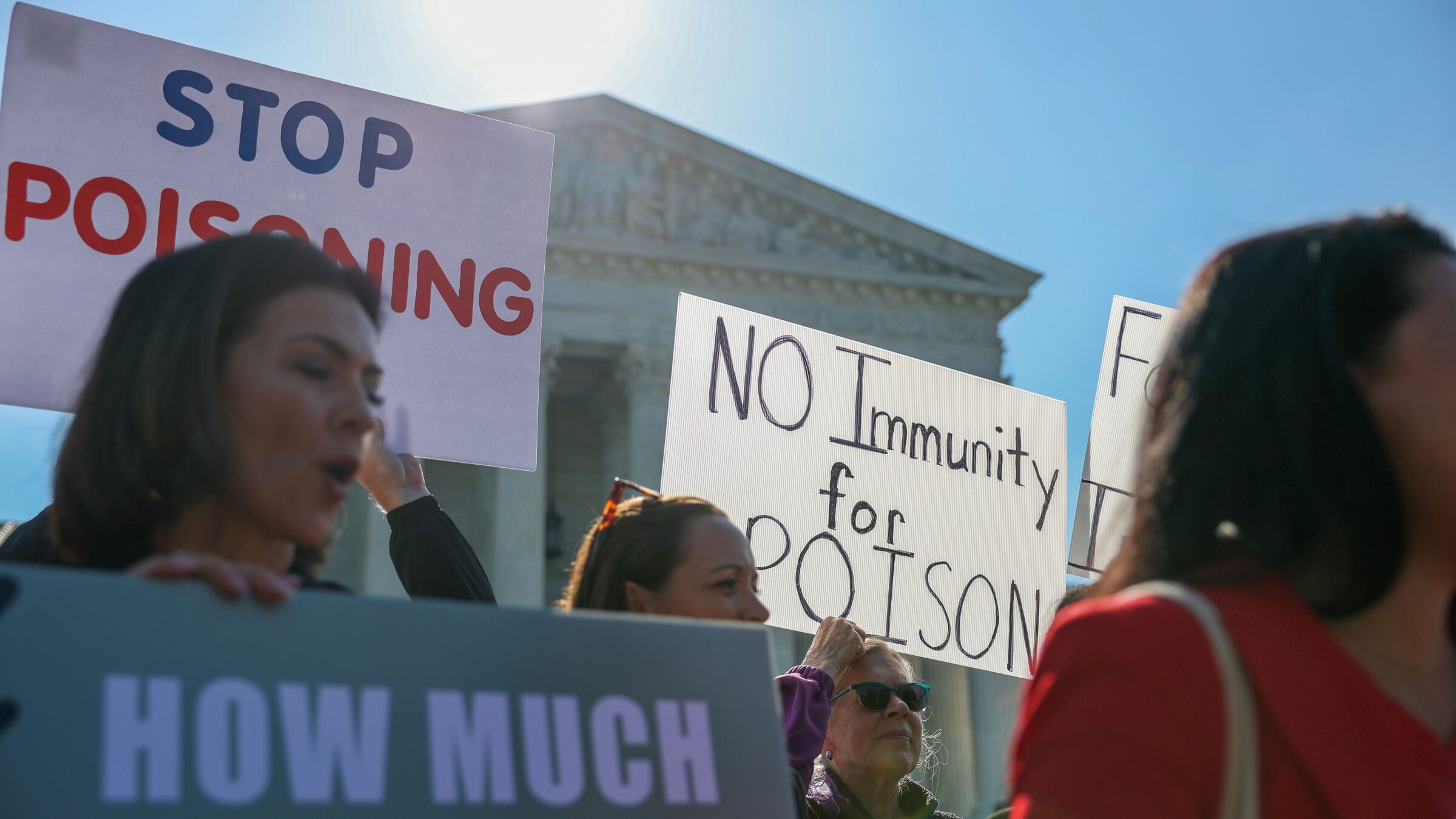
Protesters gather outside the Supreme Court as the justices hear oral argument in Durnell, April 2026 (Photo by Tasos Katopodis/Getty Images)
That alone would make Durnell one of the most significant corporate liability decisions during the tenure of Chief Justice John Roberts. But what makes it especially revealing is how awkwardly it fits with the Court’s broader administrative law revolution. For the better part of two decades, the Roberts Court has portrayed federal agencies as institutions requiring constant judicial supervision. In 2024, it dismantled Chevron deference—a longstanding precedent that required courts to defer to agency interpretations of ambiguous statutes in the agency’s area of expertise—on the grounds that such deference usurped power from Congress and the courts.
The Court has also embraced a “major questions doctrine” that prevents agencies from making decisions of economic or political significance without (whatever the Court deems to be sufficiently) explicit congressional authorization. When agencies have tried to take action to regulate climate change, enhance workplace safety, and offer student debt relief, the Court has used “major questions” to arrogate power to itself instead.
However, Durnell presented a new problem: In this case, a private corporation had been relying on a federal agency’s determination that glyphosate is safe. In Durnell, the Court attributed extraordinary legal significance to that determination: Because the EPA approved a label, juries lost the ability to conclude that the label might be inadequate under state law.
Durnell is a statutory interpretation case, not one that implicates Chevron-style deference to agencies. But that point does not resolve the glaring contrast in the Court’s treatment of agency decisions. For a Court obsessed with the virtues of federalism when it comes to, say, abortion rights, why were the justices so willing to interpret federal law here to extinguish state common-law remedies?
The answer lies less in the Court’s theory of administrative law than in its broader theory of institutional power. Again and again, the Roberts Court has narrowed the mechanisms for ordinary people to hold corporations accountable. It has expanded mandatory arbitration, made class actions harder to maintain, narrowed implied causes of action, restricted access to federal courts, and limited universal injunctions. Empirical research has found the Roberts Court to be the most pro-business Supreme Court in at least a century. Durnell is no exception. The democratically accountable branches produced a messy, incomplete result for corporate defendants, so the Supreme Court produced a cleaner one for them.
The Roberts Court’s administrative law cases have never just been about whether agencies deserve trust. The real issue is which institutions the Court believes should wield power. When an agency tries to regulate corporate power, the justices scrutinize the agency’s every action. In Durnell, when an agency helped protect corporate power, suddenly, the justices were willing to treat agency judgments as the foundation for nationwide immunity.
That is the real significance of Monsanto v. Durnell—another chapter in the Roberts Court’s project of reallocating power from legislatures, juries, state courts, and people to the Court itself.