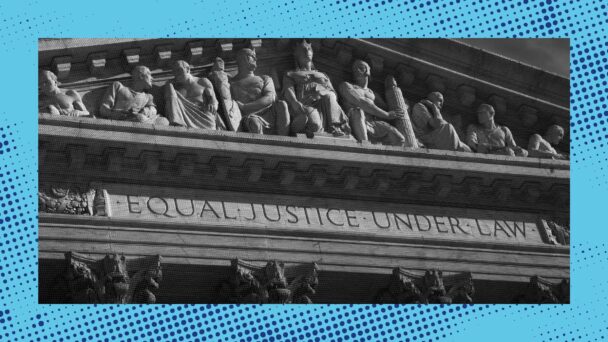
In one of its final decisions of the 2025-26 term on Tuesday, the Supreme Court ruled 6-3 along the usual lines that states may legally ban trans girls from playing on women’s sports teams. Nothing about Justice Brett Kavanaugh’s opinion for the majority in West Virginia v. B.P.J. will be surprising to anyone familiar with the Republican Party’s full-on embrace of rank transphobia, or with the conservative legal movement’s goal of facilitating legal discrimination against trans people. Generally speaking, when the fifth paragraph of a Supreme Court opinion contains the phrase “biological males who identify as females,” it is safe to assume that the author is not working toward a ruling that respects the dignity or existence of trans people.
The portion of the opinion that consists of legal analysis is just 21 pages long, and treats all the underlying questions as if they all have easy, obvious answers. It is the work product of a six-justice conservative supermajority whose members are fluent in anti-trans rhetoric, and comfortable converting its tenets into anodyne-sounding legalese: There are solemn discussions of the “inherent physical differences between the sexes,” for example, and the “zero sum” nature of roster spots and playing time, and the injustice of “forcing” cisgender girls to “play against biological males” in “what they view as an unfair competition,” and so on. If Kavanaugh had invited Riley Gaines to ghostwrite his opinion in B.P.J., I am not sure anything about it would have turned out differently.
The respondent in this case is Becky Pepper-Jackson, a trans girl challenging a ban on trans girls playing women’s sports that the West Virginia legislature passed in 2021. (Because she is a minor, the Court refers to her by her initials.) Pepper-Jackson, who began receiving gender-affirming medical care in elementary school, argued that the ban violates Title IX, a federal law that prohibits sex discrimination in schools. She also raised a constitutional claim, arguing that by restricting participation in women’s and girls’ sports to athletes who were assigned female at birth, West Virginia’s ban discriminates on the basis of sex in violation of the Equal Protection Clause of the Fourteenth Amendment.
Kavanaugh had little trouble disposing of the Title IX issue. Under that law, he wrote, the word “sex” contemplates “biological sex,” not “gender identity,” and neither the statute nor its regulations “say (or even hint) that schools must allow certain biological males to participate in women’s and girls’ sports.” Nor did he find the equal protection argument persuasive: Under Supreme Court precedent, the state’s interest in ensuring “safety and competitive fairness,” he said, “amply” justifies laws that limit participation in women’s sports to “biological females.”

As he so often does, Kavanaugh wrapped by professing his deep respect for the people whose civil rights he is taking away. “We greatly admire the desire of all students, including transgender students such as B.P.J., who want to participate in sports,” he wrote; later, he added that no student-athlete, cis or trans, deserves for any reason to be “ostracized or vilified.” It is an instant classic of the genre of Brett Kavanaugh opinions that employ flowery language to paper over their ghoulish real-world consequences: Nothing shows that you are “acutely aware” of the “difficulties” that trans kids face, as Kavanaugh claims to be, like using the power of your office to exacerbate them.
Perhaps the most revealing opinion in B.P.J. comes from Justice Clarence Thomas, whose concurrence includes what are (at least for now) the most gleefully transphobic lines committed to the pages of the United States Reports. “A man does not have a legal right to compete against women just because he believes that he is a woman,” Thomas wrote. “Men and boys with gender dysphoria are not women or girls, even if they believe that they are.” He closed with language that tracks the vile transphobic talking point that transgender people do not exist: To use language that obscures the “reality” of “biological” sex, Thomas wrote, “is to lie to the public.”
Thomas’s opinion spans just two pages and three paragraphs, and does not add any substantive analysis to the majority opinion. There is no reason for Thomas to include it; he simply saw an opportunity to be cruel to trans people in public, and was happy to take it.
B.P.J. will not be the last time that conservative culture warriors ask the Court to put a jurisprudential gloss on their gutter transphobia. The breezy nonchalance with which Kavanaugh and company disposed of this case is a preview of how those cases are going to turn out: six-to-three opinions that start by paying lip service to the human dignity of trans people, and end with the justices once again slamming the courthouse door in their faces.