Well over a decade ago, Ignacio Sosnava Rodriguez, Miguel Angel Gomez Alvarado, and Alejandro Villegas Angel entered the United States “without inspection” by an immigration officer—the legal term for entering the country without lawful authorization. In the many years since, the men built strong ties to this country, living continuously in Texas and becoming fathers of U.S. citizen children. None of the men incurred a criminal record.
Between November 2025 and February 2026, immigration officials arrested the men and moved them to T. Don Hutto Detention Center, a facility 35 miles outside of Austin. Under a policy the Trump administration adopted last summer, all three men were subject to “mandatory detention,” which means they had no opportunity to challenge their imprisonment. In legal briefs, the federal government says it has the authority to detain anyone it suspects of entering the country without inspection; to initiate removal proceedings against them; and to keep them locked up until those removal proceedings conclude, whenever that may be.
The Constitution says otherwise. In February 2026, the men filed habeas petitions, arguing that the Trump administration violated the Fifth Amendment by detaining them indefinitely without holding a hearing to determine if their detention served a valid purpose. Here, that would mean assessing whether they are a flight risk or a danger to the community. By early March, federal district courts in Texas agreed, and ordered the government to release the men immediately.
The Trump administration then appealed those orders to the Fifth Circuit, which is generally regarded as the Trumpiest federal appeals court in the country. Perhaps unsurprisingly, then, this is where the case gets weird.
At first, the administration had a stroke of bad luck, drawing a three-judge panel with only one Trump appointee. On July 2, the panel voted 2-1 to affirm the district courts’ orders, and held that the government must provide a hearing to noncitizens detained on “entry without inspection” allegations within 90 days. Then, on July 10, the full Fifth Circuit vacated the panel’s order—all on its own, without the Trump administration even asking it to—and announced that it would rehear the administration’s appeal with all 17 active judges in the circuit.
Immediately afterwards, the Trump administration filed a motion asking the full Fifth Circuit for a “precedential stay order” to lift the district courts’ decisions in the meantime. This request was strange, because “precedential stay orders” do not exist. Stays are, by their nature, interim orders. They do not resolve the merits of a case. They are not usually based on full briefing and oral argument. And they do not usually contain any reasoning. Precedent provides guidance; it tells lower courts what to do, and tells litigants what to expect. Stay orders do not.
Nevertheless, the Trump administration urged the Fifth Circuit to grant a stay that would be binding throughout its jurisdiction, which covers Texas, Louisiana, and Mississippi. “Absent a precedential stay order,” the administration argued, courts will continue to face the “crushing burden” imposed by the “continuing flood of habeas petitions.” Presumably, the administration could also reduce the number of unconstitutional detention lawsuits it has to deal with by reducing the amount of people it unconstitutionally detains, but I digress.
In any event, last week, the full Fifth Circuit granted the administration’s request for a stay, which means that, at least for now, the Trump administration is free to take the three men back into custody. And like most stay orders, it contains no analysis whatsoever. This is not an exaggeration. Check it out for yourself.
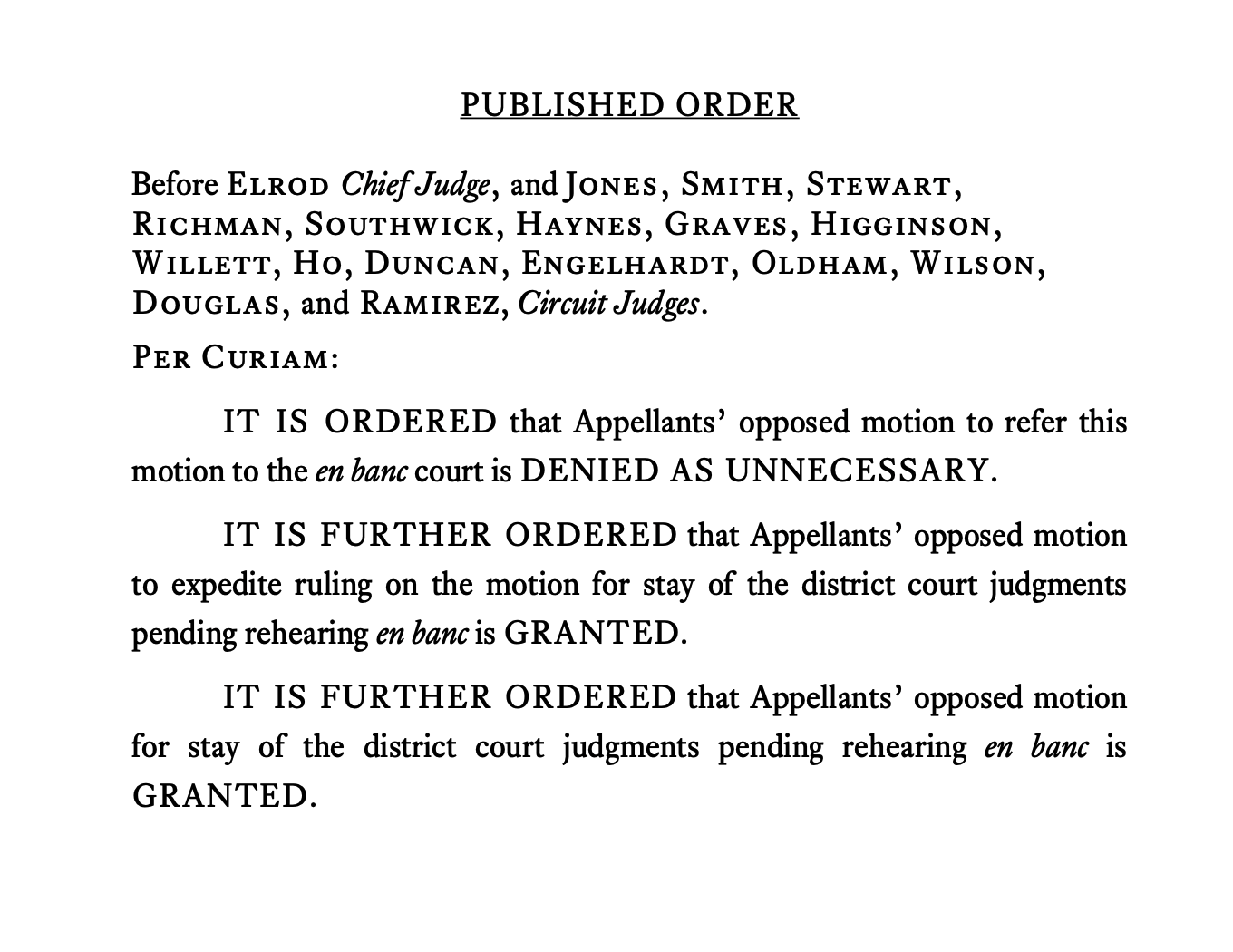
On Twitter, Assistant Attorney General Brett Shumate celebrated this sparse text as a full endorsement of the administration’s argument. “The full Fifth Circuit has issued an extraordinary precedential order making clear that illegal aliens do not have a constitutional right to roam free in the United States during their removal proceedings,” he said on July 22.
Federal district court judges across Texas do not appear to share Shumate’s view. On July 23, for example, in the border town of Laredo, Judge Diana Saldaña granted a habeas petition, and held that mandatory detention without a hearing was unconstitutional. Saldaña acknowledged the Fifth Circuit’s recent stay order, but noted that it was “issued without analysis,” and that such stays are “not conclusive” under the Supreme Court’s precedents. “Without clearer direction,” she said, “the Court will not deny relief this Court deems meritorious.”
That same day, in Houston, Judge Keith Ellison granted another habeas petition, and held that it is unconstitutional to imprison noncitizens indefinitely “merely because” they “initially entered the country” without authorization. The immigrant detained without a hearing in that case was a 43-year-old mother of two U.S. citizen children; she crossed the border at age 3.

Ellison wrote that he was “aware” of the Fifth Circuit’s stay order, but said that the stay did not “clearly state what precedential effect, if any, it has.” For good measure, Ellison added that his determination rests on different grounds than the reasoning at issue in the case that reached the Fifth Circuit, so “even assuming that the stay has some precedential effect” in other cases, it has no such effect in this one.
The next day, in El Paso, Judge David Briones granted a habeas petition, too. Briones recognized his duty to follow precedent, but also recognized that the stay order had little to no precedential value. The Fifth Circuit’s order “is silent as to the contours of its applicability,” said Briones, who declined to “infer directives of constitutional magnitude from the Fifth Circuit where none have been given,” and noted that doing so would foreclose hundreds of habeas cases “based on mere speculation.”
Federal appeals court judges, like those on the Fifth Circuit and the Supreme Court, have been disturbingly accommodating of Trump’s lawlessness, often by granting the administration’s requests for stays blocking federal district court orders. The administration is now trying to push those stays further, and block lower courts from ruling against it at all. But lower court judges remain bound to apply the law as it exists—not as Trump wishes it to be—and give stay orders all the respect they deserve. Often, that means no respect at all.