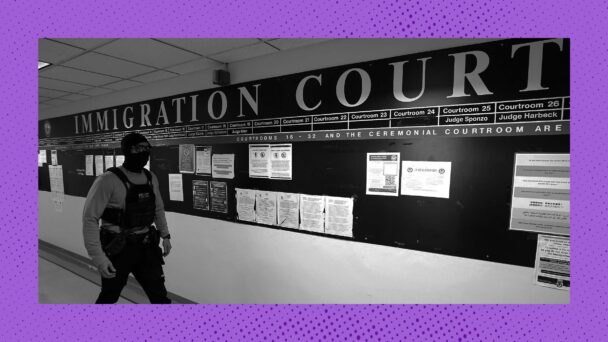
On the morning of Sunday, September 20, police officers in the Chicago suburb of Evanston responded to a 911 call about a confrontation in the street. When the officers arrived, they found a man on the ground who reported injuries to his head, neck, and teeth. Soon, the officers learned that the injured man was a U.S. citizen, and his assailants were federal immigration agents.
The Department of Homeland Security put out a statement on Tuesday claiming that the beaten man “resembled the target” of an immigration enforcement operation, and that he was “not cooperative” with agents’ investigation. “Once the individual finally identified himself,” said DHS, immigration officers “left the scene without further incident.”
A video of the incident shows that immigration officers pinned the man to the ground while he repeatedly yelled, “I’m a fucking U.S. citizen,” and while concerned witnesses asked why the agents were “fucking him up.” Eventually, the agents drove off without rendering medical aid. People tried to comfort the man, who remained motionless on the ground.
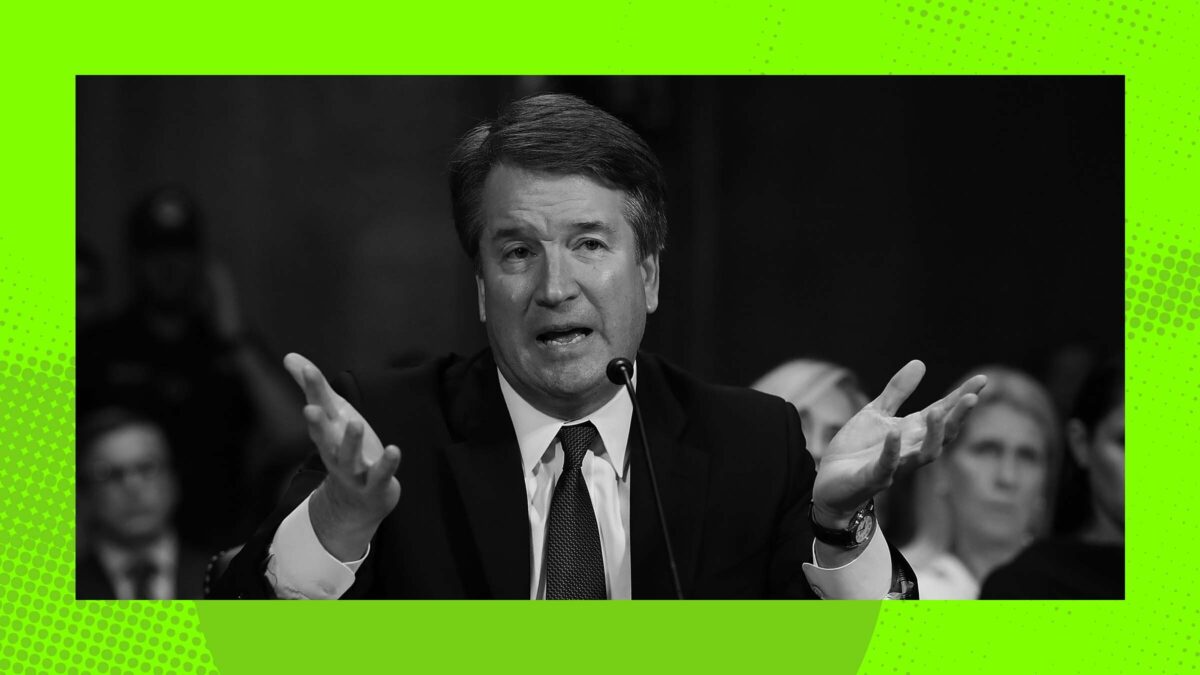
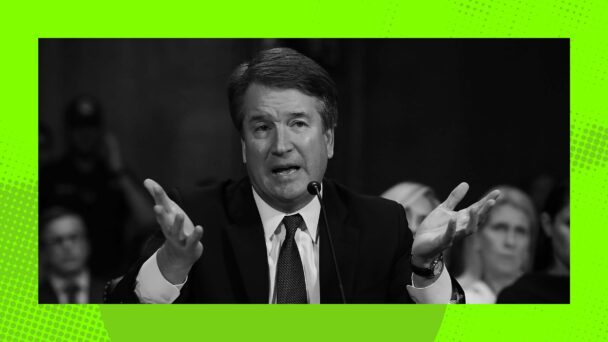
The citizen whom immigration agents attacked experienced what Justice Brett Kavanaugh described one year ago in Noem v. Vasquez Perdomo as a “brief investigative stop.” In that case, the Supreme Court lifted a lower court’s injunction and allowed immigration agents to resume racially profiling Latino people in Los Angeles.
Although the Republican majority on the Supreme Court did not bother to provide any rationale for the order, Kavanaugh wrote a solo concurring opinion that tried to offer an explanation. And one of the reasons he gave was: Immigration stops are no big deal. “The government sometimes makes brief investigative stops,” he said, when it has a “reasonable suspicion” that people are in the United States unlawfully. If a person is here lawfully, he continued, they only need to make that “clear” to immigration officers, and then they will “promptly go free.”
Kavanaugh did not support this claim with any citations to the voluminous record developed by the district court, or to news reports, or to any of the other credible sources available to him. Instead, he appeared to rely on his own imagination as a rich and powerful middle-aged white man. And the Trump administration has relied on him in turn: In Tuesday’s statement, DHS claimed that the immigration officers in Evanston had “reasonable suspicion,” and that “the Supreme Court has already vindicated us on these practices.”
The unreasoned tacit endorsement of racial profiling in the Court’s order cannot be squared with the Constitution’s express prohibition on “unreasonable searches and seizures” or its guarantee of “equal protection of the laws.” And the fictional rationale espoused in Kavanaugh’s opinion has repeatedly proven irreconcilable with both the law and reality.
The falseness of Kavanaugh’s framing was exposed again just 24 hours after the attack in Evanston, when a federal district court in Alabama issued an order in Venegas v. Homan. Leonardo Garcia Venegas is a natural-born American citizen living in Alabama who has repeatedly been detained by federal immigration agents. First, in May 2025, they raided the construction site where he worked, and targeted only workers who, like him, were visibly Latino. Agents ignored the shouts of people who said that Venegas was a citizen, and dismissed his proof of citizenship as fake. Rather than quickly letting him “go free,” agents handcuffed Venegas, removed him from the worksite, and held him in an unmarked vehicle for over an hour.
Then, in June 2025, agents raided another construction site where Venegas worked, and again said his identification could be fake. After this second incident, Venegas filed a class action lawsuit, which did not stop immigration agents from detaining him for the third time in May 2026. Again they tackled and shackled him, and again they didn’t believe that he was a citizen.
In response to Venegas’s lawsuit, the Trump administration contended that the government had a reasonable suspicion to detain him, and that this argument was supported by Kavanaugh’s concurrence in Noem v. Vasquez Perdomo. Basically, Kavanaugh said that agents detain and question people when they have reasonable suspicion, and since agents detained and questioned Venegas, they must have had reasonable suspicion to do so. In a September 21 order, though, Trump-appointed district judge Jeffrey Beaverstock wrote that the government offered “no factual support whatsoever” as to why its suspicion was reasonable, and that he was “simply not inclined to take the Government’s word for it.”
Beaverstock also wrote that Kavanaugh’s concurrence offered no help to the administration, because the immigration stops they carried out looked nothing like the immigration stops that Kavanaugh imagined. “Venegas was not promptly released,” said Beaverstock. “Instead, the officers disregarded the veracity of his documentation and continued to detain him.” Beaverstock concluded that the administration’s warrantless raid and detention policies are likely unconstitutional, and issued an order temporarily blocking them.
The abuse that immigration agents inflict on people everywhere from Evanston streets to Alabama construction sites underscores that Kavanaugh’s racial profiling apologia in Vasquez Perdomo was always based on a fantasy. People of color have no choice but to live in the real world. The Venegas case shows that federal judges can choose to engage with that reality, rather than indulge in Kavanaugh’s fiction.