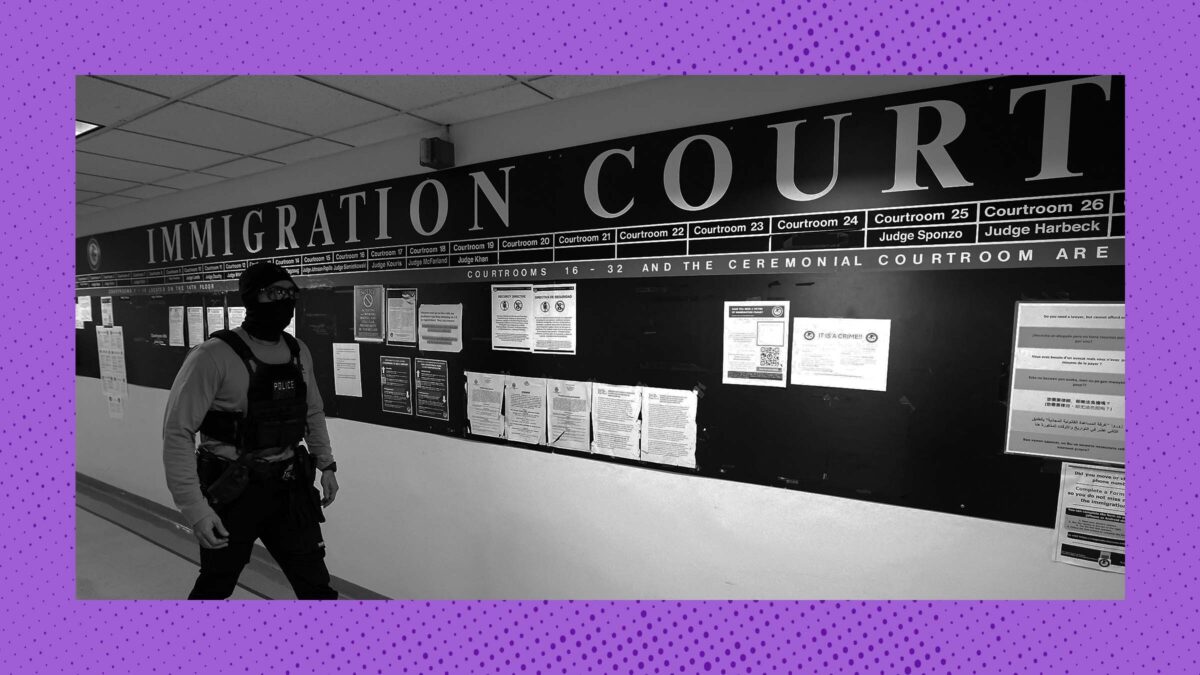
It’s the plot of The Trial by Franz Kafka, but it’s actually your real life. You are sitting in federal immigration court, but you don’t speak English. Everyone around you—the immigration judge, your lawyer, the Immigration and Customs Enforcement attorney prosecuting your case—is speaking about you, but you don’t understand anything they are saying.
Finally, you have your chance to explain to the judge why you should be allowed to stay in the United States. You take the witness stand. For this, at least, you have an interpreter. But the questions you are asked are a little strange, as if they are not meant for your case at all. When the interpreter conveys what you have said, she stops a lot and makes a lot of “um” noises. She corrects herself a few times. And her sentences are much shorter than yours.
A few minutes later, the judge makes his decision: He does not find your story credible, and thus decides that you must be deported. The interpretation of this part is crystal clear, as if the interpreter has said it thousands of times.
The outcomes in immigration court can be devastating. A non-citizen can be separated from their family, detained for months, or even be ordered sent to a country to which they have no connection. Yet immigration courts lack many of the basic protections often associated with the legal system, including the provision of interpreter services. As a lawyer who practices in immigration court, I have seen this scenario happen too many times—a person’s future erased before they have any idea what just happened.
There is no official language in the United States. But English is the language of the legal system, and beginning in the 1970s, courts began recognizing that litigants have a legal right to understand court proceedings even if they don’t speak English. In 1970, the Second Circuit held that both the Fourteenth and the Sixth Amendments of the Constitution require the government to provide criminal defendants with interpreters. And in 1974, the Supreme Court held that when the government discriminates on the basis of English-language ability, it violates Title VI of the Civil Rights Act.
In response to these developments, Congress passed the Court Interpreters Act of 1978, which set out procedures for providing court interpreters in federal courts to litigants who need them. Interpreters, for example, need to be able to do “simultaneous interpretation”—to be able to speak words in English while listening to words in another language. To comply with the law, the Administrative Office of the United States Courts hires a private contractor to create and administer certification exams for individual interpreter candidates.
The Court Interpreters Act has not made problems go away for non-English-speaking litigants. But the law was still revolutionary in requiring a reliable mechanism for assessing and assigning interpreters in federal courts. Today, most states have their own policies in place to provide a more or less equivalent level of access, with exams administered by the National Center for State Courts.
The problem, though, is that the immigration court system is not like the federal or the state systems, since it is just a sub-office in the Department of Justice. The federal statute does not cover it, and although the Constitution and Title VI still apply, bringing these cases is far more challenging for individual litigants. Further complicating matters is the fact that after taking office in 2025, President Donald Trump rescinded a Clinton-era executive order expanding access to interpreters, and gutted the division of the Justice Department that used to be responsible for enforcing it.
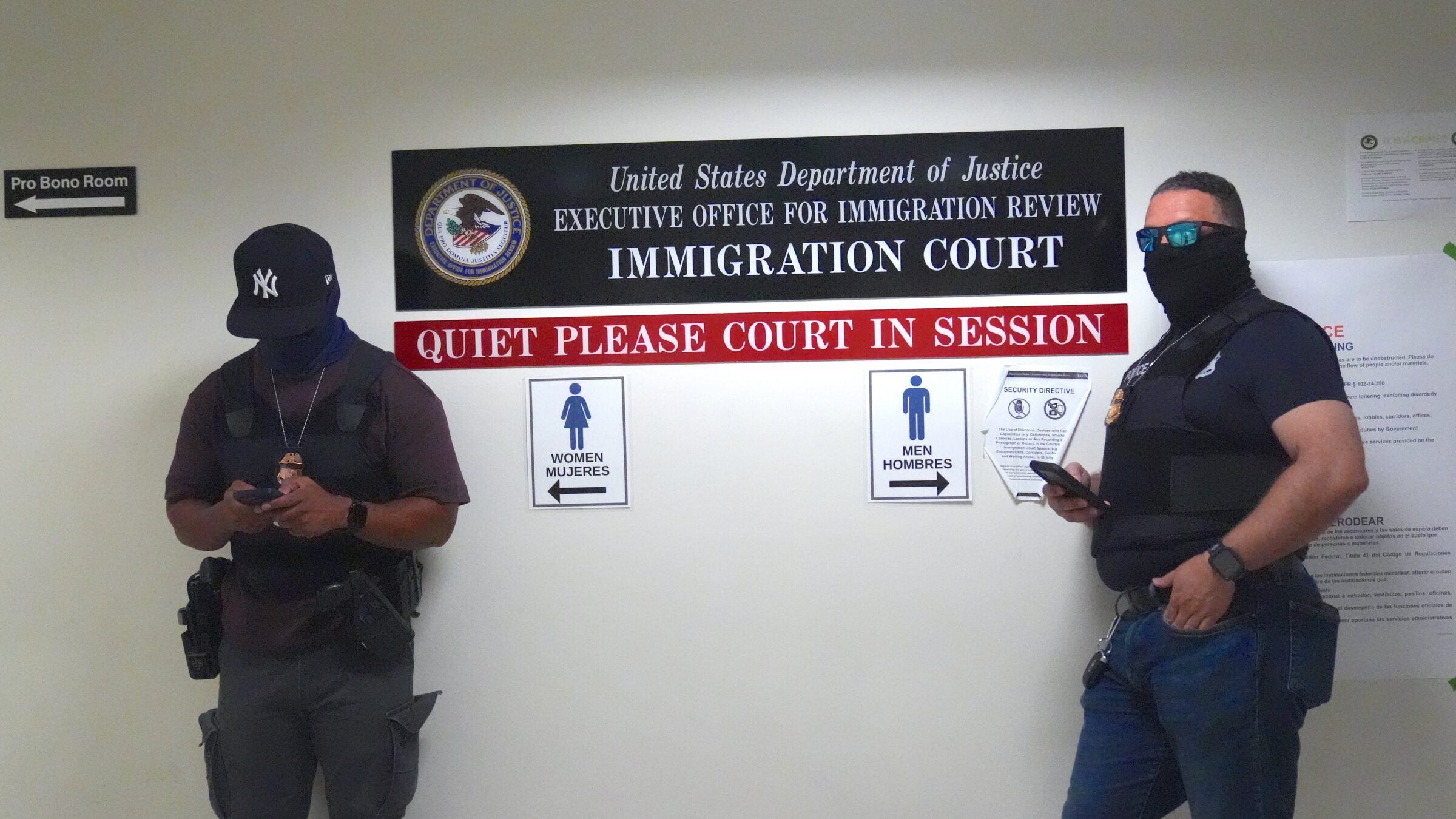
(Photo by Selcuk Acar/Anadolu via Getty Images)
Even before the Trump administration took measures to restrict access to interpreters, interpretation in immigration court had serious drawbacks. First, not every hearing—or even every part of a hearing—is interpreted for the immigrant. Many immigration courts only require interpretation when a non-English speaker is testifying or when the judge is directly speaking to the immigrant. If, for example, the ICE attorney and the immigration judge are having an extended conversation about a case, a non-English-speaking immigrant without a lawyer will not know what they are talking about.
Second, judges are supposed to determine whether an immigrant is “credible” based on the immigrant’s demeanor. But, in reality, judges often end up basing their decisions on the demeanor of the interpreter. When an interpreter hems and haws over a word, or offers several variants of the translation of a word, judges often see it as the immigrant being cagey, or declining to answer a question directly.
In one of my cases, a Spanish interpreter made my client, who had been detained after observing a political demonstration, look like a wackjob conspiracy theorist by repeatedly translating my client’s impersonal constructions—a common way for Spanish-speakers to recount events—using the subject “they.” So, when my client said, “There were protesters in the road,” the interpreter translated it as, “They protested in the road.” In the interpreter’s telling, this mysterious “they” then did all sorts of things: blocked all the exits, called the police, beat people, fell down, and died.
Eventually, the immigration judge himself asked, “Who is they?” and we were able to clear up the confusion. But I believe the judge was left with the impression that it was my client who was confused and inarticulate, not the interpreter.

(Photo by Michael M. Santiago/Getty Images)
Third, the transition to mostly remote video hearings significantly worsens the effectiveness of interpretation. When an interpreter can’t even see the person speaking, they can miss things like metaphorical speech, sarcastic speech, speech where the immigrant is imitating someone else speaking, and so on.
Fourth, when mistakes happen, the process for challenging poor interpretations is extremely onerous. You have to order the audio of the hearing and have a qualified interpreter listen to both the original track and the interpreter track—hopefully they are indeed on separate tracks—and then compare this against the court’s transcript. Even if there are significant discrepancies, in order for an appeal to be successful, the immigration judge has to decide that the error caused the immigrant to lose their case. Otherwise, courts hold that the errors are harmless.
Even when the attorney speaks both languages and knows on the spot that a crucial error was made, it can be difficult to convince the judge that there is a problem. In one of my cases, an interpreter was performing simultaneous interpretation using a headphone-and-microphone setup during the testimony of a Spanish-speaking witness. The witness was wearing headphones and the interpreter was whispering into the microphone, interpreting both my questions to the witness and the witness’s responses.
During the hearing, the witness testified to the exact opposite of what I expected, so at the break, I asked him what had happened. It turned out that, sure enough, the interpreter had asked him the exact opposite of the question I actually asked, but I couldn’t hear any of this because of the headphone-and-microphone setup. As court resumed, I objected to the interpretation problem. The immigration judge overruled my objection, saying that I needed to have objected at the time of the utterance—an utterance which, again, I could not hear.
Fifth, the challenges inherent in measuring language proficiency are exacerbated by the specialized nature of interpretation in the immigration context. For example, immigrants are often telling stories of persecution in their home countries that depend on location-specific practices and terminology. One client of mine was telling a story that hinged on the purchase of a topogigio, a Honduran flavored ice snack in a plastic bag. The interpreter, who was competent in Mexican Spanish, translated this as “soda water,” which was not the same thing at all and ruined the story. Similar problems arise when immigrants from, say, Libya are given interpreters who are only competent in Gulf Arabic, which is not spoken in Libya.
Most ethical canons for interpreters require that an interpreter speak up if they are no longer able to competently interpret—for example, when someone is speaking too fast. But the current system incentivizes interpreters to stay silent, since a single negative report from an immigration judge can result in an interpreter losing their contract. An immigration judge may not enjoy being interrupted by a conscientious interpreter and could report the interpreter as “difficult.” Or an interpreter who acknowledges mistakes after an objection from an attorney might also risk losing their contract.
Immigration courts promise “fundamental fairness.” But without providing adequate language access, the system cannot deliver on this promise even if it wanted to.