American elections are increasingly expensive. Back in 2008, individual donors and groups (like corporations and political parties) spent a total of $574.4 million to influence federal elections. By 2016, political spending jumped to $1.6 billion. And in 2024, political spending hit $4.3 billion—even adjusted for inflation, more than 400 percent above spending in 2008.
A major contributing cause of this explosive increase was Citizens United v. Federal Election Commission, the Supreme Court’s 2010 decision striking down a federal law that prohibited corporations from using their general treasury funds to support or oppose candidates for office. Justice Anthony Kennedy wrote for the five-justice majority that the prohibition was tantamount to “censorship,” and that the intrusion on corporations’ First Amendment rights could not be justified by the government’s interest in preventing corruption.
According to a 2025 YouGov poll, 79 percent of Americans disagree with the majority’s conclusion that independent corporate expenditures “do not give rise to corruption or the appearance of corruption.” On the contrary, 75 percent believe that unlimited spending in elections makes democracy weaker by allowing the wealthy to exert too much influence over the decisionmaking of ostensibly public servants. Basically, Citizens United opened the floodgates to a wave of big money in politics, and people are tired of drowning.
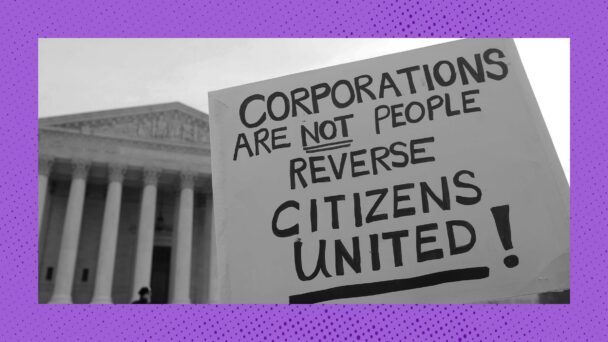
At least 23 states and hundreds of cities have called for a constitutional amendment to overturn Citizens United and remedy the problem the Supreme Court caused. Importantly, people have also grown skeptical of the idea that the Constitution actually requires us to live like this. And at the state level, they are pursuing legislation to curb the corrosive impact of money in politics, Citizens United be damned.
In May 2026, Hawaii became the first state to enact legislation that prohibits corporations from spending money to influence elections or ballot measures. The state legislature declared, in the text of the bill, that political power is “inherent in the people,” while the creation of a corporation is “a privilege granted by the state, not a natural right.”
In doing so, Hawaii carefully threaded the needle of Supreme Court precedents. For over 200 years, the Court has recognized that corporations—artificial legal entities created under state law—only have the powers that state law allows them. Citizens United strengthened corporations’ right to freely exercise powers of political speech. But nothing in Citizens United compels states to grant corporations those powers in the first place. Nor could it have reasonably done so: As Justice Samuel Alito wrote for the majority in Burwell v. Hobby Lobby, a 2014 decision related to the First Amendment rights of corporations, the “objectives” that companies may legally pursue are “governed by the laws of the States in which they were incorporated.”
Unsurprisingly, this has not deterred conservative activists from challenging Hawaii’s law as unconstitutional. In June of this year, the Grassroot Institute of Hawaii, a libertarian think tank, sued in federal district court. This lawsuit is in the very early stages, but it will function as a test case for the viability of a strategy that organizers hope to replicate in all 50 states.
While Hawaii legislators were preparing a bill for the governor’s approval, volunteers in Montana were gathering tens of thousands of signatures so they could put a similar proposal before voters. In November, Montanans will have the chance to approve a measure that would prohibit “artificial persons,” including corporations, trade associations, and other business entities, from “contributing anything of value to candidate elections, supporting or opposing political parties, or supporting or opposing state or local ballot issues.” The law would be enforced through ordinary civil law proceedings, and if companies violate this provision, they would forfeit the privilege of doing business in the state.
Like Hawaii’s statute, this ballot initiative is tailored to avoid running afoul of existing law. The proposal, dubbed the “Montana Plan” by its supporters at the Transparent Election Initiative and the Center for American Progress, would not prevent any person from exercising their speech rights. All it would do is specify which powers the state chooses to grant to the artificial entities its law creates. Legislation similar to the Montana Plan is now pending in over a dozen other states.
Hawaii’s law and Montana’s proposal reflect just some of the ways that states are actively working to curb corporate influence over the democratic process. Maine, for instance, is currently in court defending a ballot initiative, approved by nearly 75 percent of Maine voters in 2024, imposing a $5,000 limit on the amount of money that any person or entity can contribute to a super PAC in any given year. Also in 2024, New York launched a public campaign finance program that matches small donations with public funds, thus counteracting some of the outsized influence of the wealthy.
For around 15 years, the Supreme Court has allowed corporations to exert massive influence over elections. And throughout the country, people are declaring that this domination has gone on long enough.