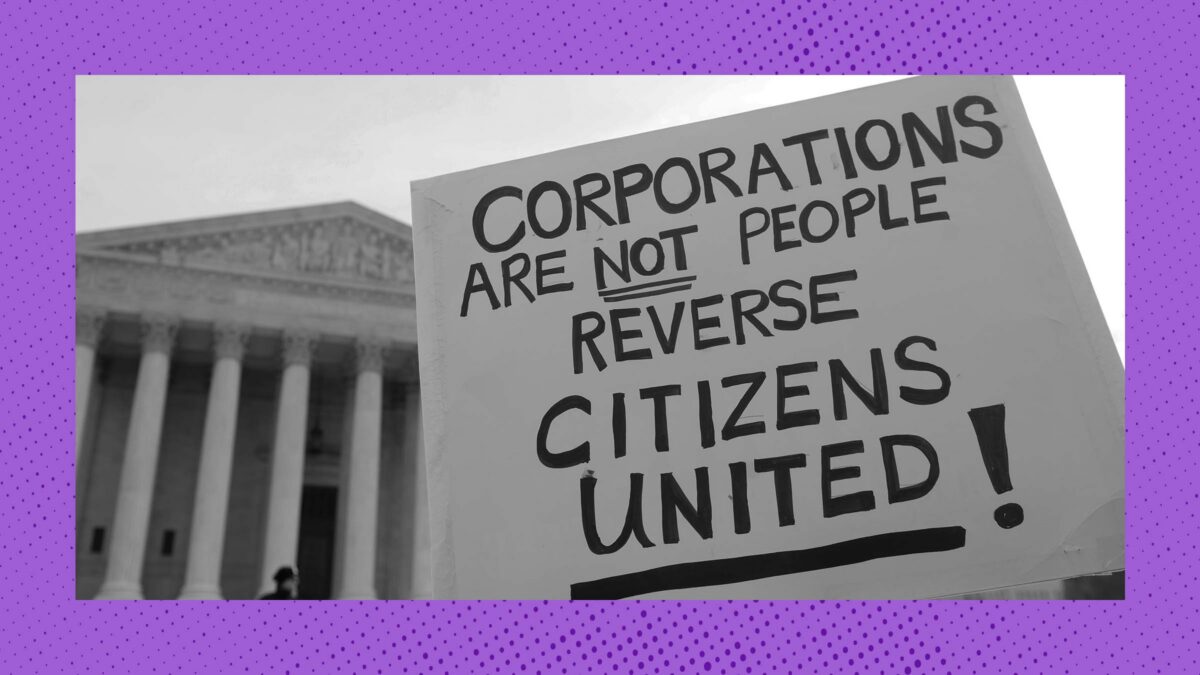
Whenever the Supreme Court decides to review a campaign finance rule, it’s a safe bet that the ultraconservative majority will overturn it as a violation of speech rights. Last week’s decision in National Republican Senatorial Committee v. Federal Election Commission therefore came as no surprise. It merely serves as the latest example of the Supreme Court’s fondness for billionaires’ dark money and its disdain for precedent. And as the latest in a long line of cases striking down laws intended to limit political corruption, NRSC also shows the need for Supreme Court reform in order to have any hope of reducing the role of money in politics.
NRSC overturned a quarter-century old precedent known as Colorado II, a 2001 decision in which the Court upheld a federal law that imposes limits on coordinated spending between political parties and candidates. Those limits existed to prevent parties working as a backdoor to circumvent contribution limits from donors. If parties and candidates could coordinate spending, donors who hit their individual limits could give money to the parties; parties could then coordinate spending of that additional money with candidates, circumventing the legal limits on donors directly giving to candidates.
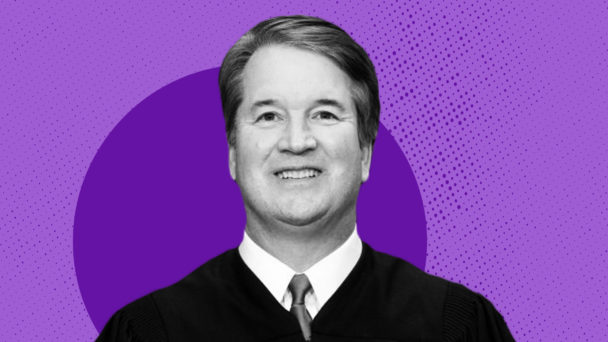
For today’s Supreme Court, funneling money to candidates through parties sounds like a fabulous idea. Justice Brett Kavanaugh’s majority opinion in NRSC struck down the federal limitation on coordinated spending, overruling Colorado II and once again eliminating an attempt by Congress to limit corruption in the political process.
In her NRSC dissent, Justice Elena Kagan does the math: Whereas an individual can give $7,000 directly to a candidate, they can now also give up to $551,300 to the national party to cover that candidate’s bills—almost eighty times more money than was possible just a month ago. But hey, at least now we’ll have more dark money-fueled political speech spreading throughout the public sphere—all thanks to the Court’s brave stance against the tyranny of Congress.
If your eyes glaze over just hearing about the constitutionality of coordinated spending and limitations on expenditures versus donations, you have the Supreme Court to thank. In the foundational 1976 case of Buckley v. Valeo, the Court evaluated the Federal Election Campaign Act, which Congress had substantially amended post-Watergate, and established a framework for evaluating campaign finance regulation against First Amendment challenges. Buckley, a chaotic per curiam opinion lacking a lead author, elicited partial concurrences and dissents from five different justices who disagreed with various parts of its constitutional reasoning.
The result is a confusing, convoluted mess, but it boils down to a fundamental principle: According to the Buckley court, limitations on contributions to candidates create fewer First Amendment problems than limitations on expenditures by candidates. The perverse fundraising incentives for candidates are obvious: Get as much as you can from as many wealthy people as possible, because no one can stop you from spending it.
Buckley’s problems became particularly obvious under the leadership of Chief Justice John Roberts. Congress enacted additional campaign finance regulations in 2002 (commonly known as McCain-Feingold), which the Supreme Court largely upheld in 2003. But after the Court’s shift rightward following the replacement of Justice Sandra Day O’Connor with Justice Samuel Alito in 2005, the Roberts Court began aggressively unwinding federal campaign finance regulations, most famously in 2010’s Citizens United v. FEC and then again in 2014’s McCutcheon v. FEC and 2022’s FEC v. Cruz.
The conservative case against campaign finance rests on Buckley’s claim that spending money is essential to speech in a political system. Once the Court adopted that dubious premise, limitations on contributions from the wealthiest Americans were in the justices’ crosshairs. Buckley held that Congress couldn’t prevent a political candidate from spending as much as they wanted. It’s no surprise that the Roberts Court has struck down limitations on donors as well, all in the name of facilitating more speech.
Justice Brett Kavanaugh’s majority opinion in NRSC airily celebrates our new political ecosystem, which he says “will allow all political parties…to participate more freely and compete more fully in the political process, and to coordinate more closely with their candidates.” This perspective ignores the severe problems with an excess of money in politics and its corrosive effects on democracy. As Justice Elena Kagan notes in dissent, the Roberts Court has left mere scraps of campaign finance regulation remaining, with a resulting “legal regime increasingly unable to stop political corruption, and thus to preserve our institutions’ democratic legitimacy.”
For many years, progressives and some Democrats have called to “end” Citizens United in response to that decision’s radical invalidation of key provisions of federal campaign finance regulation. But merely ending Citizens United—probably through an extremely unlikely constitutional amendment, or a radical change in the Supreme Court’s composition—won’t eliminate the core issue. The Buckley approach for considering First Amendment challenges to campaign finance rules remains fractured and unworkable; that is where reformers must begin.
A majority of the Court needs to reconsider, limit, or overturn Buckley v. Valeo to allow Congress to pass new campaign finance laws to undo Buckley, Citizens United, NRSC. And without Court reform—adding justices and limiting judicial review—there’s no path forward to undo the Supreme Court’s damage and reduce political corruption.