In a country awash with World Cup enthusiasm, it is hard to miss how much sports matter to athletes for reasons that go far beyond the outcome in any single competition. Yet the conservative supermajority at the helm of the Supreme Court just managed to demonstrate such inhumane cluelessness.
On the final day of a term full of devastating opinions, the Court added another: In West Virginia v. B.P.J., the Court decided that bans on the participation of female trans athletes in women’s sports violate neither Title IX nor the Equal Protection Clause—a ruling that leaves many young female athletes around the country with no way to participate in a key social activity.
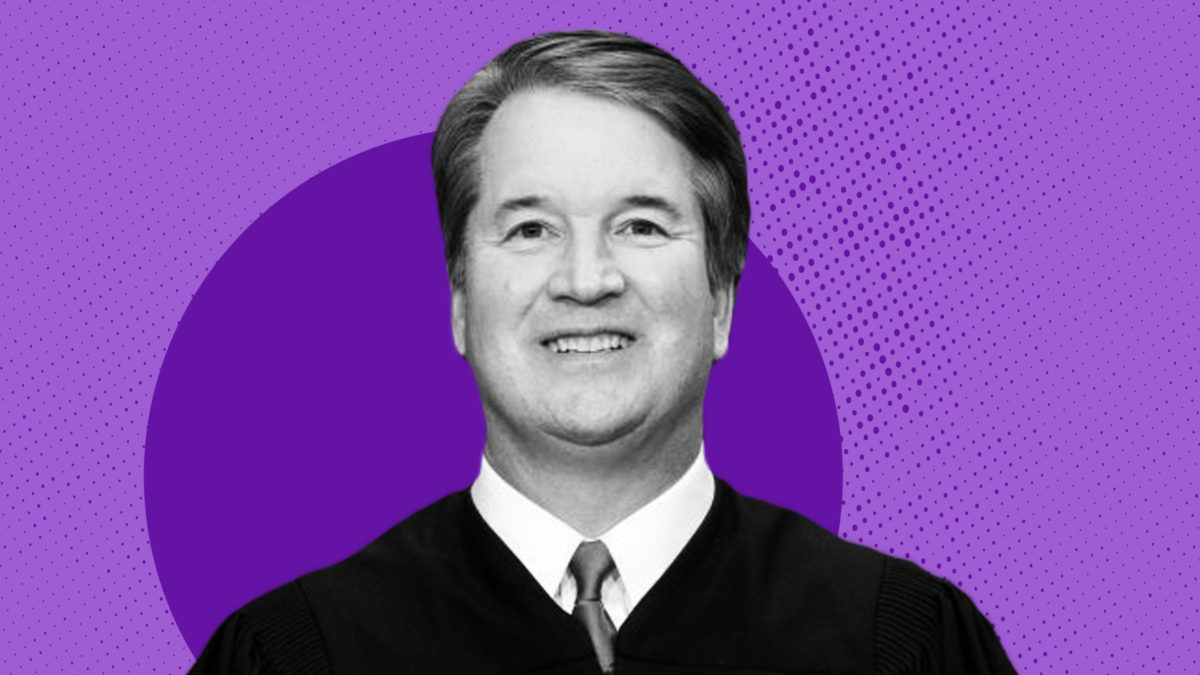
This outcome was predictable given how the oral argument unfolded in January. But the way Justice Brett Kavanaugh’s opinion for the conservatives is written dismisses the rights and lives of all transgender people and contributes to an ongoing right-wing campaign that deploys constitutional opportunism against LGBTQ people. Just as it excludes trans girls and women from sports, the majority also displays a disrespectful paternalism toward young cisgender women. By contrast, only the liberal justices expressed genuine sympathy for the young trans athletes whose plight the Court exacerbates.

As to the general rejection of transgender people, no one went as low as Justice Clarence Thomas, who, in a brief concurrence infused with resentment and contempt, stated that “men and boys with gender dysphoria are not women or girls, even if they believe that they are.” He also asserted that there is immorality in being transgender, or even just in acknowledging trans existence, writing that “to use language” that recognizes trans people in any context, not just in sports, is “to lie to the public.”
While Kavanaugh’s opinion did not go as far, it was still quite blunt. It referred to each of the petitioners pleading for the Court’s protection as a “biological male who identifies as female.” It repeatedly insisted that, as far as playing sports is concerned, trans athletes are really just male athletes who retain their “male performance advantage” because, according to Kavanaugh, “there is no current evidence that testosterone suppression or gender-affirming hormone treatment eliminates this advantage.” The opinion even framed trans girls as threats to the physical safety of cis girls, reasoning that “forcing women and girls to play against biological males can deter some…who would otherwise participate in sports from doing so—out of understandable concern about suffering serious injury.”
Kavanaugh closed his opinion by proclaiming to “admire the desire of all students, including transgender students…who want to participate in sports,” and stated that “no student-athlete on either side of the issue…deserves to be ostracized or vilified.” But after expressing close familiarity only with the habits and struggles of “women and girls who play sports,” he concluded they alone “should be allowed to compete for…life-changing opportunities…without fear of physical injury from biological males.”
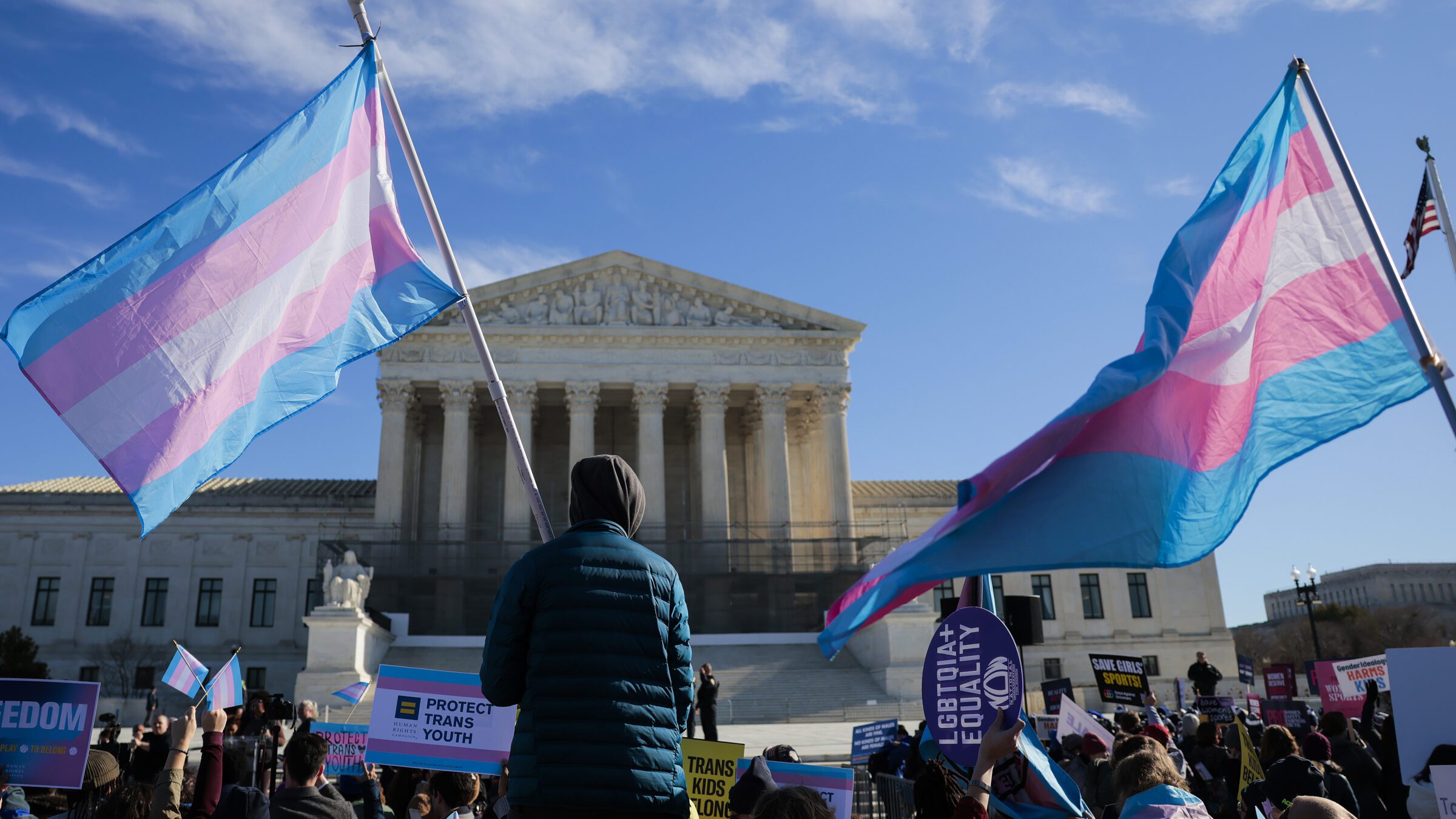
(Photo by Heather Diehl/Getty Images)
To support the legitimization of bans on trans athletes’ participation in sports, Kavanaugh’s analysis extended the same tortured logic the Court first introduced last term in United States v. Skrmetti, which focused on gender-affirming care for trans young people. On this view, laws that deny trans people access either to healthcare or to sports activities “do not classify based on gender identity or transgender status.” Instead, they merely “classify on the basis of biological sex.” Overall, the opinion’s offensive rhetoric and contorted reasoning make the animosity that motivated the bans in West Virginia, Idaho, and 25 other states pale in comparison to that conveyed by the Court.
The Court’s opinion does not just convey the conservatives’ disrespect for trans athletes, though. At times, its portrayals of cis girls in sports almost read as a younger version of the tradwives idealized by the religious right. Kavanaugh’s opinion amplified not only girls’ “inherent” physical inferiority in terms of “height, weight, strength, speed, endurance, and jumping ability,” but also their supposed inability to handle fairness, safety, and competitive issues, and a general struggle to cope with “debilitating disadvantage.” Sorely missing from this stereotype-laden account are reports showing that inclusion of transgender athletes has had no impact on sports participation or women’s athletic achievements, as well as the stories of cisgender teammates supporting their transgender peers and celebrating their joint accomplishments.
Finally, there is some limited consolation in the liberal justices’ dissenting opinions. Justice Sonia Sotomayor, for example, resisted the majority’s “biological male” language and referred to B.P.J. as a transgender girl, and she compassionately described B.P.J. as a “kind child who cares deeply about her family and friends.” Sotomayor also highlighted the cruelty of forcing trans girls like B.P.J. to play with boys, which she emphasized will “further isolate, stigmatize, and erase” trans girls.
Sotomayor further underscored that for trans athletes—and not only for their cisgender peers, as the majority one-sidedly asserted—participation in sports means much more than winning medals, and is an essential source of joy, belonging, and friendships. The result in B.P.J., she emphasized, takes these benefits away from trans athletes because the Court “thinks they have an inherent athletic advantage, even if the facts show that they do not,” and applies a “diminished view of equal protection to the sports context.”
So, on the day Pride Month ended, the conservative supermajority demonstrated again its role in not only failing to block anti-LGBTQ policies, but also in shaping them. Just as it did in 303 Creative, Skrmetti, Mahmoud, and Chiles, the Court in B.P.J. betrays its constitutional duty to protect sexual and gender minorities. And by refusing to impose checks and balances on an outrageous convergence of assaults on transgender people from red-state legislators, the executive branch, and the president, the decision embraces those attacks, inviting more to come.