In August 2022, Detroit Police Department officers arrested and jailed Daren Fenderson, a 24-year-old Black man, in connection with a fatal shooting. And at the start of the interrogation at police headquarters, Sergeant Reginald Beasley read Fenderson his rights.
If you’ve ever watched Law & Order, you’ve heard this spiel: Miranda warnings, named for the 1966 Supreme Court decision Miranda v. Arizona, advise arrestees of their Fifth Amendment right to remain silent and their Sixth Amendment right to assistance of counsel, whether or not they can afford a lawyer. Unless police inform people in custody of their rights—and unless the accused person knowingly and voluntarily waives those rights—any incriminating statements the suspect makes without a lawyer present are supposed to be inadmissible as evidence against them.
Initially, when Beasley provided the Miranda warnings, Fenderson waived his rights, saying that “everything’ll be good.” But after about an hour and a half of questioning, during which Beasley repeatedly told Fenderson that police had video of the shooting and that photos of the victim were “fucked up,” Fenderson invoked his right to counsel.
Beasley then asked Fenderson if he had an attorney already. He did not, and asked, “Y’all are gonna appoint one, right?” Fenderson also asked how long this would take. Beasley said he would “make a couple phone calls” to find out, and left the room. Video of the interrogation shows that, once alone, Fenderson started worrying aloud: “Man, they’re trying to get me to confess to some shit I ain’t do,” he said. “I knew this was gonna happen.”
Around 40 minutes later, Beasley came back and said he was still “trying to get that attorney.” Fenderson said he hadn’t taken his medication yet, and asked to use the bathroom. Police handcuffed Fenderson, with his arms in front of him, and escorted him to the restroom. Officers then returned Fenderson to the interrogation room, and left him alone—still in handcuffs, and still with no information about an attorney—for another two hours.
Beasley then returned with another police officer, who re-cuffed Fenderson, this time with his hands behind his back. Fenderson became confused and asked where his lawyer was. “You don’t got one,” said Beasley. He told Fenderson that they “tried to call one,” but that “ain’t nobody available and you ain’t got no money.” Fenderson said he came into the station with money and asked if they could use that. Beasley said they could not. “Aw, come on,” said Fenderson.
Beasley then told Fenderson that they could not continue speaking because Fenderson had asked for an attorney. “We’re gonna submit a warrant and the prosecutor will review it,” said Beasley. Fenderson reiterated his confusion, saying things like “I don’t know what’s going on” and “I’m not sure what all that means.” But Beasley repeated that he couldn’t talk about the case unless Fenderson said he wanted to talk without an attorney.
Fenderson relented and agreed to waive his rights in writing. Only then did officers remove the handcuffs. Fenderson signed the waiver while crying. Beasley and another detective started yelling at Fenderson to stop crying and tell them what they needed to know.
In 2024, a Michigan state appeals court held that Fenderson’s statements to police after he signed the waiver could be used against him at trial. Last week, however, the Michigan Supreme Court reversed that judgment in a 6-1 decision. In her majority opinion, Justice Kimberly Thomas wrote that police gave Fenderson “confusing and inaccurate information,” and thereby “undermined the advice of rights required by Miranda.” As a result, she concluded, “both the federal and state constitutions” require the suppression of Fenderson’s statements.

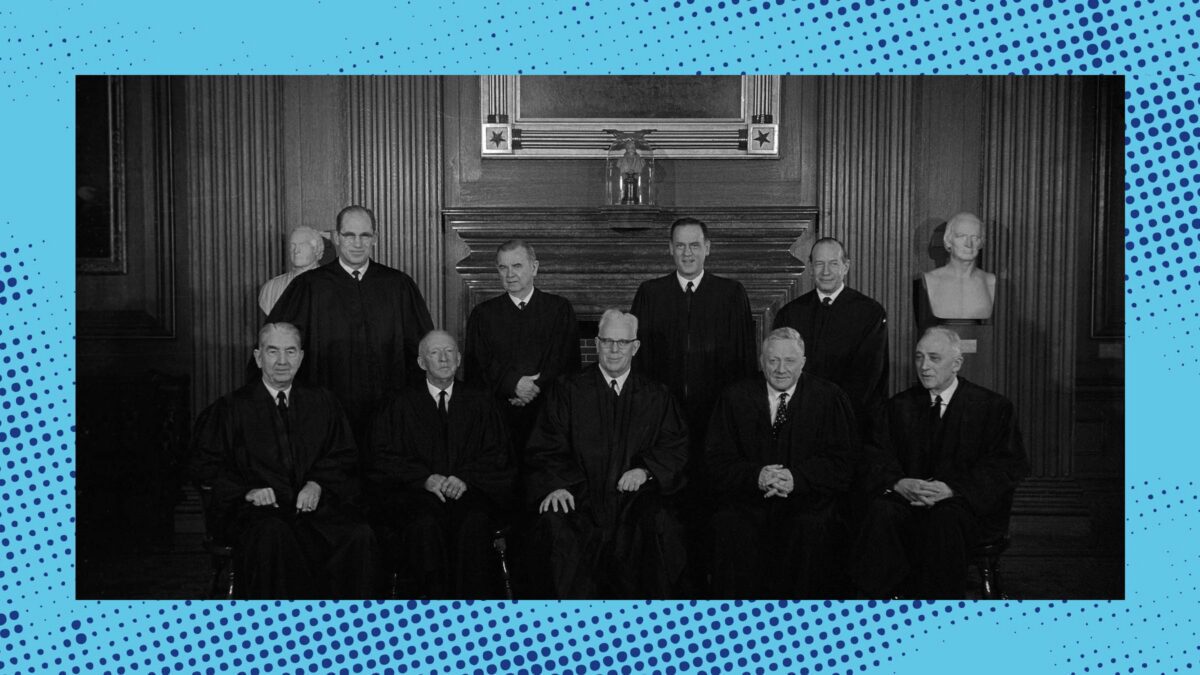
The Michigan Supreme Court’s decision afforded a level of respect to Miranda that the U.S. Supreme Court hasn’t shown in decades. In his majority opinion, Chief Justice Earl Warren warned that any evidence that police “threatened, tricked, or cajoled” a person in their custody would show that a waiver is not “voluntary” in any meaningful sense. “The requirement of warnings and waiver of rights is a fundamental with respect to the Fifth Amendment privilege, and not simply a preliminary ritual to existing methods of interrogation,” he wrote.
But that was before Republicans took over the federal judiciary. Shortly after Miranda, Richard Nixon was elected president and made four Supreme Court appointments within just three years. Those appointees and their successors would go on to chip away at more and more of Miranda’s protections. In 1971, for example, the Court held that un-Mirandized statements could be admitted at trial for some purposes; a prosecutor could, for instance, use the statements to show a contradiction in the defendant’s testimony. In 1984, the Court created a “public safety” exception to Miranda that further relaxed officers’ obligation to advise suspects of their rights.
More recently, in 2022, the Court held that a violation of Miranda is “not necessarily” a violation of the Constitution, so defendants have no right to sue under federal civil rights law when un-Mirandized statements are used as evidence against them at trial. In his majority opinion in that case, Vega v. Tekoh, Justice Samuel Alito wrote that Miranda is merely “a judicially crafted prophylactic rule” that should apply “only where its benefits outweigh its costs.”
The Supreme Court has so thoroughly eroded Miranda over the years that some scholars argue that the decision has already been “stealth overruled.” State courts, however, do not need to follow the U.S. Supreme Court’s lead. In fact, in a law review article published in 1977, Supreme Court Justice William Brennan recognized the Court’s reactionary direction and urged state courts to chart a different, more just path. “Federalism need not be a mean-spirited doctrine that serves only to limit the scope of human liberty,” he said.
In his article, Brennan specifically pointed to a handful of decisions in state courts that rejected the Supreme Court’s narrowing view of Miranda. While it “might have been safe” in the past for lawyers to “raise only federal constitutional issues,” Brennan said, “plainly it would be most unwise these days not also to raise the state constitutional questions.”
Today, as a host of federal constitutional rights face intensified hostility from the U.S. Supreme Court, it is only becoming more urgent to shore up those rights in state courts. At the federal level, Miranda is getting weaker. But last week’s ruling in Michigan is a reminder that state courts can still protect it.