On Friday, a six-justice majority of the Supreme Court struck down President Donald Trump’s tariffs regime. Tariffs are taxes on imported goods that are paid by importers. And for the past year, Trump has unilaterally imposed a tariff on all countries with which the United States trades, amounting to an average tax increase of $1,000 per household.
Article I of the Constitution gives the taxing power to Congress—not the president. But since taking office last year, Trump has argued that he had the authority to impose these tariffs anyway under a federal law called the International Emergency Economic Powers Act. IEEPA, which Congress enacted in 1977, permits presidents to “regulate” imports in order to “deal with any unusual and extraordinary threat.” And Trump thought that meant he could levy tariffs at will to respond to “emergencies” like drug trafficking, trade deficits, and women who are insufficiently polite to him.
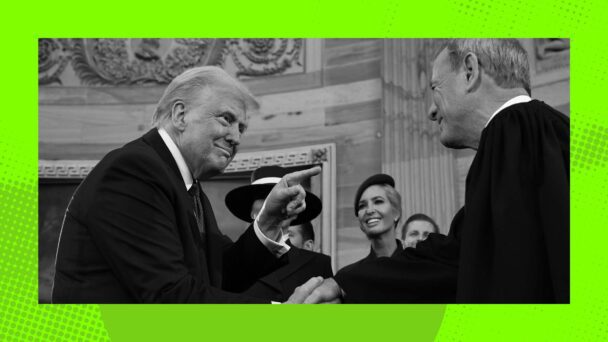
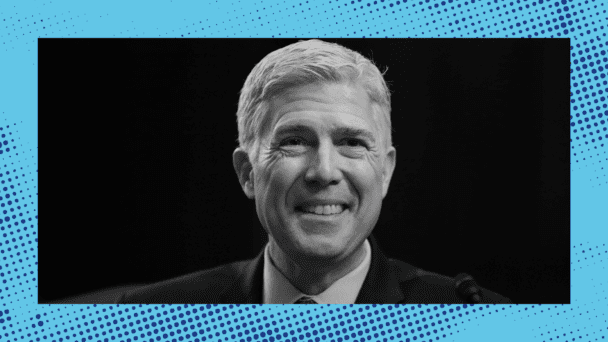
In Learning Resources v. Trump, the Court ruled otherwise. Chief Justice John Roberts wrote for the majority that Trump was claiming an “independent power to impose tariffs on imports from any country, of any product, at any rate, for any amount of time” based on only two words in IEEPA, “regulate” and “importation,” which are separated from each other by 16 other words. Joined by the liberal justices, along with Justices Neil Gorsuch and Amy Coney Barrett, Roberts concluded that “those words cannot bear such weight.”
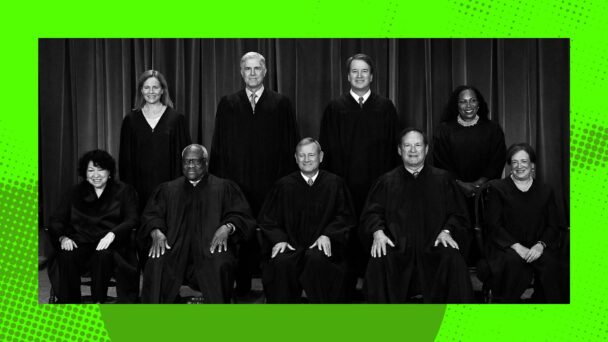
While six justices agreed on the bottom-line conclusion that IEEPA does not authorize Trump to impose tariffs, the Court was deeply fractured as to the rationale. Much of Roberts’s opinion was joined only by Gorsuch and Barrett, both of whom wrote their own solo concurrences. Justice Elena Kagan wrote a concurring opinion, too, joined by Justices Sonia Sotomayor and Ketanji Brown Jackson. Jackson also wrote a concurrence for herself alone.
The source of the split was Roberts’s reliance on the so-called “major questions doctrine.” The “major questions” principle is a recent conservative innovation that empowers the Court to invalidate executive decisions of “vast economic and political significance” if the justices think Congress did not “clearly” give the executive that authority.
Until today, the major questions doctrine only surfaced when the Court wanted to block progressive policymaking. In Learning Resources v. Trump, Roberts said the Court has “long expressed reluctance to read into ambiguous statutory text extraordinary delegations of Congress’s powers.” He then cited a 2022 case that blocked the Environmental Protection Agency from regulating carbon emissions, a 2022 case that blocked the Occupational Safety and Health Administration from mandating COVID-19 vaccines in the workplace, and a 2023 case that blocked the Department of Education from implementing President Joe Biden’s student debt relief plan.
In her concurrence, Kagan argued that there is no need for the Court to use the major questions doctrine in this case, since using “ordinary tools of statutory interpretation”—like text, context, and a modicum of common sense—would lead to the same result. “It is not just that the Government’s arguments fail to satisfy an especially strict test,” Kagan said. “It is that they fail to satisfy the normal one.”
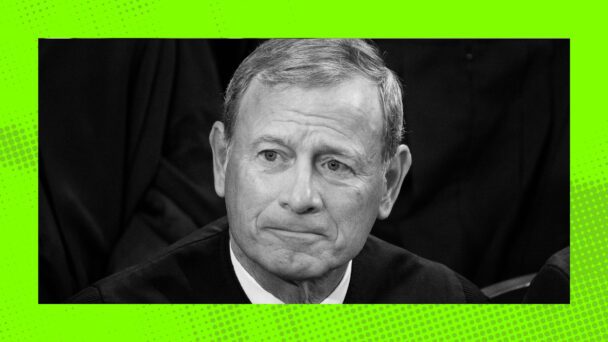
There are plenty of reasons to reject “economic significance” as a legal standard for striking down executive actions. But if that is the standard, there is no question that Trump’s tariffs qualify. “The President’s assertion here of broad statutory power over the national economy is extravagant by any measure,” said Roberts. “And as the Government admits—indeed, boasts—the economic and political consequences of the IEEPA tariffs are astonishing.” Roberts went on to use Trump’s own description of the tariffs as a reason to rule against him. “In the President’s view, whether ‘we are a rich nation’ or a ‘poor’ one hangs in the balance,” said Roberts. “These stakes dwarf those of other major questions cases.”
The chief justice also detailed Trump’s chaotic implementation of his signature economic policy. “One month after imposing the 10% drug trafficking tariffs on Chinese goods, he increased the rate to 20%,” said Roberts. “One month later, he removed a statutory exemption for Chinese goods under $800,” Roberts continued. “Less than a week after imposing the reciprocal tariffs, the President increased the rate on Chinese goods from 34% to 84%. The very next day, he increased the rate further still, to 125%.”
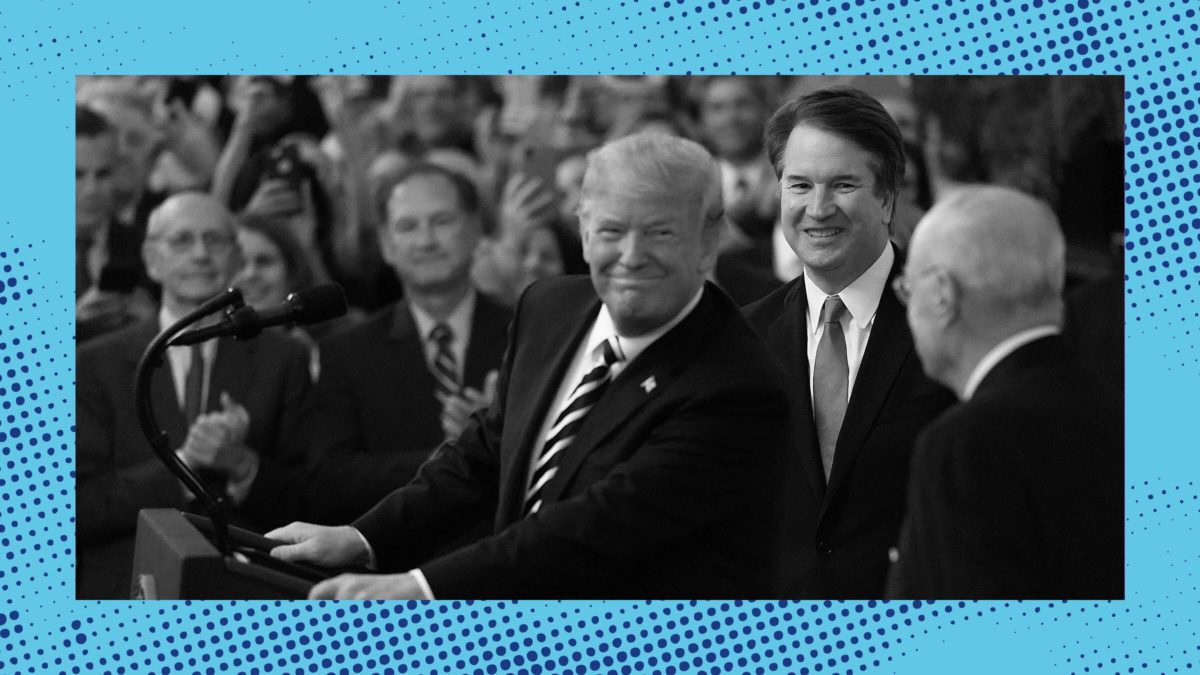
In a dissent joined by Justices Clarence Thomas and Samuel Alito, Justice Brett Kavanaugh suggested that, with IEEPA off the table, Trump could try and impose tariffs under a different statutory authority. And Trump indicated at a press conference and on social media that he intends to take Kavanaugh up on the idea. “The Supreme Court did not overrule TARIFFS, they merely overruled a particular use of IEEPA TARIFFS,” he wrote on Truth Social.
This is true, for now. But any renewed tariff attempt will surely wind up before the Supreme Court again. Whether the Court uses the major questions doctrine, as Roberts and two conservatives would prefer, or statutory interpretation, as the liberals would prefer, the Court’s jurisprudence remains flexible enough to stop Trump’s financial fuckery, or anything else enough conservatives don’t like.