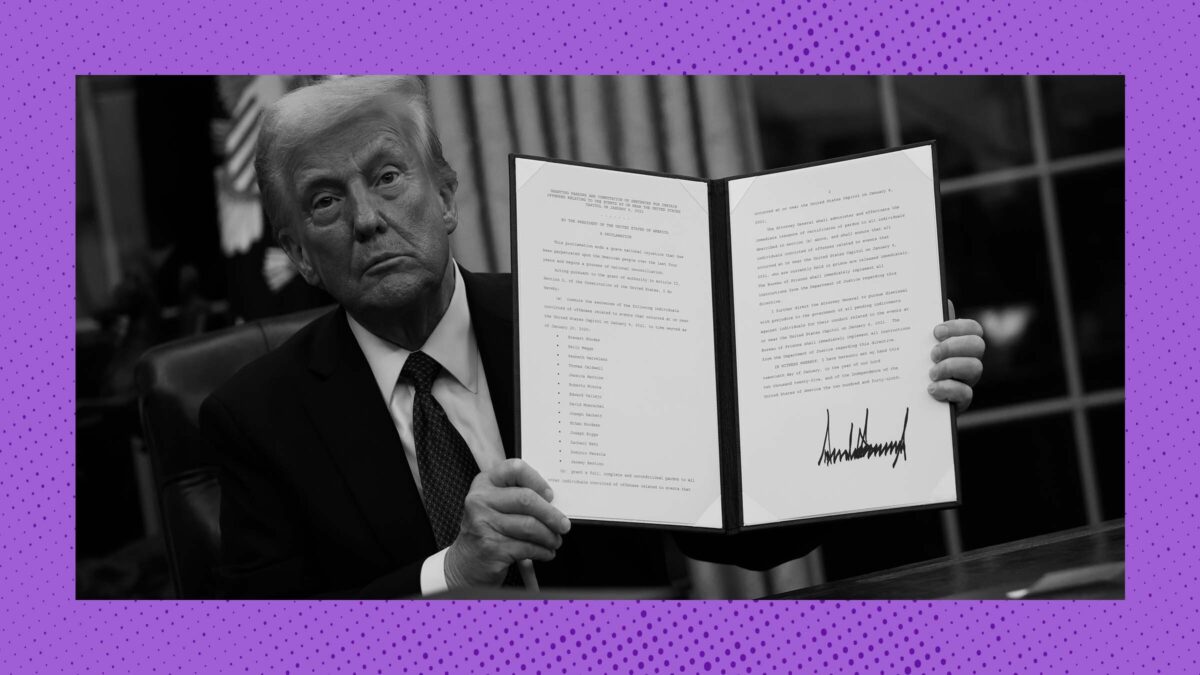
A razor-thin majority of the Supreme Court confirmed today that the Fourteenth Amendment means what it says: “All persons” born in the United States and “subject to the jurisdiction thereof” are citizens of the United States. In January 2025, President Donald Trump issued an executive order that attempted to unilaterally revoke that guarantee, limiting citizenship at birth to only U.S.-born children with at least one parent who is a citizen or legal permanent resident.
If implemented, Trump’s directive would have denied the rights and privileges of citizenship, like the ability to vote and freedom from deportation, to hundreds of thousands of people born in the U.S. every year. But on Tuesday, the Court held this scheme unconstitutional, ruling 5-4 in Trump v. Barbara that Trump’s order contravened the plain language of the Fourteenth Amendment as it has been understood across centuries.
Chief Justice John Roberts, joined by the three Democratic appointees and Justice Amy Coney Barrett, explained that early American colonists imported the English common-law rule of citizenship by birth in a territory, but that slave states had “abandoned” that rule by making citizenship depend on “blood, not soil.” In the “odious decision” of Dred Scott v. Sandford, Roberts continued, the Court had “imposed the Southern States’ beliefs onto the Nation,” holding that the longstanding tradition of citizenship by birth did not apply to Black people.
Roberts’s opinion makes clear that Congress adopted the Fourteenth Amendment after the Civil War to “repudiate” Dred Scott. Roberts also quoted the amendment’s drafters, who were explicit about their aim to put the “great question of citizenship” squarely “beyond the legislative power.”
By attempting to exclude people with disfavored ancestry from citizenship at birth, Trump’s directive was a brazen effort to reproduce an antebellum white supremacist legal order that the Fourteenth Amendment and subsequent Supreme Court decisions already repudiated. Trump v. Barbara should thus have been an extraordinarily easy case; it should not have taken so long or been so difficult for the Court to affirm the constitutional foundation of multiracial democracy in the United States.
Indeed, lower court judges had no difficulty quickly recognizing that the president cannot override the Constitution. Barely three weeks after Trump’s proclamation, three federal district courts temporarily blocked it from taking effect, finding that it conflicted with the “plain language” of the Fourteenth Amendment and “the century-old untouched precedent that interprets it.”
Trump’s legal arguments to the contrary alternately baffled and infuriated the judges who had the misfortune of trying to make sense of it. “I’ve been on the bench for over four decades, and I can’t remember another case where the question presented is as clear as this,” said Judge John Coughenour, a Reagan appointee in Washington state, to a Justice Department lawyer. “Frankly, I have difficulty understanding how a member of the bar would state unequivocally that this is a constitutional order. It just boggles my mind.”
Astonishingly, several Republican justices found the question much more challenging. “The constitutional issue is not straightforward, much as we might want it to be,” wrote Justice Brett Kavanaugh in a partial concurrence in Trump v. Barbara. Writing only for himself, Kavanaugh argued that Trump’s order runs afoul of existing federal law but “does not violate the Fourteenth Amendment,” and concluded that Congress could “enact new legislation establishing exceptions to birthright citizenship.”
Justice Samuel Alito, dissenting alone, accused the majority of paying “little attention” to the constitutional text, telling an “incorrect” story of American history, and wrongly relying on 19th-century precedent that he described as “to put the point gently, very far from a model of careful judicial craftsmanship.” In Alito’s view, the Fourteenth Amendment does not “degrade the concept of United States citizenship” by granting it to the child of a “birth tourist.”
Joined by Justice Neil Gorsuch, Justice Clarence Thomas authored a similar dissent that accused the majority of dabbling in “alternative history,” promoting “birth tourism,” and devaluing American citizenship. Thomas also pushed a strikingly narrow view of the Fourteenth Amendment, arguing that its “one pervading purpose” was “securing equal citizenship for the freed slaves,” and lamenting the Court’s contribution to the “sad history” of “repurposing” the amendment for “political projects” that the Reconstruction Congress purportedly “never contemplated” and “did not support.”
Justice Ketanji Brown Jackson exposed the falsity of that claim in a concurrence joined by Justice Sonia Sotomayor. In her opinion, Jackson explained how Black people and their allies made a “conscious choice” during Reconstruction to advance a “universalist vision” of what it means to be an American citizen and, indeed, what it means to be America. The Reconstruction Amendments were not “a mere spot treatment for the dark stain of slavery,” said Jackson, but an “anticaste, antisubordination reset for the Nation.”
“Freed Blacks fought for the shared humanity of all people,” Jackson wrote. “Our Constitution stands firmly against caste and subjugation—on all axes and in all manners.”
Both constitutionally and morally, Jackson’s read is the better one. But it does not yet command a majority of the Supreme Court. And the 100-plus pages of dissents in Trump v. Barbara make clear that the dissenters’ unconstitutional and immoral misread of the Fourteenth Amendment will motivate the conservative legal movement for years to come.