
The nicest thing you could say about Todd Blanche, President Donald Trump’s former criminal defense lawyer and the current Acting Attorney General, is that he’s an innovator in corruption. It would already be obscene that Blanche personally signed an addendum to the heinous “anti-weaponization fund” that prohibits tax audits of the president or his family. But even after the Justice Department backed away from the payouts, Blanche said that the agreement not to audit Trump would remain in place, because for him, there is no law enforcement task as important as licking the president’s boots.
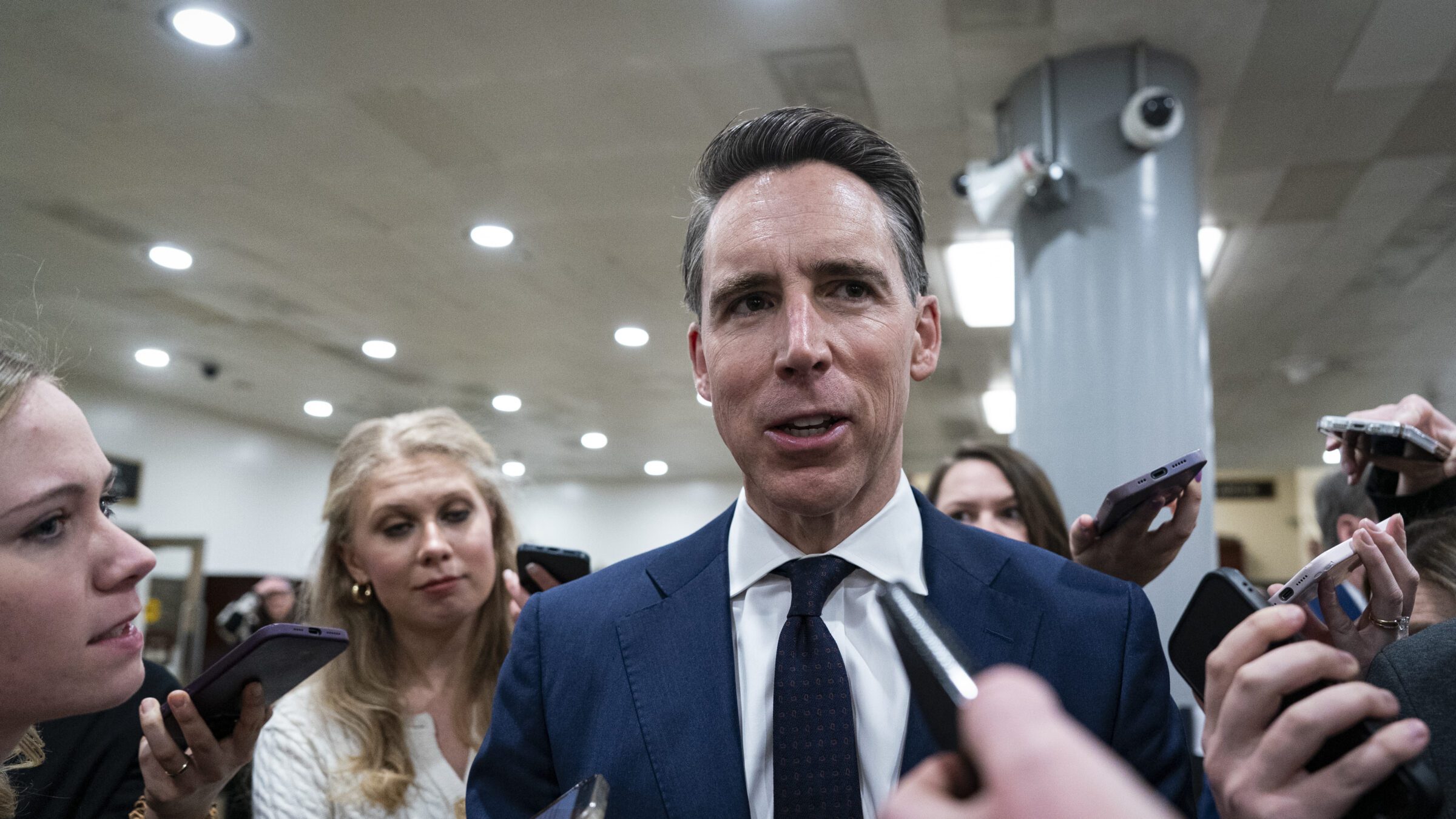
But now, it appears that a sitting senator will try to leverage Blanche’s obvious thirst for power amid his quest to get confirmed as the full-time attorney general. Last week, Missouri Republican Senator Josh Hawley suggested that his vote for Blanche could be contingent on Blanche doing him an anti-abortion favor.
That’s no idle threat: Blanche can only lose one Republican vote on the Senate Judiciary Committee, on which Hawley serves, and Politico recently reported that at least two GOP senators—Thom Tillis of North Carolina and John Cornyn of Texas, both of whom are retiring—are already noncommittal. Depending on how serious they are about bucking Dear Leader, this could give Hawley an inordinate amount of power over the process.
Hawley told Politico that he wants to know whether Blanche would settle multiple active lawsuits that conservative-led states filed against the Food and Drug Administration over the agency’s 2023 decision to allow telemedicine prescriptions of the abortion drug mifepristone. One of those cases was filed in Louisiana by his wife, Erin Hawley, a lawyer with the far-right activist group Alliance Defending Freedom, while the other two originate from Missouri and Texas. Any settlements in these cases could mean the end of telehealth mifepristone nationwide, a key goal of the anti-abortion movement, and one enumerated in Project 2025. In what I’m sure is a coincidence, ADF was an advisory board member of Project 2025.

(Photo by Mark Peterson – Pool/Getty Images)
The brief Politico story did not mention Erin Hawley’s involvement, but Josh sure seemed excited to talk to a reporter about one of his wife’s cases. “It would be a shock to me if he says, ‘No, we’re not going to do that,’” he said, adding that he’s “interested in what [Blanche’s] timeline is and how he gets there.” Hawley also indicated that Blanche’s answers on settling the lawsuits could affect his committee vote, since the issue is “important to my state, and certainly important to pro-lifers.” In November 2024, Missouri voters approved an amendment to overturn its abortion ban, a fact that, for some reason, Hawley failed to mention.
Hawley seems to understand that he has an opportunity to help the anti-abortion movement, in which he and his wife are key players. Much to the chagrin of conservatives, abortions have increased, not decreased, in the years since the fall of Roe v. Wade. A key reason why is that Democratic-led states responded to Dobbs by passing telehealth “shield” laws allowing providers to prescribe abortion pills across state lines. Medication abortions by telemedicine now make up 28 percent of all abortions in the medical system—a fourfold increase since 2022.
Just months after Dobbs, the conservative movement was eager to make medication abortion its next anti-abortion fight. Erin Hawley tried and failed to restrict abortion pills in a Texas lawsuit that the Supreme Court rejected in 2024 on standing grounds. The Project 2025 playbook proclaimed that “abortion pills pose the single greatest threat to unborn children in a post-Roe world” and called on the next Food and Drug Administration to end telemedicine of mifepristone, if not revoke its approval and pull it from the market altogether. But just the act of reimposing the outdated requirement that people have an in-person visit for abortion pills may function as a backdoor ban: There are a shrinking number of clinics in legal states and they could be flooded with patients trying to get care that was previously available virtually.

Shortly after Trump returned to office, Hawley and other conservative activists seized on a dubious, non-peer-reviewed analysis published by the conservative Ethics and Public Policy Center—also on the Project 2025 advisory board—which claimed that mifepristone is less safe than its label suggests. In April 2025, Hawley sent a letter citing this analysis to Health Secretary Robert F. Kennedy, Jr., who pledged to conduct a “review” of the medication.
Conservative litigants tried to hurry the process along, by challenging FDA policy on telehealth prescriptions and suing shield law providers to halt the flow of pills. But anti-abortion players, including Hawley, became livid after Bloomberg reported in December that FDA Commissioner Marty Makary was slow-walking the analysis so it wouldn’t be complete until after the midterm elections. The influential group Susan B. Anthony Pro-Life America immediately called for Trump to fire Makary, and Hawley began bad-mouthing the FDA in huffy press statements and interviews. Trump didn’t actually give Makary the boot until SBA President Marjorie Dannenfelser told The Wall Street Journal in May that, on abortion, “Trump is the problem.”
Now, the FDA says it has finally begun its “review” of mifepristone. But to the frustration of accelerationists like the Hawleys, that analysis is expected to take about six months, meaning that it won’t be complete until after the midterms. Another blow came between Makary’s departure and the FDA’s news, when the Supreme Court denied Erin’s request to ban telemedicine while the Louisiana case proceeded. A Trump-appointed judge had previously paused that case until the completion of the FDA’s review. So—for now at least—mifepristone remains available under telehealth shield laws.
Which brings us back to Josh Hawley’s proposal to Blanche: It appears the Hawleys are throwing everything at the wall to restrict abortion pills as soon as possible, faster than the litigation or agency process would normally allow. If Blanche, as the newly confirmed attorney general, were to “settle” this litigation on behalf of the government, the anti-abortion groups could claim victory and hope the FDA finishes the job after the elections.
(Photo by Al Drago/Getty Images)
It’s not entirely clear that such a shady deal would be successful in the long run. Two mifepristone manufacturers that intervened in the conservative states’ suits against the FDA would surely sue the agency should it reimpose any restrictions. But the Hawleys are true believers, and Josh may simply be using a corrupt nomination to bolster his own résumé.
Josh and Erin have teamed up on this issue before. Josh signed an amicus brief in Erin’s failed Texas lawsuit, and the Hawleys launched their own anti-abortion PAC late last year. That move pissed off Trump advisors who don’t want this issue in the headlines during a midterm election season in which Trump’s approval is in the mid-30s. Undeterred, Josh introduced a messaging bill in March that would go much further than ending telehealth prescriptions of mifepristone, and ban the drug outright. The bill thankfully won’t pass, as it has just six cosponsors in the Senate, but it’s notable that yanking the drug’s approval was one of the asks in Erin’s Texas case.
The press conference for Hawley’s aforementioned bill, the “Safeguarding Women from Chemical Abortion Act,” featured appearances from Dannenfelser, the SBA president; Kristen Waggoner, his wife’s boss at ADF; and Erin herself. The bill also came with statements of support from the groups who have criticized the Trump administration’s hesitance to enact new national restrictions on the pills. If you squint, you can see these organizations rallying around a certain ambitious lawmaker who might be courting the anti-abortion vote in 2028.
With Blanche in a vulnerable position, Hawley seems to sense that he can use this moment to make a splash. The question now is what Blanche is willing to do to get the job, and the power, that he craves.