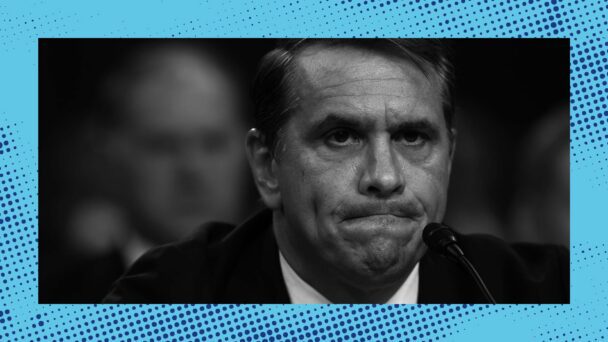
When he sat down for his Senate confirmation hearing on Wednesday, attorney general nominee Todd Blanche had his work cut out for him. In the decades since Watergate, the Justice Department has built a reputation for doing its work independently, without regard to the president’s personal or political agendas. This reputation has taken some hits of late, but it lingers nonetheless; on its official website, the DOJ describes its mission as “following the facts and the law wherever they may lead, without prejudice or improper influence.”
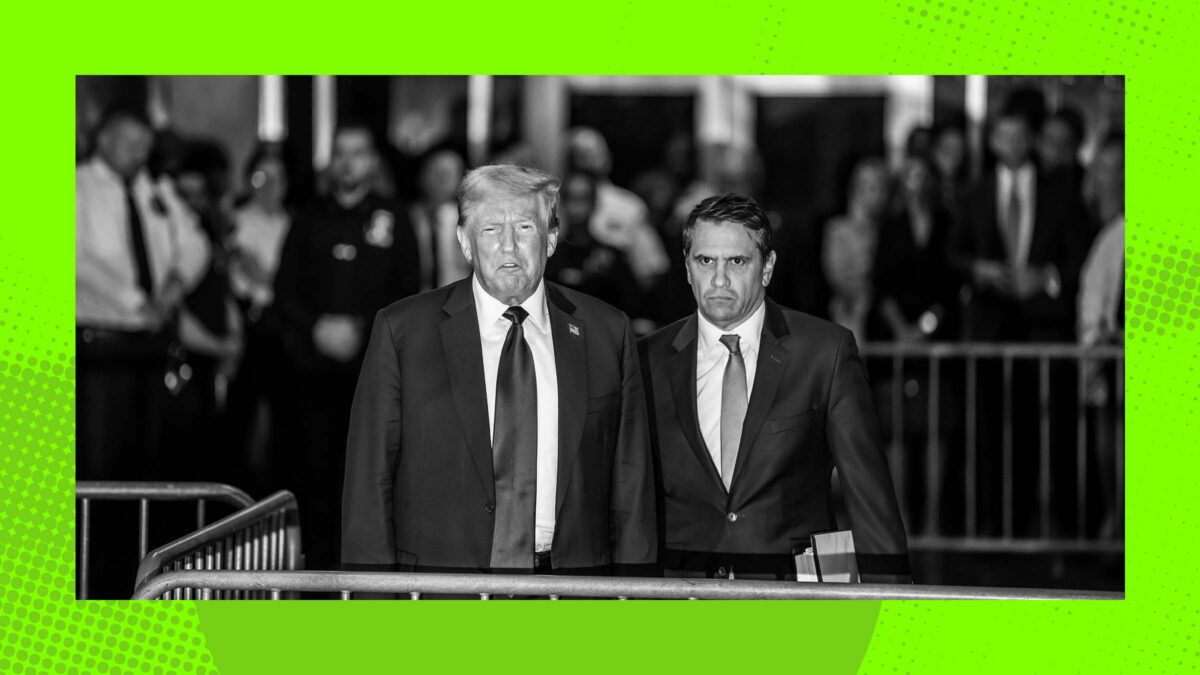
The complication for Blanche is that he is only in line for the job because he spent several years as President Donald Trump’s criminal defense lawyer, representing the former president in (among other matters) the New York hush money prosecution and the classified documents case in Florida. By taking on Trump and various Trump hangers-on as clients, Blanche, a generic ex-BigLaw partner with an otherwise unremarkable résumé, made a pretty simple bet: that if Trump were re-elected president in 2024, Blanche would be repaid for his loyalty.
He was right. Shortly after Election Day, Trump nominated Blanche to be deputy attorney general, and after firing Attorney General Pam Bondi in April 2026, he elevated Blanche to serve as her temporary replacement. Since then, Blanche has done little to indicate that he views his professional responsibilities as substantively different than they were two years ago. His best-known accomplishment is probably “settling” Trump’s lawsuit against the Internal Revenue Service by creating a $1.8 billion fund to compensate “victims” of Biden-era “weaponization” of the legal system. This is a euphemism for Trump allies who have been convicted of crimes, and whom the president would like to reward for their troubles.
The fund, which Blanche walked back after even Senate Republicans found it to be a bit much, is so cartoonishly illegal that earlier this week, a federal judge in Florida sanctioned the lawyers who drafted the settlement and forwarded her order to judicial officials in New York, where Blanche is a member of the bar, for possible disciplinary action. If the Senate confirms Blanche, this raises at least the theoretical possibility that he becomes the first person to serve as the federal government’s top law enforcement official after being stripped of his right to practice.
One of Blanche’s primary tasks on Wednesday was thus persuading a critical mass of senators that his time as Trump’s personal lawyer is really, truly over, both literally and spiritually. He failed almost immediately. When Louisiana Republican Senator John Neely Kennedy asked him to describe his relationship with Trump—a softball if there ever was one—Blanche answered straightforwardly. “I’m his lawyer,” he said.
Kennedy: Are you and President Trump friends?
Blanche: I’m his lawyer—was his lawyer pic.twitter.com/V4P1fNezYT
— Acyn (@Acyn) July 15, 2026
Blanche quickly corrected himself—“I was his lawyer,” he said. But this (I am being generous here) slip was part of a pattern that recurred throughout the hearing: Every time senators posed a question like this one, Blanche made clear that he perceives no meaningful distinction between representing Trump in criminal court on the one hand, and serving as his attorney general on the other. The thought would never occur to him, because every ambitious right-wing lawyer in America understands that for as long as Trump is president, no one who wants to be an “independent” attorney general is getting considered for the job in the first place.
When Delaware Democratic Senator Chris Coons asked Blanche if the Justice Department would be “independent” under his leadership, Blanche more or less shrugged. “We certainly operate with integrity,” Blanche said. “But if confirmed, I will be a member of the Cabinet…Just like the other Cabinet members, President Trump can fire me whenever he wants.”
This is descriptively right, of course. But responding to a question about Trump’s authority to commandeer the Justice Department by asserting that Trump can fire him for any reason does not inspire confidence that Blanche perceives any limits on Trump’s authority to commandeer the Justice Department. When an attorney general nominee says that they would “operate with integrity,” it is a pretty ominous sign when they feel compelled to follow up with a “but.”
Clip via YouTube
Blanche stuck to these talking points in an exchange with Hawaii Democratic Senator Mazie Hirono, who raised his April 2026 comments suggesting that Trump has a “right” and “duty” to direct federal prosecutors to investigate people he “has had issues with.” Blanche explained to Hirono that he was only referring to the fact that under Article II of the Constitution, Trump is “in charge of the Department of Justice.” Again, that is true, and again, it is not responsive to Hirono’s point, which is that Todd Blanche does not seem to have a problem with Trump directing federal prosecutors to investigate people he “has had issues with.”
Finally, like Trump’s judicial nominees, Blanche was careful to avoid saying anything that might make his notoriously moody benefactor upset. He told senators that he is not a “yes man” and sometimes disagrees with Trump, but did not elaborate further. He danced around the subject of January 6, emphasizing that he did not “question” Trump’s “very generous” decision to pardon the rioters. And he occasionally mixed it up with Democrats, calling questions from Rhode Island Senator Sheldon Whitehouse “extraordinarily obnoxious.” In both substance and style, it was exactly the performance that Trump, watching on TV, expects from his subordinates: At every opportunity, Blanche reiterated his fealty to Trump’s agenda, his deference to Trump’s power, and his eagerness to adopt Trump’s political enemies as his own.
Over the course of his two terms, Trump has replaced every bad attorney general with a successor who is even more partisan and more obedient. In 14 months, Bondi did more to transform the Justice Department into the president’s personal law firm than either of Trump’s first-term attorneys general, Jeff Sessions and William Barr. Trump fired her anyway, though, because she was still not working as quickly or ruthlessly as he’d hoped. Assuming the Republican-controlled Senate confirms him, Blanche will be the worst of the lot, because he understands that the job is the same as it ever was: to do what his most famous client asks.