I will say this about Lindsey Graham, the South Carolina Republican senator who died on Saturday at 71: He had Donald Trump clocked right from the jump. During the 2016 presidential primary, Graham, who had spent years carefully curating a reputation in Washington as one of the proverbial Reasonable Republicans, described Trump as a “race-baiting, xenophobic, religious bigot.” He said he would “rather lose without Donald Trump than try to win with him,” and that Trump didn’t “have a clue about anything.”
“You want to make America great again? Tell Donald Trump to go to hell,” Graham said in December 2015. On Election Day, he tweeted that he’d voted for a third-party candidate because, he said, he “couldn’t go where Donald Trump wanted to take the USA & GOP.”
Trump’s victory later that night changed Graham’s mind in a hurry. In the years that followed, Graham became one of the president’s most enthusiastic cheerleaders, always willing to hop on the Sunday shows and say whatever was most likely to earn him the shiny bauble of an attaboy Trump tweet.
Probably his most consequential performance came in September 2018, when the psychology professor Christine Blasey Ford testified to the Senate Judiciary Committee that Brett Kavanaugh, Trump’s nominee to the Supreme Court, had sexually assaulted her when they were in high school. And for much of the hearing, it felt like Kavanaugh’s nomination really might be on the ropes: Several key Republicans were already waffling, and in the wake of Ford’s gut-wrenching testimony, behind closed doors, they were preparing to accept defeat. Even Trump, who was watching on TV, would later describe Ford as “compelling” and “very credible.”
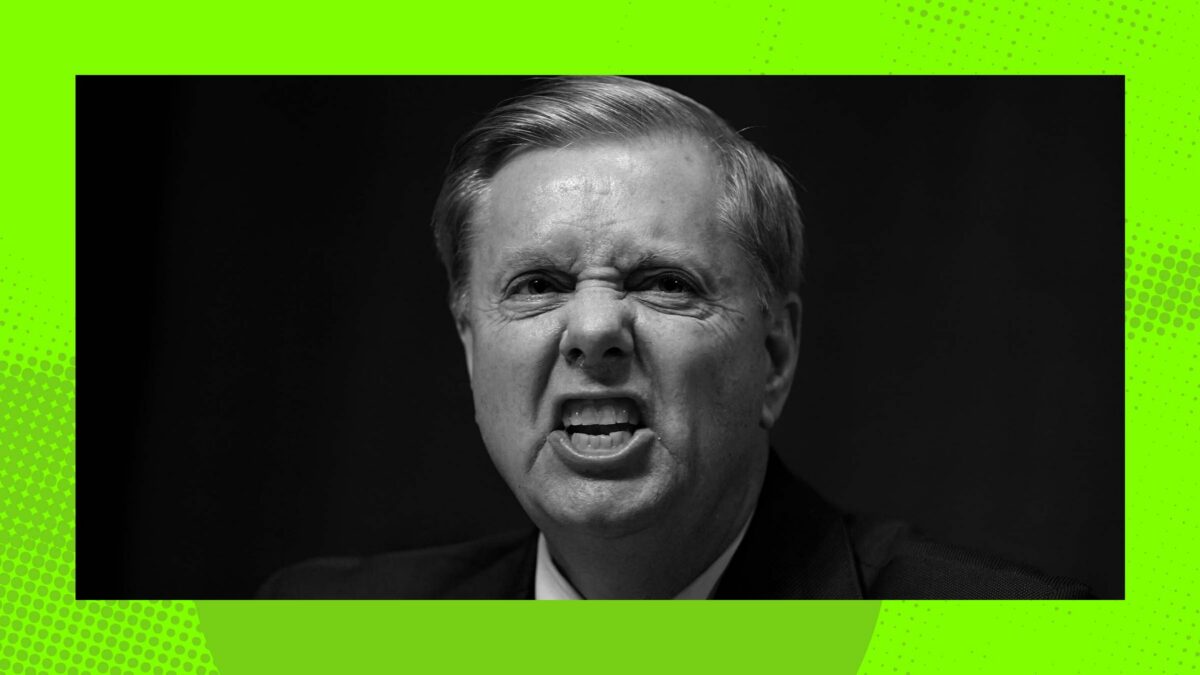
All Graham saw was an opportunity. When Kavanaugh replaced Ford at the witness table for the second part of the hearing, Graham barely even bothered asking questions. Instead, he used his time to deliver a snarling, made-for-television attack on Democratic lawmakers, as well as anyone else who would have the temerity to suggest that a serial liar credibly accused of sexual assault was not fit for a life-tenured seat on the Supreme Court. “Boy, y’all want power,” Graham shouted. “God, I hope you never get it.”
Clip via YouTube
Graham wrapped with an unvarnished appeal to tribalism, urging his Republican colleagues to come to Kavanaugh’s aid in his greatest hour of need. “If you vote no, you’re legitimizing the most despicable thing I have seen in my time in politics,” he told them. Kavanaugh, looking on from the witness table, could not suppress a grin of triumph.
As you are probably aware given that Kavanaugh is a Supreme Court justice now, Graham’s gambit worked. The White House praised his “decency and courage,” and Kavanaugh seemed invigorated by the histrionics, suddenly more confident than ever that his fellow Republicans, led by Graham, would close ranks around one of their own. Rhode Island Democratic Senator Sheldon Whitehouse later told the journalist Ruth Marcus that Graham’s speech was “probably the single most effective piece of political theater I have ever seen in my life,” and credited it with saving Kavanaugh’s nomination from defeat.
Trump, who has a special place in his heart for men who defend men accused of sexual assault, never forgot Graham’s heroics. After news of Graham’s death broke over the weekend, Trump told CNN’s Jake Tapper that the Kavanaugh hearing was Graham’s “finest moment.”

When Justice Ruth Bader Ginsburg died in September 2020, Graham, who was by then the chairman of the Senate Judiciary Committee, had a second and perhaps even more consequential opportunity to reshape the Court. By shepherding a Ginsburg replacement through the confirmation process before the November election, Graham could transform the solid five-justice conservative majority created by Kavanaugh’s confirmation into a six-justice conservative supermajority—one that was a lock to kill Roe v. Wade at last.
One potential challenge with this plan was the calendar: Ginsburg died just 46 days before Election Day. The other was the fact that four years earlier, after the February 2016 death of Justice Antonin Scalia, Graham had explicitly promised not to confirm a Supreme Court justice in these exact circumstances. At the time, Senate Majority Leader Mitch McConnell had vowed to leave Scalia’s seat vacant for the 11-month balance of President Barack Obama’s term, on the grounds that no Senate should confirm any justice in the final year of any presidency.
Graham, obedient as ever, backed McConnell in public, but sort of apologetically: He assured Democrats that Republicans would enforce this “new rule” even-handedly, and went so far as to put his reputation at stake. “I want you to use my words against me,” Graham said. “If there’s a Republican president in 2016 and a vacancy occurs in the last year of the first term, you can say Lindsey Graham said, ‘Let’s let the next president, whoever it might be, make that nomination.’”
Clip via YouTube
Several months after Kavanaugh’s confirmation in 2018, Graham reiterated his commitment to that precedent. “If an opening comes in the last year of President Trump’s term and the primary process is started, we’ll wait for the next election,” he told The Atlantic.
For any politician capable of feeling shame, this paper trail might be a problem. For Lindsey Graham, it did not. “I now have a different view of the judicial-confirmation process,” he said three days after Ginsburg’s death, promising to “proceed expeditiously to process any nomination made by President Trump.” Sure enough, under his leadership, the Senate Judiciary Committee’s Republicans approved Amy Coney Barrett’s nomination on October 22, and she was confirmed by the full Senate on October 26. Eight days later, Democrats won the Senate, and voters selected Joe Biden to be the next president.
It is hard for me to get too upset when a politician does an egregious flip-flop, for the same reason I do not get too upset when my dog eats a sandwich that I leave out on the table: When the prize is valuable enough, the rules suddenly feel a lot more flexible. But what set Graham apart was the cheerful effortlessness with which he would debase himself. When he believed that being perceived as a moderate Republican would serve his interests, Graham loudly played the part, excoriating Trump in the media and insisting that the no-justices-in-an-election-year thing would bind Republicans as well as Democrats. By the time the Kavanaugh and Barrett confirmation fights rolled around, he had learned that the surest path to stardom in Trump’s Republican Party was doing whatever Trump wants. He proceeded accordingly.
Some of the early tributes to Graham mourned him as the last of a dying breed: a genteel pursuer of compromise who never forgot his duty to put country above party. These tributes are works of fantasy. Whether he was screaming into a microphone to defend one Republican Supreme Court nominee against allegations of sexual assault or speed-running the confirmation of another Republican Supreme Court nominee a week before an election, the only constant in Lindsey Graham’s career was his sweaty, desperate need for relevance. His “values” were whatever allowed him to cling to it for a little longer. Everything else was negotiable.