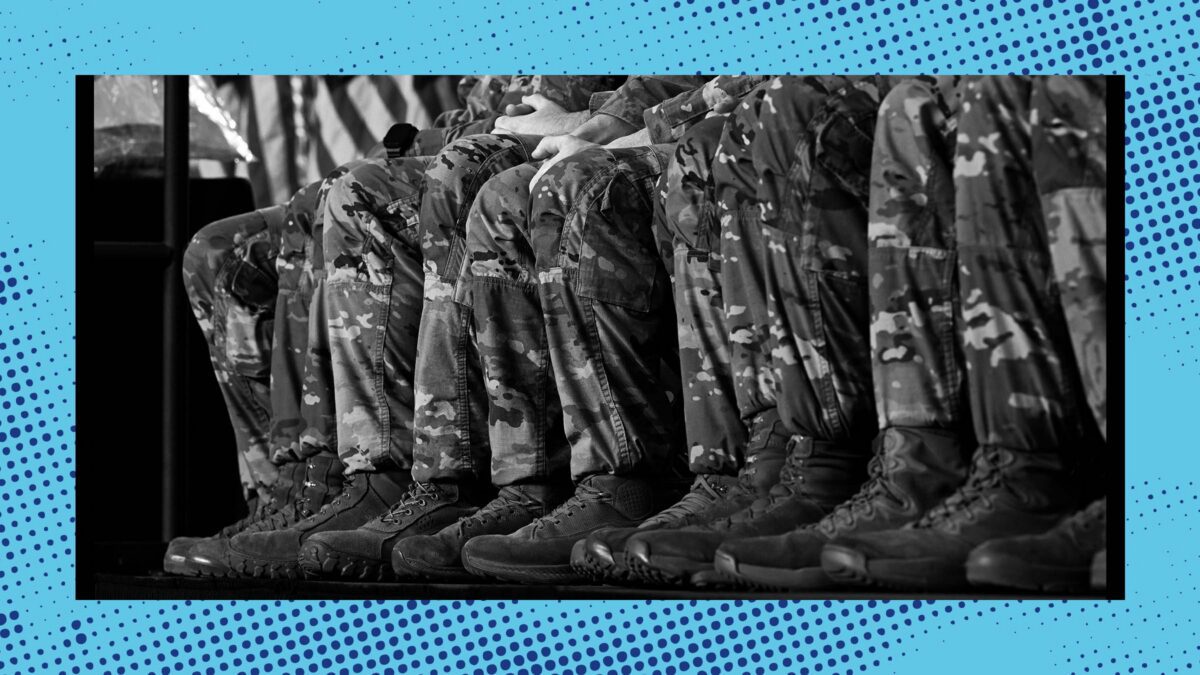
More than 1,400 members of the Tennessee National Guard spent the Fourth of July holiday weekend patrolling Memphis, Tennessee, as part of President Donald Trump’s so-called “Memphis Safe Task Force.” Back in September 2025, Trump issued a memorandum that mobilized over a dozen federal agencies and the National Guard for the stated purpose of reducing “tremendous levels of violent crime” in the city.
That directive came six days after the Memphis Police Department announced that crime in the city had dropped to a historic 25-year low. But as a result of Trump’s order, Memphis, one of the largest majority-Black cities in the country, has been under occupation by the federal government for the past nine months.
At around 4 AM on July 5, two National Guard soldiers assigned to the Task Force joined Memphis police officers to respond to a report of shots fired. Upon their arrival, local police claim, they saw a man leaving the area carrying a handgun. Public carry of handguns is legal in Tennessee. Still, police and the National Guardsmen followed the man. And then, for reasons that are still under investigation, the soldiers shot him twice in the chest. Tyrin Johnson, a 20-year-old Black man and a new father, was pronounced dead at the scene.
Four days later, Task Force members affiliated with the Drug Enforcement Administration shot and killed another Black man, 47-year-old Alfonso Ivy, at an East Memphis hotel. The attorney for Johnson’s family put out a statement noting that Ivy was the fourth person killed during an encounter with the Memphis Safe Task Force in fewer than 60 days.
A state law enforcement agency has opened a probe of Johnson’s death to determine how and why the situation “escalated.” Tyrin’s grandfather, Evaniel Johnson, and local community organizers are demanding the release of video footage of the shooting, and pressing state and local authorities for answers.
One question community members may have about the fatal incident is: Why were on-duty American soldiers patrolling the streets of Memphis in the first place? The answer is: Because courts allowed them to do so. Shortly after troops started descending on the city, seven Democratic officials in Memphis filed a lawsuit to stop their deployment. In November 2025, they won an order from a state trial court that temporarily blocked Tennessee from complying with Trump’s directive. But on April 28, a three-judge state appeals court reversed the lower court’s order, finding that the plaintiffs lacked standing.
Tennessee Attorney General Jonathan Skrmetti celebrated the reversal and said that the National Guard would now be able to provide “critical support” for the “lifesaving work” of the Memphis Safe Task Force. In the months since the reversal, Task Force members have shot at least four people. All four, including Johnson and Ivy, have died.
Several state and federal laws put limits on how and when the government can mobilize the National Guard. The Tennessee state constitution, for example, prohibits the governor from calling the National Guard into service unless there is a “rebellion or invasion” and the state General Assembly declares that “public safety requires” the mobilization.
None of that happened here. Trump’s memo merely requests that Tennessee’s governor make troops available under the authority of Title 32, a federal law traditionally used to order the Guard on training missions, which the Trump administration has been refashioning into a free pass for domestic military deployments. The week the administration launched the Task Force, Trump told top generals that the military should use American cities as “training grounds” to confront “the enemy within.” White House Deputy Chief of Staff Stephen Miller told Memphis law enforcement that, with the Task Force behind them, they were now “unleashed” and free to be “ruthless.”
Even before the Task Force, Memphis police were well-versed in brutality. In January 2023, officers pulled over Tyre Nichols, an unarmed 29-year-old Black man, and beat him to death. In December 2024, a Department of Justice investigation concluded that Memphis Police Department officers regularly make unlawful stops, searches, and arrests; use unlawful force; and engage in unlawful discrimination against Black people.
Memphis lawmakers responded to the death of Tyre Nichols in part by passing a law prohibiting police from pulling drivers over for minor infractions like expired tags or broken taillights. But in April 2024, the Republican-led state legislature passed a new law that nullified the city ordinance. Now, much of the Memphis Safe Task Force’s work consists of pulling people over for minor traffic infractions, and looking for anything that could be arrestable. The Trump administration boasted last month that the Task Force has now made over 10,000 arrests in Memphis, as if the volume in and of itself has any bearing on public safety.
The stated objective of the Task Force is to “end street and violent crime.” But that is not what soldiers do, nor is it Trump’s actual goal. The shooting death of Tyrin Johnson by the Tennessee National Guard is the predictable consequence of the court letting Trump turn the American military against Americans. Tennessee courts had the opportunity to stop him. Their decision not to do so is costing lives.