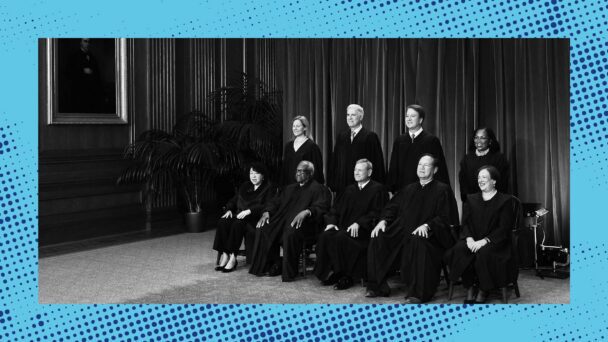
Last week, the Republican-controlled House of Representatives voted on a proposal to amend the Constitution to fix the size of the Supreme Court at nine justices. It failed spectacularly: Of the 206 Democrats who voted on the resolution, 205 voted no.
This result does not mean that there are now 205 Democrats who would definitely vote yes on a bill to expand the Court under a future Democratic president. But when the Court’s approval rating is at a historic low and a growing chunk of the electorate understands the members of the six-justice conservative supermajority to be partisan hacks, the proposal did serve as a useful reminder that Congress, not the Constitution, sets the size of the Court—and that a future Democratic majority could add seats to it simply by passing a statute.
For the people who run the Wall Street Journal opinion section, the possibility of meaningful Supreme Court reform represents the most significant threat to The Way Things Ought To Be that does not directly involve Zohran Mamdani social media content. So on Monday, they responded with a column from Manhattan Institute senior fellow James Piereson that contains what is, even by the lofty standards of the Wall Street Journal opinion section, one of the most specious arguments I have encountered in quite some time: that amending the Constitution in this way might not be “necessary,” because there are “good reasons” to believe that Supreme Court expansion is secretly unconstitutional already.
“There are no clear precedents that support a partisan court-packing plan,” Piereson writes. Instead, he says, there is a “strong argument” that Court expansion would violate the Constitution by “undermin[ing] the separation of powers and the independence of the judiciary.”
If such a “strong argument” exists, Piereson does not make it. In fact, his case begins unraveling in the very next paragraph, in which he explains that the Constitution “leaves to Congress the authority to establish the structure of the federal judiciary, including the number of justices.” Apparently undeterred by the implications of this correct statement, Piereson goes on to note that Congress has indeed exercised this power on several previous occasions. Generally speaking, if you are trying to persuade readers that an amendment to fix the Court’s size at nine is not “necessary,” and you then find yourself having to explain away all the different times and reasons that the Court’s size has been something other than nine, it is time to set aside that column and find something else to get upset about.
Piereson tries to get around this problem by parsing the motives of the legislatures that changed the Court’s size: In his telling, doing so for “political” reasons is constitutionally acceptable, because Congress has done it before, but doing so for “partisan” reasons is not, because in 1937, Congress rejected President Franklin D. Roosevelt’s proposal to expand the Court to 15 justices. This “history” of changes to the Court, Piereson concludes, provides “no support” for a hypothetical Democratic effort to expand the institution any further.
Set aside, for now, Piereson’s putative distinction between adding justices for “political” reasons and adding justices for “partisan” reasons, which in this context is both factually incorrect and also nonsensical to anyone with a working knowledge of the English language. The more basic problem with Piereson’s argument is that Congress’s authority to establish the size of the Court does not require the “support” of “history,” because Congress’s authority to establish the size of the Court comes from the Constitution itself. Congress rejected Roosevelt’s Court-packing plan because it disagreed with Roosevelt’s Court-packing plan. This is the sort of political choice that legislators make all the time. It did not create an unwritten rule of constitutional law that would magically prevent today’s Congress from choosing differently.
You do not need to be a lawyer to understand how silly the premise here is. It is true that the Constitution divides power among three branches of government, and that many specific constitutional provisions—life tenure for judges, for example—are designed to preserve some degree of judicial independence. But if the Constitution gives a branch of government (say, Congress) the power to do a thing (say, change the size of the Supreme Court), and doing that thing does not run afoul of a different part of the Constitution, then doing that thing is “constitutional.” There is not an additional, extratextual requirement that Congress exercise this power over the years at intervals that a conservative think tank guy deems legally sufficient.

Perhaps the clearest sign that Piereson understands the incoherence of his legal case is that he does not really attempt to explain it. Instead, he transitions to offering policy arguments against Court expansion, which, he says, would “undermine respect for the rule of law” and yield a supersized Court that resembles “another legislative body.” (I thought the justices were not supposed to leave questions like these to the elected branches to decide, but perhaps there exists a secret constitutional justification for substituting their own views that Piereson will reveal in his next column.)
My view is that adding seats to the Court would not “undermine respect for the rule of law” any more than its recent decisions—to legalize racial gerrymandering, to end the right to reproductive autonomy, to create an inviolate right to gun possession, to invent a special rule of criminal immunity that applies only to the conservative justices’ favorite president, and so on—already have. On the merits, I am not persuaded that a larger Court that more closely resembles the sizes of high courts in other countries would be a bad thing. And given how much power the justices have already siphoned from Congress, a Court that looks like “another legislative body” would probably be an improvement over a nine-member council of unaccountable lawyers controlled by whichever faction experiences fewer untimely deaths.
That said, the effects of Supreme Court expansion on “respect for the rule of law” and the extent to which a more crowded Court would resemble another “legislative body” are differences of opinion between me and James Piereson, a senior fellow at the Manhattan Institute. They are irrelevant to the threshold question of whether Court expansion is “constitutional,” because there are not and never have been serious arguments that Court expansion is unconstitutional. There are just pundits willing to repackage standard anti-expansion talking points in the language of erudite constitutional law and hope no one notices.
If nothing else, the Journal opinion crew’s willingness to publish this post indicates just how desperate the conservative legal movement is to shore up the Court’s reputation and impugn the motives of its critics. Support for Court expansion is not (yet) table stakes for Democratic politicians, but the more time and effort this conservative supermajority spends implementing its political and ideological agenda by judicial fiat, the easier it will be for Democrats to make the case to voters that the institution could use some new blood. If and when the party gets there, I am sure Piereson will have plenty to say about it. But the Constitution will not.