On Thursday, House Judiciary Committee Republicans held a hearing to discuss, as they put it in the hearing’s official title, “a threat to the Supreme Court’s legitimacy.” The threat to which they referred, though, was not the Court’s myriad ethical scandals, or its efforts to gut both the Voting Rights Act and the Fifteenth Amendment, or its 200-plus-year track record of concentrating power in the hands of well-connected white guys named John.
Instead, the threat that had House Republicans all riled up is the idea of increasing the number of justices on the Court. On its website, the Judiciary Committee promised during the hearing to “examine the history and perils of court packing,” as well as “other policy proposals that threaten to undermine the integrity of the judicial branch.”
Throughout the morning, Republicans framed their resistance to Court expansion as a defense of the institution’s legitimacy. The GOP’s first witness, Missouri Solicitor General Louis Capozzi, claimed that expansion would undermine the Court’s “insulation from partisan politics,” which enables it to make decisions based on “what the law requires, and not the fleeting goals of political actors.” The second witness, Cumberland School of Law professor William Ross, claimed that expansion would let the elected branches “manipulate the outcome of judicial decisions” by appointing justices who “would be expected to conform to the political predilections of the president.”
The third witness, a law firm partner named Gene Schaerr, claimed that expansion proposals “distract from the more important work of building political and legislative coalitions.” Schaerr further suggested that people who don’t like the Court’s interpretation of the Voting Rights Act should simply ask the Republican-controlled Congress to amend the statute.
Claims that Court expansion threatens the Court’s legitimacy presuppose that the Court has any legitimacy to threaten in the first place. As demonstrated by the Court’s plummeting approval numbers—less than a quarter of voters now say they have a “great deal” or “quite a bit” of confidence in the Court, per a March NBC News poll—it does not have much “legitimacy” left. As Georgia Democratic Congressman Hank Johnson emphasized during the hearing, Republicans have spent 50 years and billions of dollars building a Court that consistently prioritizes oligarchs over ordinary Americans. Their claims to be stewards of judicial integrity “would be laughable if the consequences were not so dangerous for our democracy,” he said.
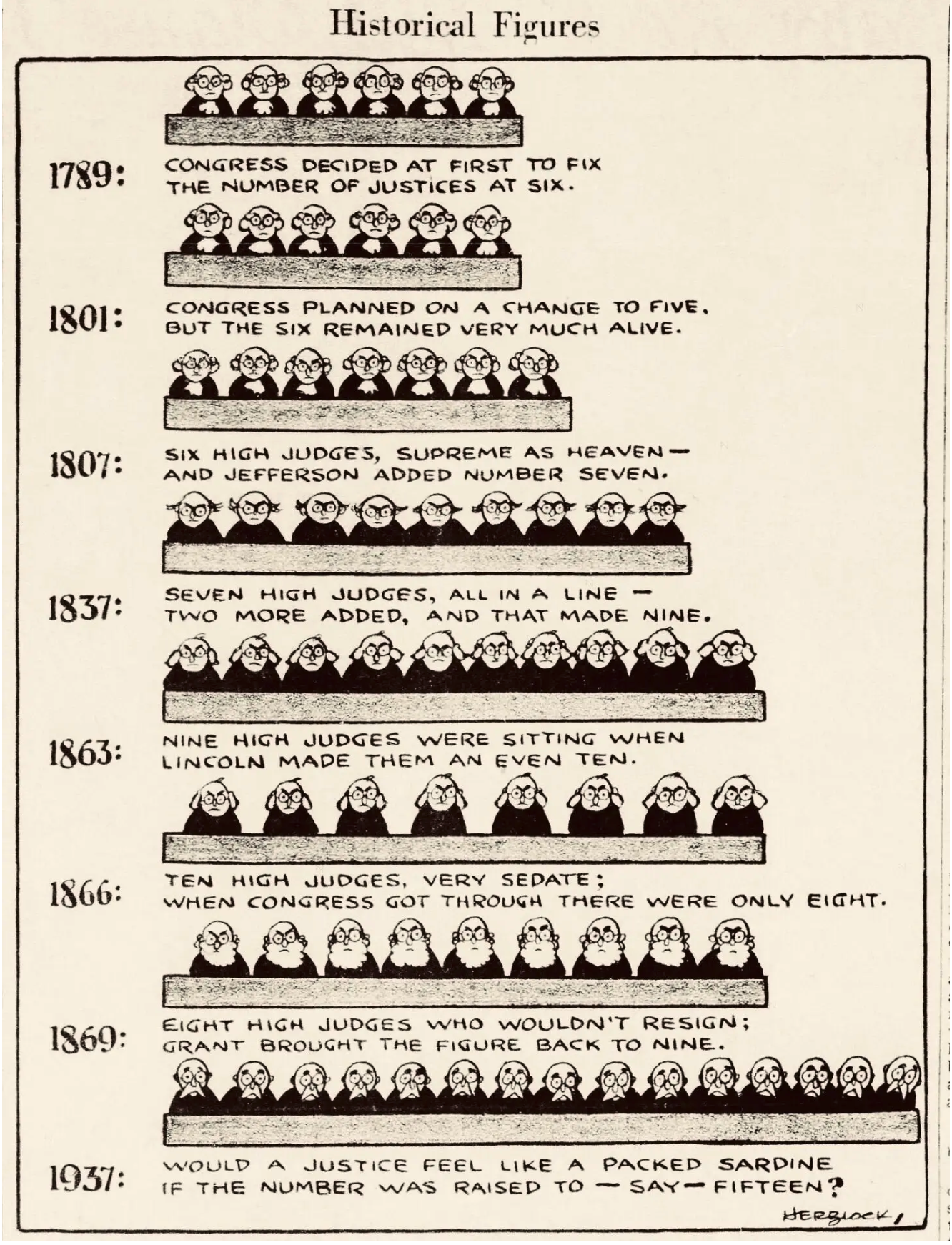
Congress has the constitutional authority to change the size of the Court. And it has done so, by statute, seven times. It has also changed the size of the Court without passing a statute; as Maryland Democratic Congressman Jamie Raskin reminded his colleagues, beginning in 2016, Senate Republicans limited the Court to eight justices for 422 days after the death of Justice Antonin Scalia so that President Barack Obama would not get to nominate his replacement. And while the Court currently has nine justices, it has had as few as six and as many as ten. There is nothing special about the number nine.
Although voters once regarded Court expansion with skepticism, six years of a six-justice conservative supermajority have changed things quite a bit. For example, an April 2021 Politico/Morning Consult poll showed that only 26 percent of the public thought Congress should add justices, while 46 percent supported keeping the Court’s size as-is. This past February, a Strength In Numbers/Verasight poll found that 39 percent of Americans supported increasing the number of justices to 13, compared to 32 percent who opposed doing so. (29 percent were not sure.) A 2022 YouGov study added another wrinkle: If they were told that Republicans have controlled the Court for more than 50 years, a majority of respondents—52 percent—supported expanding and rebalancing it.
Some Democratic leaders, too, are coming around. After taking office in 2021, President Joe Biden infamously punted on Court reform, creating a blue-ribbon commission to study the problem in lieu of actually addressing it. Earlier this month, after the Court’s decision in Louisiana v. Callais kicked off the mass disenfranchisement of people of color in Republican-controlled states, Biden’s vice president, Kamala Harris, called on Democrats to seriously consider “bold” ideas for reform, “including the notion of expanding the Court.”
Republicans’ putative worries about the Court’s “legitimacy” assume a shared understanding of what “legitimacy” even means. The sole Democratic witness at Thursday’s hearing, Harvard Law Professor Niko Bowie, pointed out that Congress cannot assess how expansion may affect the Court’s legitimacy without first answering a more basic question: “What is the legitimate role for the Court to play under our Constitution?” And for Bowie, the answer is clear: “The legitimate role for the Court is to enforce federal law against anyone who considers themselves above it, whether that ‘anyone’ is a corporate executive, a state official, or a president.” A glance at the Court’s recent decisions reveals that, to the extent the Court was ever operating in that lane, it is now well outside of it.
Bowie highlighted that the Constitution gives Congress many tools for stopping an out-of-control judiciary from using its power to “undermine multiracial democracy while making the future of republican governance unviable.” Ultimately, then, Thursday’s hearing was not really a referendum about Court expansion at all. It was a referendum on the Court. And under these conditions, Bowie explained, “regulating the Court is not just legitimate—it is Congress’s responsibility.”